
High-Pressure Small Bore Tubing in FPSO and FLNG Facilities Application Context, Standards Alignment, and Execution Control
Small bore high-pressure tubing systems play a defined and regulated role within FPSO and FLNG facilities. While welded piping systems form the backbone of hydrocarbon process infrastructure, tubing systems are widely applied in instrumentation, hydraulic control, chemical injection, analyzer, and auxiliary services.
These systems operate within established piping code frameworks such as ASME B31.3 and are governed by structured procurement specifications, including IOGP S-716, which define minimum requirements for design, material selection, installation, inspection, testing, and traceability.
Although tubing systems eliminate field welding within their scope, integrity is maintained through strict control of material compatibility, single-manufacturer fitting systems, installer qualification, defined routing and support practices, and performance-based testing requirements.
When engineered and executed in accordance with recognized industry standards, small bore tubing systems provide a reliable and technically appropriate solution for control and auxiliary services in floating production environments.
Functional Role in FPSO and FLNG
Floating Production Storage and Offloading (FPSO) units and Floating Liquefied Natural Gas (FLNG) facilities incorporate both welded piping systems and small bore tubing systems.
Welded piping systems are typically used for bulk hydrocarbon processing and transport. Small bore tubing systems are commonly applied in:
Process impulse lines
Pneumatic and hydraulic control lines
Chemical injection units
Analyzer and grab sampling systems
Instrument air distribution
Heat-traced tubing bundles
Industry procurement specifications define small bore tubing systems as generally covering outside diameters up to approximately 50 mm (2 in).
Tubing systems are not substitutes for process piping. They are defined subsystems within the overall piping system.
Standards Framework and Engineering Boundaries
Small bore tubing systems in FPSO and FLNG installations operate within recognized piping design frameworks such as ASME B31.3. Industry specifications, including IOGP S-716, established requirements for:
Design parameters
Sizing and wall thickness
Material selection
Installation practics
Inspection and testing
Marking and traceability
Compression fittings must be sourced from a single manufacturer for a given installation. Intermixing or interchanging components across manufacturers is not acceptable. This requirement mitigates sealing performance and dimensional tolerance risks.
Similarly, mixing metric and imperial tubing sizes within a project is not acceptable practice due to lifecycle integrity and maintenance concerns.
These controls reflect structured risk management rather than product reference.
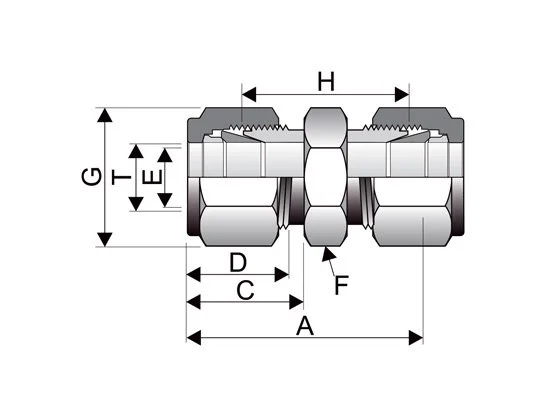
Union fitting section drawing
Tubing Design and Material Selection
Tubing wall thickness must be selected in accordance with ASME B31.3 pressure design criteria. Industry specifications define minimum wall thickness values by tube diameter, with final pressure rating verification based on code calculations.
Tubing is typically required to be:
Seamless
Fully annealed
Within hardness limits compatible with fitting system design.
Hardness control is essential to ensure proper ferrule engagement and long-term sealing performance.
Material selection is a must address:
Chloride-induced stress corrosion cracking
Marine atmospheric exposure
Pitting and crevice corrosion
Sour service conditions
Operating and ambient temperature limits
IOGP provides structured guidance covering austenitic stainless steels, 6Mo alloys, super duplex stainless steels, nickel alloys, titanium, and copper alloys, each with defined environmental limitations.
For sour service applications, materials must comply with ANSI/NACE MR0175 / ISO 15156.
When dissimilar materials are used within a tubing run, the environmental and temperature limits of the lower-grade material govern system performance.
Material compatibility is therefore a design responsibility, not a procurement afterthought.
Installation and Routing Controls
Tubing system integrity is highly dependent on installation discipline.
Industry requirements include:
Tubing shall not be used as a structural support.
Defined max span spacing between supports based on tube diameter.
Routing restrictions for hydrocarbon service away from electrical or control rooms.
Defined gradients for impulse lines in liquid and gas service
Installer certification or manufacturer-approved training
Thread seal welding is not permitted.
Thread sealing compounds must be compatible with service conditions, and PTFE tape is not permitted for hydraulic or air instrument supply connections.
These requirements demonstrate that tubing systems are governed by defined installation standards rather than informal field practice.
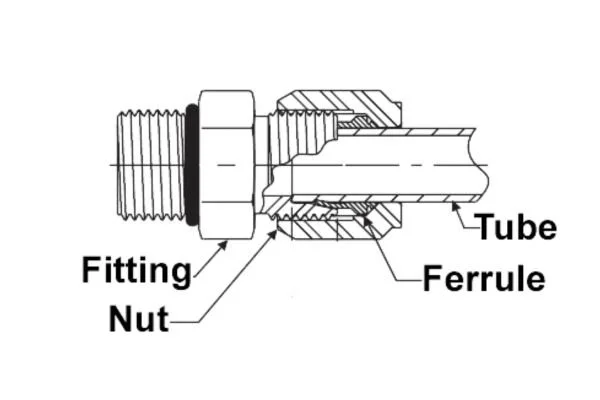
Fitting schematics with nut, ferrule and tube
Inspection, Testing, and Qualification
Although tubing systems eliminate weld NDT within their scope, inspection and testing remain rigorous.
Industry requirements include:
Visual and dimensional inspection
Positive material identification (PMI)
Pneumatic or hydrostatic leak testing in accordance with ASEM B3.1.3
Assembly verification using manufacturer-recommended gauges
Type qualification of compression fittings in accordance to ASTM F1387
Instrumentation valve qualification MSS SP-99
The inspection emphasis shifts from weld metallurgy to assembly integrity and sealing performance, but the engineering accountability remains equivalent.
Lifecycle and Risk Considerations
Industry experience indicates that small bore tubing failures typically associated with:
Improper assembly
Insufficient support spacing
Vibration-induced fatigue
Corrosion misapplication
Cross-brand component intermixing
In modular FPSO and FLNG construction environments, tubing systems may offer scheduling advantages by eliminating field welding within their defined scope. However, reliability is directly linked to compliance with specification controls and disciplined execution practices.
Engineering oversight does not decrease withing tubing. It shifts focus.
Conclusion
High-pressure small bore tubing systems in FPSO and FLNG facilities operate within clearly defined engineering and procurement frameworks. They are governed by structured standards covering design, material selection, installation, inspection, testing, and traceability.
When applied within their intended service envelope and executed in accordance with recognized industry requirements, tubing systems provide a technically robust and reliable solution for instrumentation, control, and auxiliary services in floating production assets.
Their effectiveness is not derived from simplification, but from disciplined adherence to specification-driven engineering practice.
APA Reference List
Swagelok. (2025). Medium‑ and high‑pressure fittings, tubing, valves, and accessories (FK, FKB, IPT, CTB, Sno‑Trik® series) (MS‑02‑472; rev AE). https://www.swagelok.com/downloads/webcatalogs/en/ms-02-472.pdf [swagelok.com]
Swagelok. (2021). ASME B31.3 code letter: Conformance of Swagelok tube fittings to ASME B31.3 (TSL0518). https://f.hubspotusercontent10.net/hubfs/20746215/Product%20Compliance/Table%20A-1%20v2.pdf [f.hubspotu...tent10.net]
American Society of Mechanical Engineers. (2024). ASME B31.3: Process piping (2024 edition). https://www.asme.org/codes-standards/find-codes-standards/b31-3-process-piping [asme.org]
Swagelok. (2023). Tubing data sheet (MS‑01‑107; rev W). https://www.swagelok.com/downloads/webcatalogs/EN/MS-01-107.PDF [swagelok.com]
C&N Pipefitting. (2025). ASME B31.3‑2024: Process piping (Revision of ASME B31.3‑2022). https://cnkpipefitting.com/wp-content/uploads/2025/11/ASME-B31.3-2024.pdf [cnkpipefitting.com]
Hadžihafizović, D. (2024). ASME B31.3 Process Piping. https://kh.aquaenergyexpo.com/wp-content/uploads/2025/02/ASME-B31.3-Process-Piping.pdf [kh.aquaene...gyexpo.com]
