
Gastech 2026: From Demonstration Projects to Industrialized FLNG
Every edition of Gastech 2026 has a dominant theme. This year, the message was not simply that Floating LNG (FLNG) remains an attractive solution for offshore gas monetization. The real message was far more significant: FLNG is transitioning from a bespoke engineering project into an industrialized product.
For nearly two decades, the industry has focused on proving that FLNG can be built and operated successfully. Projects such as Prelude, PFLNG Satu, PFLNG Dua, Coral Sul FLNG and Golar Gimi demonstrated technical feasibility. Today, the discussion has evolved. The industry is no longer asking whether FLNG works. The new question is:
Who can deliver FLNG faster, safer, more efficiently and with lower execution risk?
That shift was visible everywhere at Gastech.
FLNG Is No Longer a Niche Market
Perhaps the most striking observation from the exhibition floor was the rapid growth in the number of contractors offering standardized FLNG products.
The list now includes:
Saipem's FLNGenius platform for 3-4 MTPA developments.
Saipem's ZR-FLNG concept for 0.5-1.5 MTPA developments targeting stranded and associated gas resources.
Seatrium's FLNG X™ concept covering capacities between 0.6 and 6 MTPA and capable of integrating different liquefaction technologies. The design received Approval in Principle from ABS during the conference.
JGC's standardized LNG train concept based on Honeywell technology.
Wison's 6 MTPA deepwater FLNG concept featuring an internal turret and DMR technology.
CSSC's standardized FLNG concept developed together with Bureau Veritas and awarded Approval in Principle.
Exmar's next-generation FLNG concept, also receiving Approval in Principle and further reinforcing the industry's move toward standardized floating LNG solutions.
Hanwha Ocean's standardized FLNG platform, which received Approval in Principle from both ABS and DNV during the event.
Samsung Heavy Industries' FLNG concept incorporating its proprietary SENSE liquefaction technology.
Five years ago, such a list would have been unimaginable.
Today, virtually every major offshore contractor and shipyard is positioning itself in the FLNG market.
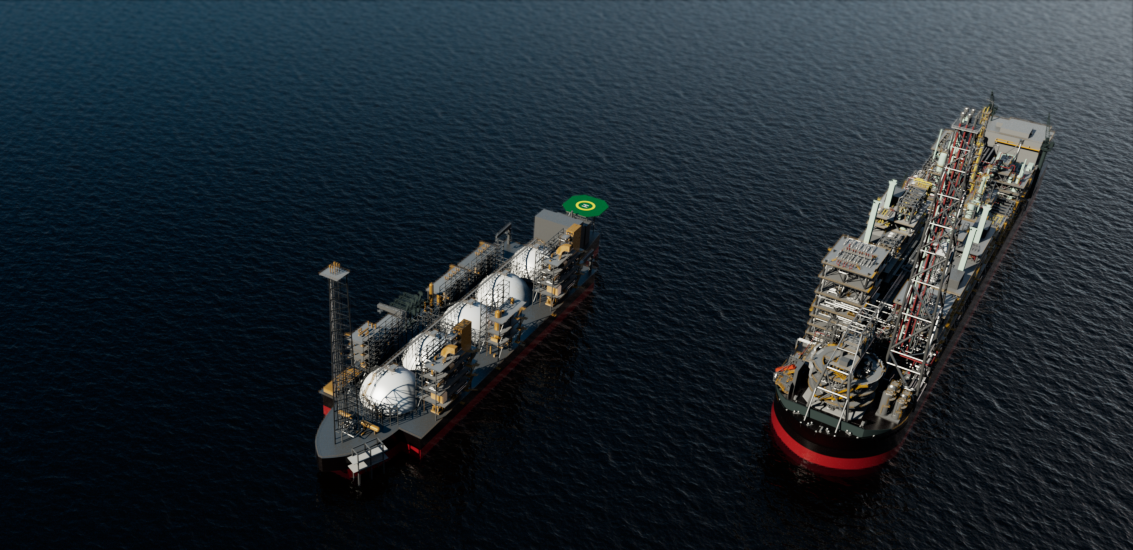
Saipme’s FLNGenius and ZR-FLNG. Source: Saipem.com
The Real Driver Is Speed, Not Cost
A recurring theme throughout the conference agenda was energy security, speed of execution, supply-chain resilience and accelerated gas monetization. One of the most telling session titles was "The next LNG playbook: Speed, optionality and portfolio power."
This highlights the appeal of standardized FLNG solutions is not only lower capital cost. The real value lies in the potential to shorten development schedules and reduce execution uncertainty.
Many offshore gas resources previously considered too small, too remote or too complex for commercialization are becoming economically viable because operators can now select from increasingly standardized floating solutions rather than starting from a blank sheet of paper.
As standardization progresses, FLNG is increasingly competing directly with conventional onshore LNG developments, particularly where permitting, infrastructure construction and land acquisition create lengthy schedules.
The Emergence of a Technology Race
While the proliferation of FLNG concepts attracted most of the attention, a deeper trend became visible during Gastech 2026.
The industry is no longer competing only on hull designs or production capacity.
It is beginning to compete on proprietary technology.
Saipem's Integrated Technology Strategy
Among all exhibitors, Saipem arguably presented one of the most complete technology roadmaps.
Beyond FLNGenius and ZR-FLNG, the company highlighted:
Continued development of its proprietary Liqueflex™ 2.0 liquefaction technology.
Integration of cryogenic patents and know-how obtained through the acquisition of Gasconsult Ltd..
AI-enabled execution tools for large LNG EPC projects.
The CASS telescopic joint technology, aimed at eliminating conventional expansion loops in LNG infrastructure.
The latter announcement may appear modest compared with a new FLNG concept, yet it potentially reveals something much more important.
Expansion loops consume space, add weight, complicate fabrication and increase installation complexity. Developing alternative solutions requires deep expertise in cryogenic systems, thermal expansion management, fatigue behavior and long-term reliability.
This type of innovation reflects investment in the engineering fundamentals that ultimately determine whether future FLNG projects become safer, simpler and more efficient.
Korean Shipyards Move Up the Value Chain
Another notable development was the strategic evolution of Korean shipyards.
Historically, shipyards largely focused on fabrication and integration. At Gastech 2026, several demonstrated ambitions extending well beyond construction.
Samsung Heavy Industries presented its proprietary SENSE liquefaction technology and obtained class approvals for its application within FLNG facilities. The company also announced commercialization initiatives and licensing arrangements, signaling an intention to compete in technology ownership rather than yard capacity alone.
Similarly, Hanwha Ocean obtained approvals for its standardized FLNG design and showcased a broader portfolio of LNG-related technologies, including containment systems and advanced fuel solutions.
This evolution is significant. It suggests shipyards are increasingly seeking value through intellectual property and repeatable platforms, not only through construction contracts.
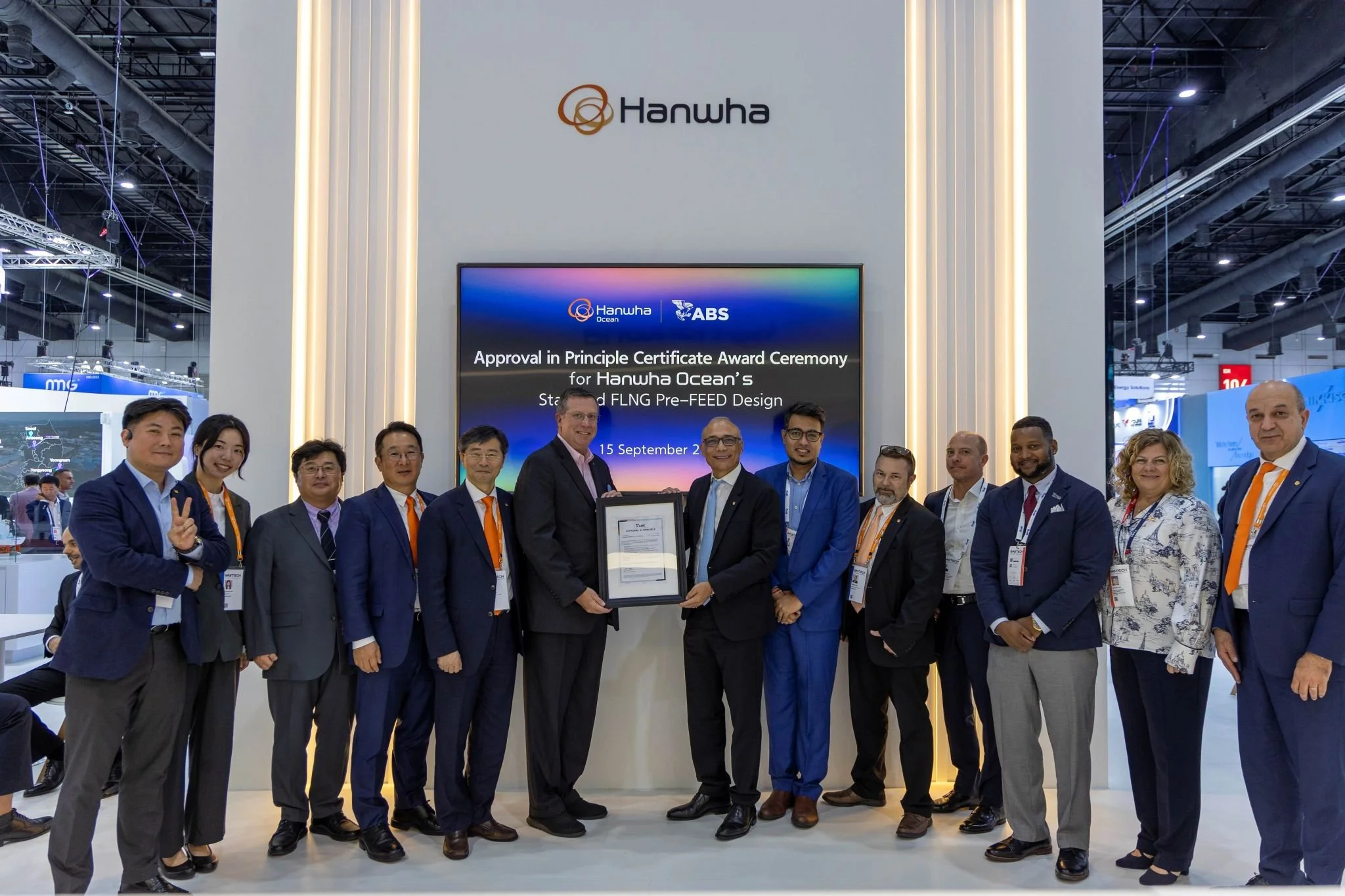
Hanwha’s Approval in Principle of Hanwha Ocean’s standard FLNG pre-feed design. Source: Linkedin
Industrialization Versus Diversification
An interesting contrast emerged among market participants.
Several companies focused on industrializing FLNG through:
Proprietary liquefaction technology.
Standardized execution strategies.
Critical equipment innovation.
Repeatable design platforms.
Others appeared more focused on expanding into adjacent opportunities.
Wison, for example, showcased its deepwater FLNG concept while also promoting floating infrastructure concepts linked to AI and data centers.
These initiatives unquestionably demonstrate creativity and an ability to identify emerging markets. However, they also raise an important question for the industry.
As FLNG matures, will competitive advantage come from developing new offshore applications, or from improving the performance of the FLNG itself?
The long-term winners may not necessarily be the companies presenting the largest number of concepts, but those capable of offering measurable improvements in:
Safety.
Availability.
Energy efficiency.
Operability.
Schedule certainty.
Lifecycle cost.
FLNG Leasing: The Next Frontier?
Another trend emerging from Gastech 2026 was the growing interest in leasing and operator-style business models for FLNG developments.
For decades, the FPSO market has demonstrated the advantages of separating asset ownership from field operations. Specialized companies such as MODEC, SBM Offshore and Yinson have built successful businesses by financing, owning and operating floating production assets on behalf of oil companies.
A similar model may now be emerging in the FLNG sector.
Several announcements at Gastech pointed in this direction:
Yinson publicly confirmed the establishment of a dedicated FLNG business line, signaling its ambition to replicate its FPSO experience in the gas market.
MODEC highlighted its growing interest in gas developments and FLNG opportunities.
Wison, Bumi Armada and FPSO Ventures signed a memorandum of understanding to jointly pursue integrated FLNG solutions combining EPCIC, ownership and operational capabilities.
These developments may prove just as important as the technological innovations discussed elsewhere in the industry.
The challenge for many stranded or marginal gas fields is not only technology. It is also access to capital. A leased FLNG solution has the potential to reduce upfront investment requirements, accelerate project sanction and enable developments that would otherwise remain uneconomic.
If standardized FLNG designs represent the industrialization of the product, leasing models may represent the industrialization of the business model.
Just as the FPSO market evolved from owner-operated assets to specialized leasing companies, the FLNG market may be following a similar path.
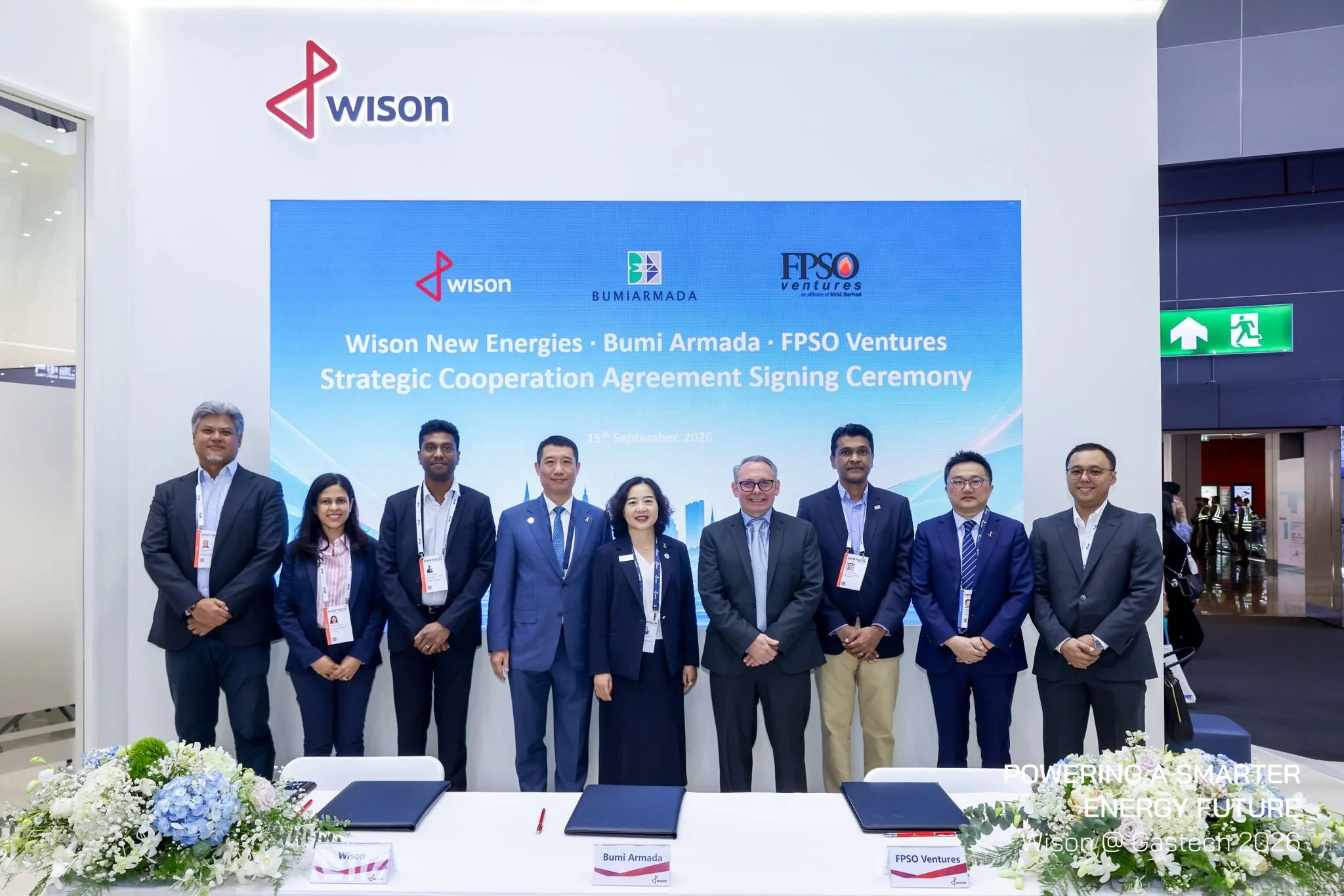
Wison, Bumi Armada, FPSO Ventures strategic cooperation agreement celebration. Source: Linkedin
Energy Security Has Overtaken Hydrogen Hype
Compared with previous editions, hydrogen and ammonia appeared noticeably less prominent in industry discussions.
This does not mean the energy transition has disappeared. Gastech maintained extensive programs dedicated to hydrogen, low-carbon solutions and electrification.
However, conversations on the exhibition floor increasingly centered on:
LNG supply growth.
Resource monetization.
Project delivery.
Geopolitical energy security.
Supply-chain resilience.
The market appears to be prioritizing solutions that can deliver secure and affordable energy in the near term.
AI's Real Impact May Be Project Execution
AI was another recurring topic, although not always in the way many expected.
While concepts such as floating data centers attracted attention, several discussions focused on practical applications:
AI-enabled EPC execution.
LNG operational optimization.
Reliability management.
Digital project delivery.
This may ultimately prove more valuable than the more speculative AI infrastructure concepts.
In an industry where megaproject schedule delays and productivity challenges remain common, even incremental improvements in execution efficiency can create enormous value.
Floating Infrastructure Beyond LNG
Perhaps the most unexpected theme of Gastech 2026 was the emergence of floating AI infrastructure.
Hanwha Ocean unveiled a 60 MW Floating Data Center concept that received Approval in Principle from ABS. The concept combines offshore power generation with seawater cooling to address land, energy and cooling constraints faced by traditional data centers.
Wison also presented concepts linking floating energy infrastructure with data center applications.
Whether these ideas become major markets remains uncertain. Nevertheless, they demonstrate how shipyards and offshore contractors are looking beyond oil and gas and exploring new applications for floating infrastructure.
Key Takeaway
Gastech 2026 should not be remembered simply as the year FLNG became mainstream. It should be remembered as the year FLNG entered its industrialization phase.
The strongest signal was not the number of FLNG concepts on display. It was the growing investment in proprietary technologies, standardized platforms and execution tools designed to improve safety, efficiency and predictability.
Saipem, Samsung Heavy Industries and Hanwha Ocean demonstrated that the next phase of competition will increasingly revolve around technology ownership, not merely EPC capability or fabrication capacity.
The industry has already proven that FLNG works.
The most important lesson from Gastech 2026 was not that more FLNG concepts were launched. It was that LNG contractors are increasingly competing through technology ownership, standardization and execution efficiency rather than through project-specific engineering. FLNG is simply the segment where this transformation is currently most visible.
Note: The observations presented in this article are based on public announcements, conference presentations, exhibitor materials, and discussions held during Gastech 2026. The conclusions and interpretations are solely those of the author.
American Bureau of Shipping. (2026). Approval in Principle awarded for Seatrium FLNG X™ concept. Referenced through Seatrium Gastech 2026 announcement. Retrieved September 2026.
Gastech. (2026). Conference agenda 2026. Gastech 2026. Retrieved from https://www.gastechevent.com/conferences/agenda-2026/ [gastechevent.com]
Gastech. (2026). Exhibition floorplan and industry sectors. Gastech 2026. Retrieved from https://www.gastechevent.com/exhibition/floorplan-2026/ [gastechevent.com], [gastechevent.com]
Hanwha Ocean. (2026). 60 MW Floating Data Center concept unveiled at Gastech 2026. Retrieved from Hanwha Ocean corporate communications and industry press coverage. [krnewsroom.net], [koreaittimes.com]
Hanwha Ocean. (2026). Standardized FLNG design receives Approval in Principle from ABS and DNV at Gastech 2026. Retrieved from industry media reports. [finance.biggo.com], [en.sedaily.com]
Saipem. (2026, September 11). Saipem at Gastech 2026 with new FLNG solutions to maximise the value of offshore gas resources. Retrieved from https://www.saipem.com [saipem.com], [saipem.com]
Saipem. (2026). Gastech 2026: Advancing gas and LNG infrastructures, CCUS, AI-driven solutions, and energy security. Retrieved from https://www.saipem.com [saipem.com], [saipem.com]
Samsung Heavy Industries. (2026). Proprietary SENSE liquefaction technology receives FLNG approvals at Gastech 2026. Retrieved from industry media reports. [en.infomaxai.com], [en.asiatoday.co.kr], [finance.biggo.com]
Seatrium. (2026). FLNG X™ modular floating LNG concept receives Approval in Principle. Retrieved from Seatrium LinkedIn announcement.
