
Hanwha Ocean Enters the Canadian FLNG Race
The global FLNG industry may soon have a new project to watch.
In June 2026, Hanwha Ocean signed a Memorandum of Understanding (MOU) with Kanata Clean Power & Climate Technologies Corp. to explore cooperation on the proposed Kanata LNG project, a floating LNG export facility planned near Prince Rupert, British Columbia. The project is targeting a liquefaction capacity of up to 12 MTPA and an estimated capital investment of approximately US$15.7 billion.
At first glance, this may appear to be another early-stage FLNG announcement. However, the significance lies not only in the project itself, but also in what it signals for the future of floating LNG and Canada's position in global gas exports.
As discussed in our previous overview of Canadian LNG developments, Canada possesses some of the world's largest natural gas reserves and enjoys a strategic geographic advantage for exports to Northeast Asia. Yet despite decades of discussion, many Canadian LNG developments have faced challenges related to infrastructure, permitting, environmental concerns, and rising project costs.
FLNG offers a potentially different pathway by relocating liquefaction offshore or nearshore, developers can leverage modular construction, reduce the onshore footprint, and potentially shorten execution schedules through established shipyard capabilities. According to Kanata Clean Power & Climate Technologies Corp., the proposed project intends to capitalize on floating liquefaction technology and modular execution philosophies.
If successful, Kanata LNG could become one of the first large-scale FLNG export projects on Canada's Pacific coast.
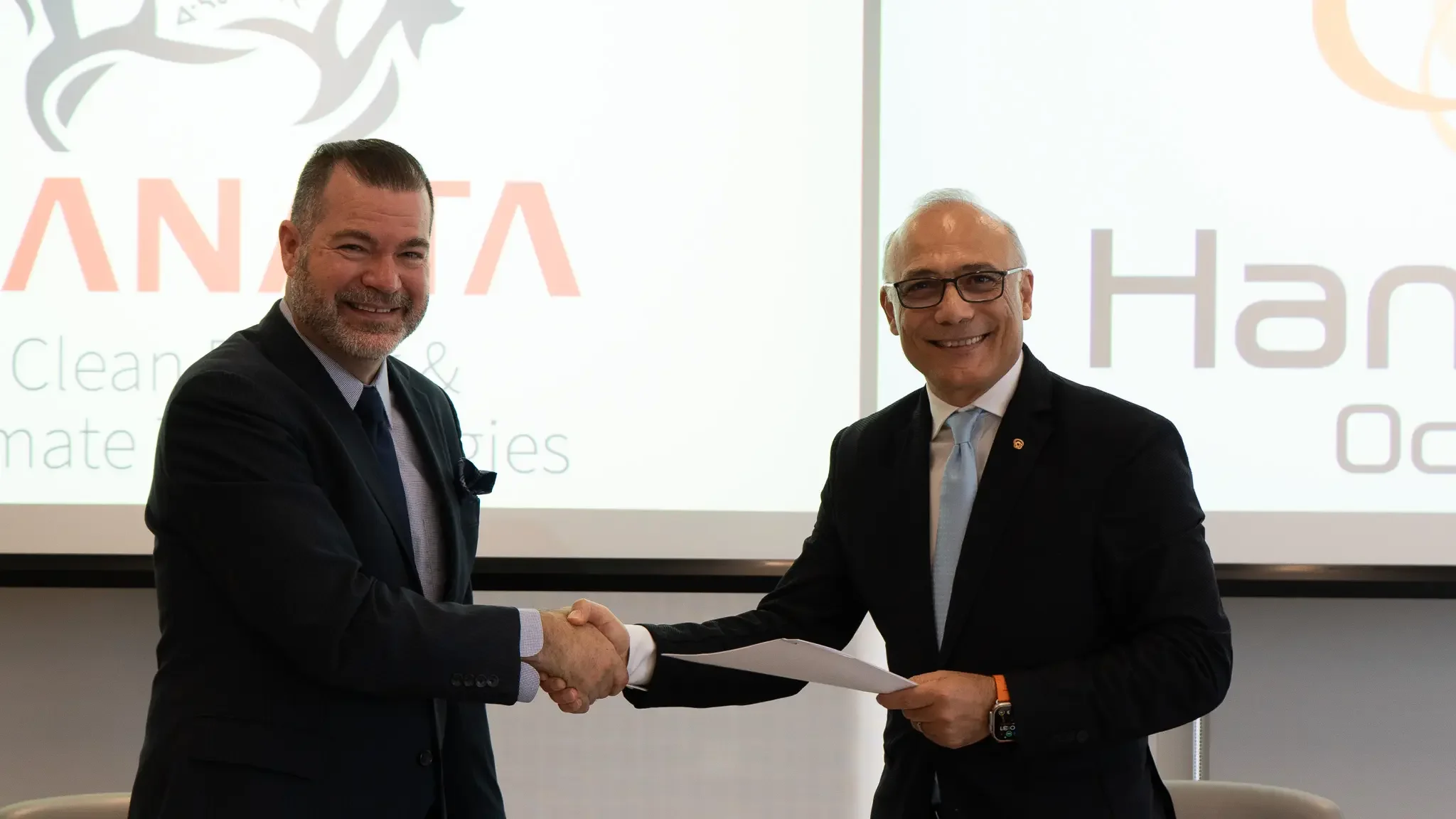
Source: Kanataclean.com
A Strategic Move for Hanwha Ocean
The most interesting aspect of the announcement is arguably the participation of Hanwha Ocean.
While often associated with commercial shipbuilding and offshore construction, Hanwha is not new to FLNG. The company previously participated in the delivery of FLNG facilities for PETRONAS, including the pioneering Malaysian floating LNG developments that helped demonstrate the technical and commercial viability of offshore liquefaction.
The Kanata LNG opportunity therefore reflects Hanwha's ambition to leverage its offshore execution experience and establish itself as a key player in the next generation of FLNG developments.
Under the MOU, both companies intend to explore cooperation across multiple areas, including:
FLNG engineering and construction
Operations and maintenance services
Potential equity participation
LNG offtake opportunities
Midstream and LNG shipping solutions
This suggests Hanwha Ocean is evaluating opportunities that extend well beyond shipyard execution and into the broader LNG value chain.
More Than an EPC Contract
Another notable aspect of the project is its proposed ownership structure.
According to the announcement, participating First Nations may be offered the opportunity to acquire up to 50% ownership of the project, subject to negotiations, financing arrangements, approvals, and final agreements.
This reflects a growing trend in Canadian energy developments where indigenous participation is increasingly viewed as a key component of long-term project success.
Why Prince Rupert port
Prince Rupert is North America's closest Pacific port to Northeast Asia, providing shorter shipping distances than many competing LNG export hubs. For buyers in South Korea, Japan, and other Asian markets, this can translate into lower transportation costs and greater supply chain efficiency.
Combined with Canada's abundant gas reserves, the location gives the project a potentially compelling strategic proposition.
Reality Check: Still Early Days
Despite the excitement surrounding the announcement, the agreement remains a non-binding MOU.
Significant hurdles remain before a Final Investment Decision (FID) can be considered:
Environmental approvals
Regulatory approvals
Indigenous consultations
Commercial agreements
LNG sales contracts
Project financing
Both companies acknowledge that substantial work remains before any construction commitment can be made.
Floaters Intelligentia View
Readers of Floaters Intelligentia may remember our previous analysis of Canada's growing LNG ambitions. What makes the Kanata LNG announcement particularly interesting is not that it introduces FLNG to Canada for the first time. That milestone has already been achieved by projects such as Cedar LNG, which is currently advancing execution and has demonstrated that floating liquefaction can successfully fit within Canada's regulatory and environmental framework.
Instead, Kanata LNG reinforces a broader industry message: FLNG is increasingly being recognized as a viable development solution for Canada. In a country characterized by stringent environmental requirements, labor shortages, challenging site conditions, and the need to minimize project footprints, floating liquefaction offers several potential advantages over conventional onshore plants. These include reduced land disturbance, higher levels of modularization in controlled shipyard environments, lower onsite construction manpower requirements, and the ability to leverage proven offshore execution capabilities.
If Cedar LNG proved that FLNG can work in Canada, Kanata LNG may help demonstrate that it can be scaled.
Reference
Kanata Clean Power & Climate Technologies Corp. (2026, June 16). Hanwha Ocean signs strategic memorandum of understanding with Kanata Clean Power for proposed floating LNG project in Canada. https://kanataclean.com/news/
