
As interest in floating LNG continues to grow across regions such as Argentina, Canada, Mozambique, and Central Africa, attention often focuses on liquefaction technology, gas reserves, or project economics.
However, one of the industry's most important constraints receives far less attention:
the limited number of shipyards capable of constructing LNG cargo containment systems (CCS).
Unlike conventional FPSOs, FLNG facilities combine offshore production, liquefaction, storage, and LNG offloading into a single floating asset. The LNG storage system itself represents one of the most technically demanding elements of the project and requires highly specialized fabrication capabilities.
While dozens of yards worldwide can build FPSO hulls, fabricate modules, or perform integration works, only a handful possess the facilities, workforce qualification, and technology licenses required to construct LNG cargo tanks.
As a result, understanding the LNG containment landscape provides valuable insight into which yards are genuinely capable of hosting future FLNG construction programs.
We already drafted an article about different cryogenic cargo technology at this link.
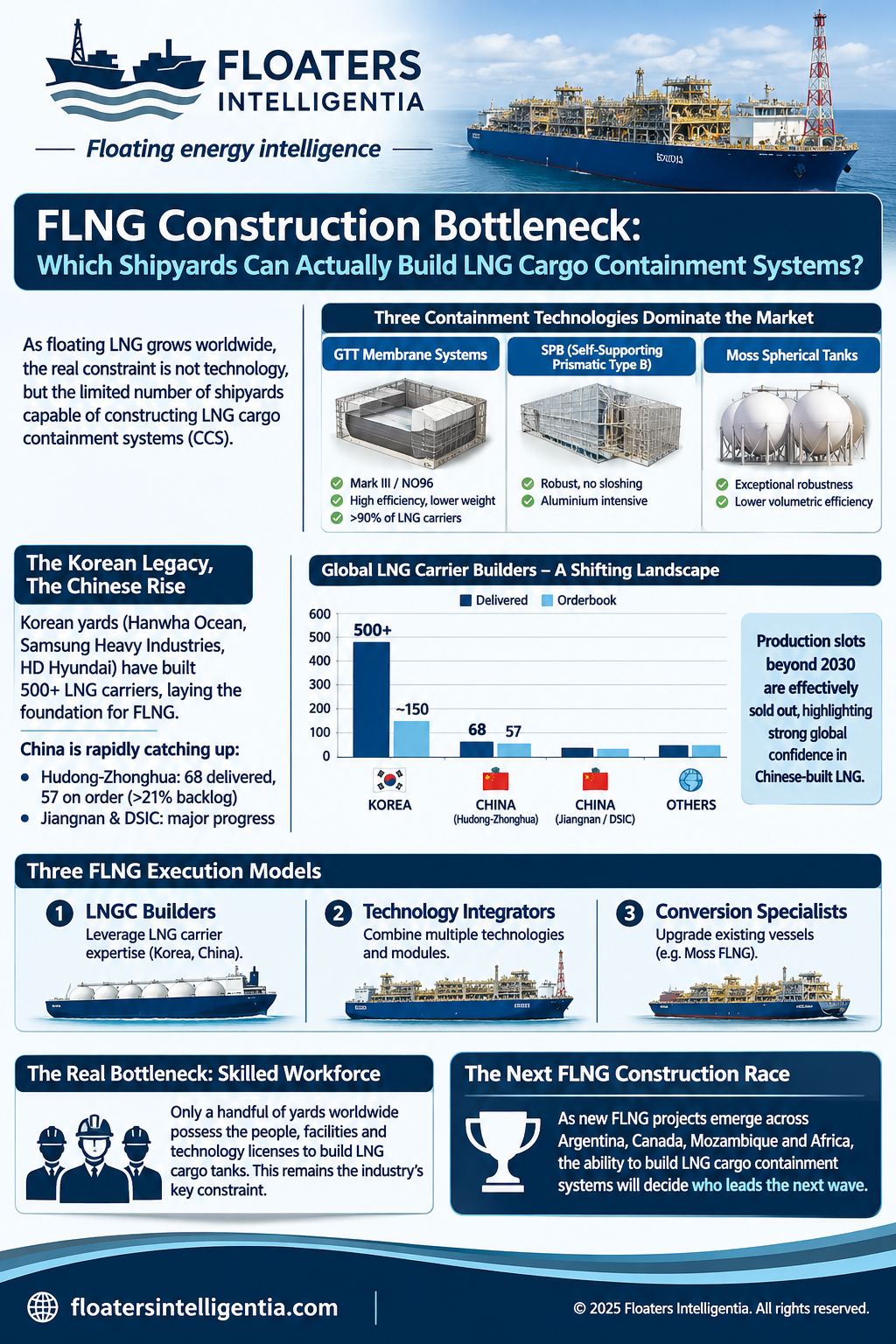
Understanding the Main LNG Cargo Containment Technologies
Three containment technologies dominate today's FLNG and LNG carrier market:
GTT Membrane Systems
Developed by Gaztransport & Technigaz (GTT), membrane containment systems currently dominate global LNG carrier construction.
The two most common variants are:
Mark III
NO96
Advantages:
High volumetric efficiency
Lower steel weight
Proven large-scale industrial supply chain
Challenges:
Requires GTT licensing
Demands highly specialized insulation and quality control
Extensive workforce qualification requirements
Today, more than 90% of LNG carriers under construction utilize GTT technology. This technology is favoured by most Korean LNG carrier builders
The most visible application remains the storage system developed for Prelude FLNG, Coral Sul FLNG, Coral Norte FLNG and Cedar FLNG.
SPB (Self-Supporting Prismatic Type B)
Originally developed by IHI in Japan, SPB tanks use self-supporting aluminium structures rather than membrane barriers.
Advantages:
Robust structural design
No sloshing restrictions
Decoupling between cryogenic tank fabrication yard and hull fabrication yard
Challenges:
Very high need of aluminium quantities
Greater fabrication complexity
Greater thermal displacement tank-hull
Limited industrial experience
Notably, Wison remains the only major Chinese contractor with significant recent SPB fabrication experience with Nguya FLNG and Genting FLNG.
Moss Spherical Tanks
The Moss system utilizes independent spherical LNG tanks mounted within the hull.
Advantages:
Exceptional robustness
Proven operational history
Simpler inspection and maintenance
Challenges:
Poor volumetric efficiency
Larger hull dimensions
Less favourable economics for large FLNGs
While rarely selected for modern newbuild LNG carriers, Moss LNG carriers continue to provide conversion opportunities for smaller FLNG developments.
Examples include Golar's Hilli Episeyo and Gimi FLNG conversions.
Which Shipyards Will Build the Next Generation of FLNGs?
The future FLNG market is unlikely to be dominated by a single group of shipyards. Instead, three distinct execution models are emerging.
The first remains the LNG carrier builder model, led by Samsung Heavy Industries, Hanwha Ocean, HD Hyundai Heavy Industries, and increasingly Hudong-Zhonghua Shipbuilding. These companies have developed their expertise through decades of serial LNG carrier construction, mastering cargo containment systems, cryogenic equipment integration, LNG commissioning and large-scale offshore fabrication. As FLNG projects continue to increase in size and complexity, this experience remains the industry's highest barrier to entry.
The second is the technology integration model, represented by Wison New Energies. Rather than developing proprietary LNG containment systems through LNG carrier construction, Wison has leveraged Japan Marine United (JMU)'s SPB technology as a packaged solution, creating an alternative pathway into FLNG execution that reduces reliance on large-scale LNG shipbuilding experience.
The third is the conversion model, pioneered by CIMC Raffles. By repurposing existing LNG carriers, particularly vessels equipped with self-supporting Moss containment tanks, CIMC has demonstrated that certain gas developments can be commercialized without constructing a new LNG carrier or FLNG hull. While this approach may not be suitable for the largest export projects, it offers an attractive option for smaller fields, phased developments, and projects where capital efficiency is a primary consideration.
The Membrane Masters: From Korean Dominance to China's Emergence
For most of the last three decades, the construction of large membrane LNG carriers has been dominated by South Korea, with Hanwha Ocean (formerly DSME), Samsung Heavy Industries (SHI) and HD Hyundai Heavy Industries collectively delivering more than 500 LNG carriers and establishing the industrial foundation that later enabled the development of complex FLNG projects. While the Korean yards still maintain a substantial lead in cumulative deliveries, the competitive landscape is evolving rapidly. China's CSSC Hudong-Zhonghua Shipbuilding, long regarded as the country's LNG carrier pioneer, has delivered 68 LNG carriers and now holds an orderbook of 57 vessels, representing more than 21% of the global LNG carrier backlog and the largest LNG orderbook in the world by cargo capacity. Production slots are effectively sold out beyond 2030, highlighting the growing confidence of international shipowners and LNG majors in Chinese-built LNG tonnage. Meanwhile, Jiangnan Shipyard and Dalian Shipbuilding Industry Co., Ltd. (DSIC) (both still part of CSSC group) are making significant progress, securing orders from major operators such as Shell, ADNOC, CMES and COSCO LNG, although both remain at an earlier stage of their LNG carrier learning curve.
From an FLNG perspective, the most significant development is not the number of LNG carriers already delivered, but the accumulation of serial production experience in membrane cargo containment systems, cryogenic piping, boil-off gas management and LNG commissioning. In this regard, the CSSC group, with the yards Hudong-Zhonghua, DSIC and Jiangnan has emerged as the first Chinese shipyard with a realistic pathway toward future FLNG hull construction. Although the Korean yards continue to dominate the sector today, the rapid growth of Chinese LNG carrier orderbooks suggests that the next decade could see the emergence of a fourth global LNG construction hub alongside Geoje and Ulsan. As happened previously in the conventional LNG carrier market, sustained repetition, rather than individual technology breakthroughs, is likely to be the decisive factor determining which shipyards will build the next generation of FLNG facilities.
The Technology Integrators: Wison and the Packaged Containment Model
Another noteworthy player is Wison New Energies, which has adopted Japan Marine United (JMU)'s SPB (Self-Supporting Prismatic Type-B) cargo containment technology rather than pursuing an in-house membrane construction capability. While membrane systems dominate the large LNG carrier market, Wison's approach offers a different industrial strategy. The key advantage of SPB is that it can be supplied as a relatively self-contained vendor package, with much of the engineering, fabrication know-how and critical equipment provided by the technology owner. This reduces the need for a shipyard to develop and maintain the extensive in-house expertise required for membrane tank construction, secondary barrier installation, insulation systems and associated quality controls. For emerging FLNG builders, this can significantly lower the barriers to entry into the LNG containment business. As a result, Wison's use of SPB should not be viewed as a direct challenge to the membrane-dominated LNG carrier market, but rather as a pragmatic pathway for delivering FLNG projects without first accumulating decades of LNG carrier construction experience. In this respect, SPB may provide Chinese yards and offshore fabricators with a faster route into selected FLNG applications, particularly where project execution, modularization and technology packaging are valued more than fleet standardization.
The Conversion Specialists: Unlocking FLNG Through Existing LNG Assets
An interesting exception to the conventional FLNG development model is CIMC Raffles. Unlike the major LNG carrier builders, which developed their capabilities around proprietary cargo containment systems and serial LNG carrier construction, CIMC has built expertise through the conversion of existing LNG assets. By leveraging the robust and self-supporting nature of Moss-type LNG tanks, CIMC demonstrated that certain FLNG developments can be realized without constructing a purpose-built LNG hull or mastering membrane cargo containment technologies. Rather than competing directly with established LNG carrier builders, the company has focused on extracting additional value from existing LNG tonnage, converting mature LNG carriers into floating liquefaction facilities. This approach avoids many of the technical and industrial barriers associated with newbuild LNG containment systems while offering developers an alternative pathway for stranded gas monetization. Although most large-scale FLNG projects continue to favor purpose-built newbuild units, the conversion route remains particularly attractive for smaller developments, early-production schemes, and projects where schedule certainty and capital efficiency outweigh the benefits of a fully optimized newbuild design.
Importantly, the conversion model is not new. Keppel Offshore & Marine, through the successful conversion of the former LNG carrier Hilli into the Hilli Episeyo FLNG for Golar LNG, demonstrated that existing LNG assets could be transformed into commercially viable floating liquefaction facilities. Together with the subsequent Gimi FLNG project, these developments proved that FLNG execution does not necessarily require a newbuild hull. However, following its transformation into Seatrium, the company appears to have shifted its strategic focus toward a broader offshore and marine portfolio, leaving a reduced presence in the FLNG sector and creating space for new participants such as CIMC Raffles to further develop the conversion-based model.
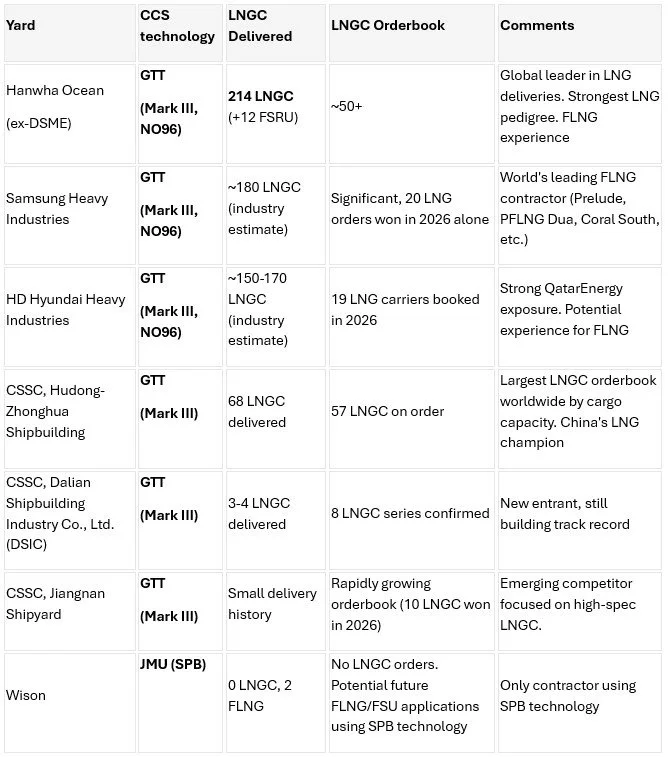
The Workforce Challenge: The Hidden Constraint Behind LNG Growth
One factor often overlooked in discussions about LNG carrier and FLNG construction is that the industry's most valuable asset is not the shipyard infrastructure itself, but the skilled workforce behind it. Membrane tank construction requires thousands of qualified insulation installers, cryogenic piping specialists, quality inspectors, commissioning engineers and supervisors who have accumulated experience through repeated LNG carrier deliveries. While obtaining a GTT license is essential, maintaining a workforce capable of consistently meeting LNG-quality standards represents a much greater long-term challenge.
Recent developments in South Korea suggest that labour availability may become an increasingly important constraint on future LNG production capacity. As LNG carrier orderbooks remain near historical highs, Korean shipyards are facing growing competition for experienced personnel, particularly in specialized disciplines such as membrane installation, cryogenic systems, LNG commissioning and quality assurance. Labor shortages have already driven greater reliance on foreign workers and subcontracting resources across major shipyards.
For emerging LNG builders in China, this creates both a challenge and an opportunity. While Korean shipyards retain an unmatched depth of experience, workforce capacity cannot be expanded as quickly as physical infrastructure. Over the coming decade, the ability to recruit, train and retain qualified LNG personnel may become as important as dry dock capacity or technology licensing in determining which industrial ecosystems are able to deliver the next generation of FLNG projects.
Conclusions
The LNG cargo containment system landscape remains highly concentrated. Despite growing interest in FLNG developments worldwide, the ability to design, construct and integrate LNG cargo tanks at industrial scale remains limited to a small group of shipyards and technology providers.
Today, South Korean shipbuilders continue to dominate the sector through decades of experience with GTT membrane technologies and an unparalleled LNG carrier delivery record. Chinese yards, led by Hudong-Zhonghua, are rapidly expanding their capabilities and are increasingly establishing themselves as credible alternatives for both LNG carriers and future FLNG developments. Meanwhile, technology integrators such as Wison New Energies are exploring alternative pathways through the commercialization of independent containment solutions such as JMU's SPB technology.
However, the future competitive battle may not be decided by containment technology alone. Dry docks can be expanded, fabrication facilities can be built, and licenses can be acquired. What is significantly more difficult to replicate is the skilled workforce required to repeatedly deliver LNG projects at scale. Membrane installation specialists, cryogenic piping experts, LNG commissioning engineers, insulation technicians and experienced supervisors represent decades of accumulated industrial knowledge embedded within the leading LNG shipbuilding ecosystems.
This challenge is becoming increasingly visible in South Korea, where major shipbuilders are managing record LNG orderbooks while competing for a limited pool of experienced personnel. As workforce availability becomes tighter, labor capacity may emerge as an equally important constraint as physical shipyard capacity. The industry's ability to attract, train and retain the next generation of LNG specialists will therefore play a critical role in determining future production capability.
Ultimately, the most important competitive battle in FLNG may not be between liquefaction technologies, EPC contractors or gas developers. Instead, it may be a contest between industrial ecosystems capable of delivering LNG containment systems safely, efficiently and repeatedly. In that race, South Korea remains the benchmark. Yet China is steadily building the facilities, know-how and execution experience required to challenge the established order. The next generation of FLNG projects may therefore be shaped less by who owns the technology than by who can assemble and sustain the workforce capable of turning that technology into operating assets.
References
Clarkson Research Services, World LNG Fleet Statistics, various editions, 2025-2026.
Hanwha Ocean. "Hanwha Ocean Delivers World's 200th LNG Carrier." Corporate announcement, 2025.
Hanwha Ocean. LNG Carrier Business and Orderbook Information, corporate publications, 2025-2026.
Samsung Heavy Industries. Annual Reports and Investor Presentations, LNG Carrier and FLNG Business Updates, various editions.
HD Hyundai Heavy Industries. LNG Carrier Construction Program Updates and QatarEnergy Shipbuilding Contracts.
QatarEnergy. North Field Expansion Shipbuilding Program Announcements and Related Time Charter Agreements.
Hudong-Zhonghua Shipbuilding. LNG Carrier Program, Orderbook and Delivery Milestones, corporate announcements, 2025-2026.
Jiangnan Shipyard. LNG Carrier Order Announcements and LNG Business Development Updates, 2025-2026.
Dalian Shipbuilding Industry Co., Ltd. (DSIC). LNG Carrier Delivery and Construction Milestones, 2025-2026.
GTT (Gaztransport & Technigaz). Membrane Containment Technologies and Global LNG Carrier Market Data.
Japan Marine United (JMU). SPB (Self-Supporting Prismatic Type-B) Cargo Containment System Technical Documentation.
Wison New Energies. FLNG Development Portfolio and SPB-Based LNG Solutions.
Golar LNG. Hilli Episeyo FLNG and Gimi FLNG Project Documentation.
Keppel Offshore & Marine. Hilli Episeyo LNG Carrier Conversion Project and Offshore Gas Solutions Portfolio.
Seatrium. Corporate Strategy and Offshore Energy Business Overview, 2024-2026.
CIMC Raffles. Offshore Gas Solutions, FLNG Conversion Capabilities and LNG Monetization Projects.
International Gas Union (IGU). World LNG Report 2025.
International Group of Liquefied Natural Gas Importers (GIIGNL). Annual LNG Industry Report 2025.
Society of International Gas Tanker and Terminal Operators (SIGTTO). LNG Shipping and Containment System Guidance Notes.
Floaters Intelligentia Analysis. "The Shipyards Behind the Next Generation of FLNG Projects", 2026.
The Korea Economic Daily, "Korean shipyards face labor shortage despite orderbook boom" (2023-2025 series of articles).
TradeWinds, multiple reports on labor constraints at Hanwha Ocean, SHI and HD Hyundai amid LNG carrier demand.
Clarksons Research, annual shipbuilding outlook reports highlighting labor availability as a capacity constraint in South Korea.
Korean Ministry of Trade, Industry and Energy (MOTIE) initiatives to expand foreign worker quotas for shipyards.
McKinsey & Company - Shipbuilding Outlook reports discussing demographic pressures and skilled labor shortages in advanced shipbuilding nations.
