
Learning to Dance in the Rain: Why No Decision Is Usually the Worst Decision in Project Execution
By Floaters Intelligentia
In every major project, whether it is an FLNG, FPSO, refinery, petrochemical plant, or renewable energy development, teams face a constant stream of decisions.
Some are small and operational.
Others can influence millions of dollars, critical milestones, contractual obligations, or even the ultimate success of the project.
Faced with uncertainty, many professionals focus on avoiding mistakes. They seek more information, request additional studies, organize further meetings, and postpone action until they feel completely confident in the outcome.
While this approach appears prudent, it often hides one of the most dangerous traps in project execution:
Decision paralysis
In reality, when an issue emerges, there are only three possible paths.
A good decision.
A bad decision.
Or no decision at all.
And surprisingly, the worst option is often the last one.
The Three Branches of the Decision Tree
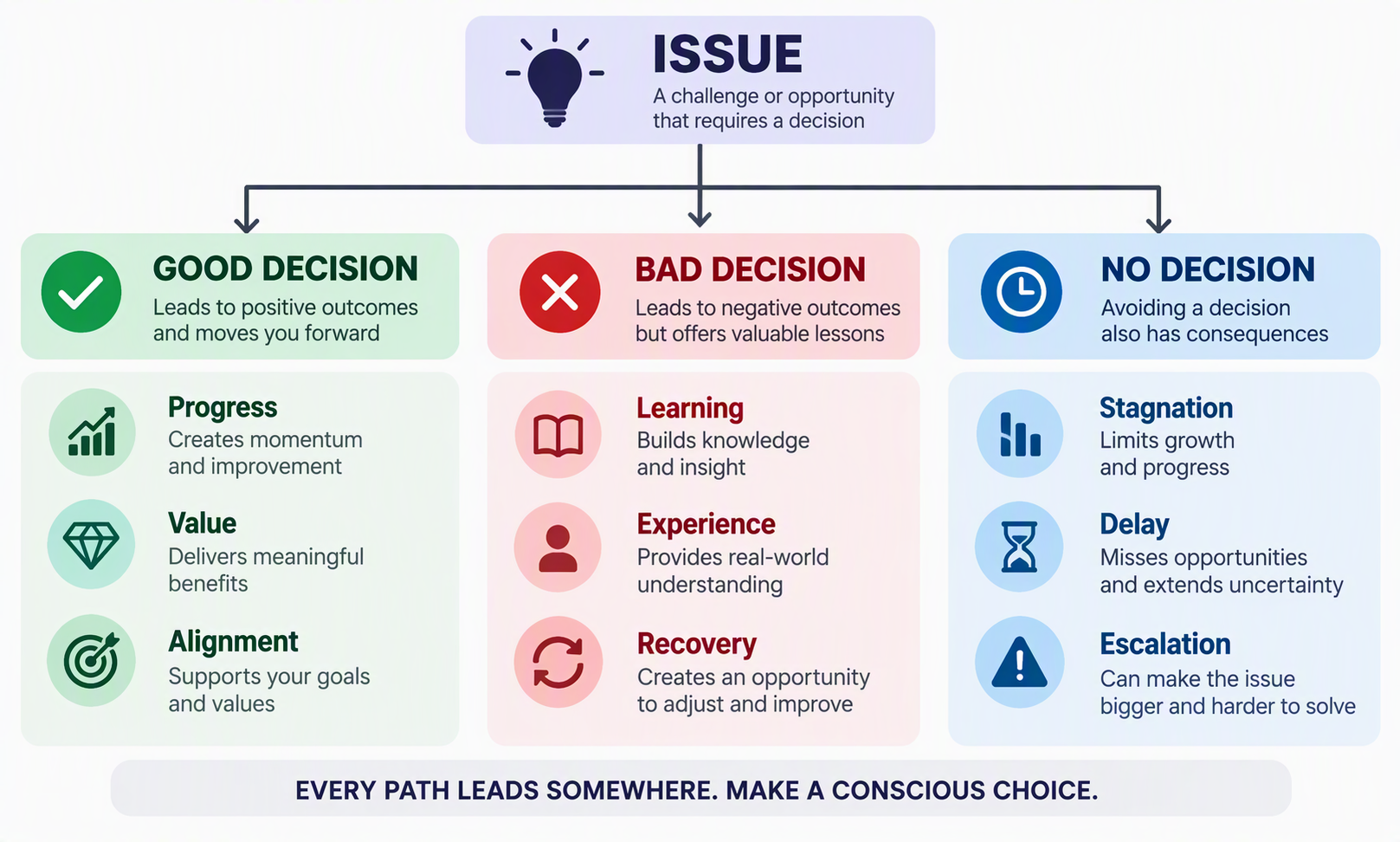
Every challenge in a project creates a simple decision tree.
At first glance, the choice seems obvious. Everyone wants to take the path of the good decision. However, project reality is rarely that simple. Most decisions are made with incomplete information, changing assumptions, and significant uncertainty.
The real challenge is not choosing between a good and a bad decision. The real challenge is choosing between making a decision and making no decision at all.
The Good Decision
This is the outcome every project manager hopes for. The team gathers sufficient information, evaluates alternatives, understands risks, aligns stakeholders, and selects the most effective solution. The issue is resolved efficiently, the schedule impact is minimized, the resources remain productive and the project objectives are protected.
Good decisions create value and maintain momentum, but unfortunately, they are only obvious in hindsight. At the moment a decision is required, certainty rarely exists.
The Bad Decision
Nobody deliberately wants to make a bad decision, yet every experienced project professional has made one.
Perhaps the selected vendor failed to perform, a redesign proved more complex than expected, an acceleration strategy generated less benefit than anticipated, a construction sequence created unforeseen constraints. The decision was not optimal, but something important still happened:
The project moved forward.
A bad decision generates valuable outputs:
Experience
Data
Lessons learned
Better understanding of the problem
Opportunities for correction
Most importantly, recovery remains possible: projects can replan, teams can redirect resources, management can introduce mitigation measures.
A bad decision can usually be corrected.
The Invisible Risk: No Decision
The most dangerous decision often does not look dangerous at all. It usually appears disguised as caution, thoroughness, or prudence.
The discussion sounds familiar: "Let's collect more data", "Let's revisit this next week", "Let's wait for Engineering's opinion", "Let's organize another workshop", "Let's see how the situation develops". Days become weeks and weeks become months, meanwhile, the issue remains unresolved.
Unlike a bad decision, no decision creates:
No progress
No learning
No accountability
No momentum
Instead, it creates:
Schedule erosion
Lost productivity
Escalating costs
Resource inefficiencies
Team frustration
In large projects, the opportunity to influence outcomes decreases over time: the longer a problem remains unresolved, the fewer options remain available.
A piping clash identified during engineering can often be solved with a few updated drawings, while the same clash discovered during commissioning may require rework, scaffolding, insulation removal, system reinstatement, retesting, and weeks of additional effort.
The issue may be the same yet the cost of indecision is not.
Why Mega Projects Are Particularly Vulnerable
Large projects create enormous pressure on decision makers.
When billions of dollars are at stake, nobody wants to be associated with the wrong decision.
Managers worry about:
Cost exposure
Contractual implications
Reputation
Stakeholder reactions
Escalation to senior leadership
As a result, organizations sometimes prioritize avoiding blame over solving problems. The irony is that the delay created by indecision often causes more damage than the original issue.
Consider a fabrication yard facing a conflict between structural steel and process piping: a wrong decision today might require several modifications tomorrow.
No decision today may stop hundreds of workers immediately. The consequence of inaction compounds rapidly.
Execution depends on momentum and momentum depends on decisions.
Leadership Means Deciding with Imperfect Information
One characteristic consistently distinguishes successful project leaders from average managers: they can make decisions without having all the answers.
Many professionals mistakenly believe leadership is about being right while in reality, leadership is often about being willing to decide despite uncertainty.
Projects rarely provide perfect information, there will always be unknowns and risks.
There will always be stakeholders requesting one more analysis before committing.
Experienced leaders understand that waiting for 100% certainty typically means waiting forever. Instead, they gather sufficient information, understand the major risks, consult relevant experts, and move forward. This philosophy is captured by a famous quote attributed to General George S. Patton:
"A good plan violently executed now is better than a perfect plan executed next week."
While originally intended for military operations, the principle applies remarkably well to project execution. In major industrial projects, opportunities are often time-sensitive. A fabrication sequence, procurement strategy, module transportation plan, or commissioning workaround can lose effectiveness if action is delayed. The objective is not reckless decision-making but timely decision-making.
A good decision executed today will usually outperform an excellent decision implemented too late.
Leaders understand that momentum creates opportunities, while hesitation often destroys them.
How to Improve Decision Quality
If no decision is usually the worst outcome, does that mean decisions should be rushed? Absolutely not.
The goal is not impulsive decision making. The goal is structured decision making.
The following framework can significantly improve both the speed and quality of project decisions.
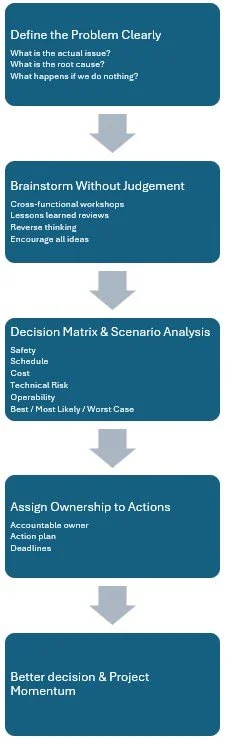
The framework is intentionally iterative rather than linear. After reviewing outcomes, new information may emerge, requiring the team to redefine the problem, reassess alternatives, and make a better-informed decision. Leadership is therefore not a single act of decision-making, but a continuous cycle of learning, adapting, and moving the project forward.
Flexibility: The Project Manager's Secret Weapon
We saw until now that a good decision creates value and a bad decision creates learning. But what allows a project to recover from a bad decision? Most of the time, the answer is not luck, it is flexibility. The most successful project managers are not those who always make the right decisions. They are those who build enough flexibility into their execution strategy to adapt when reality differs from the plan.
Flexibility is the "magic reward button" that can be activated when a decision proves imperfect.
Practical examples include:
Maintaining schedule float on critical activities.
Developing alternative execution scenarios.
Preserving procurement and fabrication options.
Qualifying backup suppliers.
Avoiding irreversible commitments too early.
Before taking any major decision, project leaders should ask: "If this decision turns out to be wrong, how easily can we recover?"
Successful projects are rarely those that execute a perfect plan. They are the projects that can rapidly adapt when circumstances change. In a world of uncertainty, flexibility is not a sign of weak planning. It is a hallmark of strong leadership.
Further Reading for Project Leaders
Decision-making under uncertainty is not a new challenge. Some of the most successful project organizations in the world have studied why certain megaprojects succeed while others fail, despite having access to similar technologies, budgets, and talent.
For readers interested in exploring the subject further, two books stand out.
This book analyzes hundreds of major projects across industries, from infrastructure and transportation to technology and energy.
One of its central messages is that successful projects are not driven by heroic last-minute interventions or perfect plans. Instead, they succeed because leaders make timely decisions, focus on execution, continuously learn from previous projects, and create mechanisms that allow rapid adaptation when reality diverges from plans.
The book also highlights a recurring pattern among failing projects: excessive optimism, delayed decisions, and an inability to react effectively when problems emerge.
A key lesson for project managers is that action, learning, and adjustment often produce better outcomes than endless analysis in search of the perfect answer.
Industrial Megaprojects: Concepts, Strategies, and Practices for Success
Considered one of the most influential references in the industrial project world, Merrow's work is based on decades of research involving large oil & gas, petrochemical, mining, and energy developments.
The book demonstrates that project success is strongly correlated with leadership quality, front-end planning, governance effectiveness, and timely decision-making.
One recurring theme is that unresolved issues tend to become disproportionately expensive as projects progress. Decisions deferred during early phases frequently reappear later as significant schedule delays, increased costs, and execution challenges.
For professionals involved in FPSO, FLNG, LNG, and offshore developments, the book provides valuable insights into why some projects consistently deliver superior results while others struggle despite having similar technical capabilities.
Final Thoughts
Across some of the world's most complex offshore projects, the most effective leaders are rarely those who make perfect decisions every time.
They are the people willing to decide.
They understand that:
A good decision creates value.
A bad decision creates learning.
Flexibility creates recovery.
No decision creates stagnation.
Perfect information, timing and certainly rarely exist.
As General George S. Patton famously stated:
"A good plan violently executed now is better than a perfect plan executed next week."
The lesson is not that project leaders should act recklessly. Rather, they should have the courage to make informed decisions, while maintaining enough flexibility to adapt when reality inevitably diverges from the plan.
This idea is captured equally well by another famous quote:
"Life isn't about waiting for the storm to pass, it's about learning to dance in the rain."
Projects are not delivered under perfect conditions. There will always be uncertainty, competing priorities, unforeseen risks, and changing circumstances.
Successful leaders do not wait for uncertainty to disappear.
They make decisions, learn from the results and adapt when necessary and they keep the project moving forward.
Because in the end, project success is not determined by the number of perfect decisions made.
It is determined by the ability to maintain momentum, recover from mistakes, and continuously steer the organization toward its objectives.
The greatest risk is rarely making the wrong decision.
The greatest risk is making no decision at all.
Author's Note: Throughout my career, I have learned that project leadership is not about making perfect decisions. It is about having the courage to decide, the humility to learn when a decision proves imperfect, and the flexibility to adapt without losing sight of the final objective. The ideas shared in this article are the result of lessons learned across complex project environments where uncertainty is the rule rather than the exception.
