
The Strategic Role of Mechanical Completion in the Construction of Floaters
In the offshore oil & gas industry, the construction of floating production units such as FPSOs (Floating Production Storage and Offloading) and FLNGs (Floating Liquefied Natural Gas) represents a major engineering challenge. Among the most critical and often underestimated phases is Mechanical Completion (MC) — the foundation for safe commissioning and startup of the facility.
What is Mechanical Completion?
Mechanical Completion is the process of certifying that all systems and subsystems have been installed according to design specifications and are ready for testing and commissioning. This includes:
Verification of piping, structure, HAVC, mechanical, electrical, instrumentation and vendor packages installation.
Certification of tagged components (valves, instruments, piping, etc.).
Compliance checks for ATEX environments and pressure-rated systems.
Conduction of MC walkdown and punch killing.
Issuance of MC dossiers and punch lists.
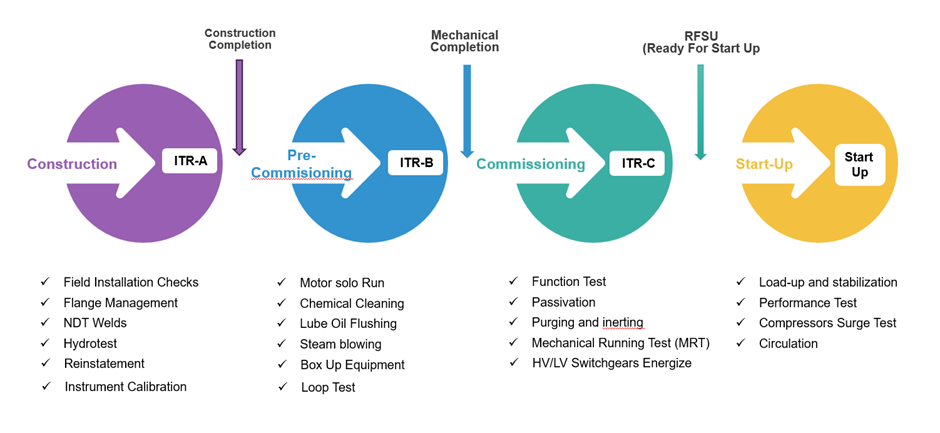
Mechanical Completion, Critical Path, and Subsystem Sequencing
In large FPSO and FLNG projects, Mechanical Completion is not only a technical certification milestone but also a key driver of the overall project schedule and commissioning critical path. While EPC schedules typically highlight major equipment delivery and integration milestones, the true readiness for commissioning is governed by the completion of Mechanical Completion (MC) subsystems, which define how the plant can be progressively energized and tested.
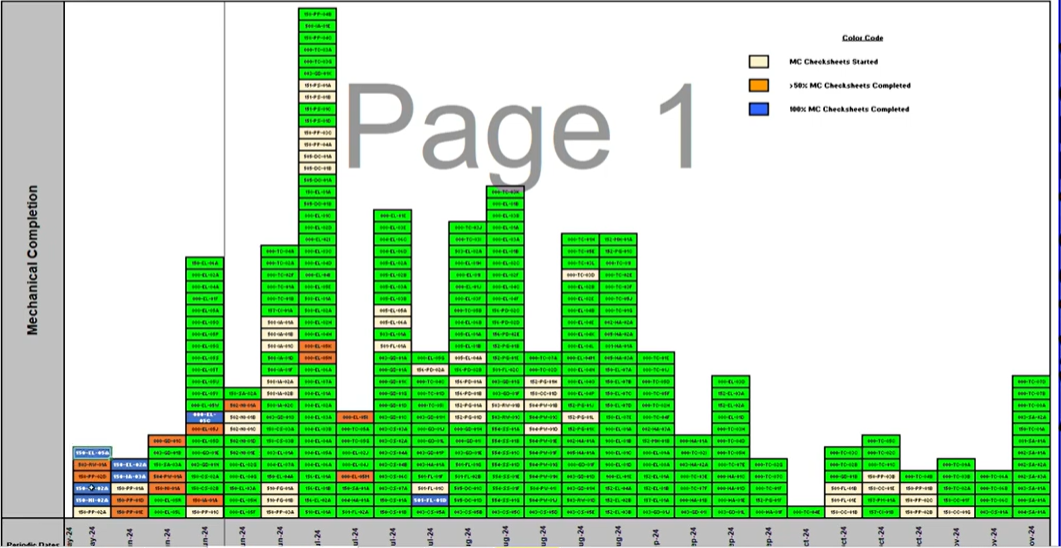
A primary tool used to monitor this progression is the MC subsystem skyline graph as illustrated below. This representation shows the planned and actual completion status of each subsystem over time, typically based on the closure of MC checksheets. The skyline provides an immediate visual indication of progress concentration, delays, and sequencing logic, highlighting whether the project is delivering subsystems in a manner consistent with commissioning priorities.
However, a frequent risk observed in execution is the misalignment between MC handover and commissioning readiness. Subsystems may be mechanically complete on paper but not yet commissionable—for example due to incomplete utilities, missing loop checks, or open punch items that prevent safe energization. This leads to situations where commissioning teams receive systems that cannot be activated (“turned on”), resulting in inefficiencies, rework, and schedule slippage.
For this reason, sequence definition becomes critical. The prioritization of MC subsystem completion must be aligned from the early stages of project execution between construction, commissioning, and planning teams. Early agreement on subsystem delivery sequencing—typically driven by utilities, auxiliaries, and enabling systems—is essential to ensure that each completed subsystem can be immediately taken over and progressed into commissioning without delay. In this context, Mechanical Completion should not be managed as a standalone target, but as an integrated, sequence-driven process directly linked to commissioning logic and project critical path.
A well-shaped skyline is not the one with the highest completion volume, but the one that enables commissioning to progress without interruption.
Mechanical Completion Under Real Project Constraints: A Risk-Based Approach
In complex facilities such as FPSOs and FLNGs, achieving full Mechanical Completion of all subsystems strictly in line with the original schedule is almost impossible in practice.
The scale of execution, combined with multiple parallel work fronts, introduces unavoidable delays driven by:
Late engineering deliverables
Procurement constraints, especially for vendor packages and bulk materials
Construction rework or quality issues
Interface complexity across disciplines and multiple fabrication yards
As a result, applying a rigid interpretation of Mechanical Completion—where commissioning can only start after full completion of all subsystems—often leads to unnecessary delays and inefficient use of resources.
For this reason, successful projects adopt a risk-based approach to subsystem handover, where controlled exceptions are accepted in order to start commissioning at the earliest feasible stage.
In this approach, the handover and commissioning teams must:
Assess the criticality of open items, distinguishing between:
Items preventing safe energization (must be closed)
Items that can be deferred without impacting commissioning progression
Maintain strict discipline on Category A vs Category B/C punch items
Clearly identify and control temporary conditions and system limitations
Ensure that all safety-critical and enabling functions are fully available
The objective is not to achieve perfect completion, but to ensure safe and progressive commissioning readiness.
This introduces a fundamental shift in mindset: Mechanical Completion is not a binary milestone (“complete / not complete”), but a managed transition based on risk, sequence, and commissioning priorities.
When properly implemented, this approach allows projects to:
Start commissioning earlier
Optimize workforce utilization
Mitigate the impact of construction delays
Protect key milestones such as Ready for Start-Up (RFSU)
In complex offshore projects, waiting for perfect Mechanical Completion often means starting commissioning too late.
Challenges in Construction Yards
Not all fabrication yards are equipped with internal systems to manage MC and commissioning. This often leads to:
Delays in delivery.
Difficulty tracking progress.
Safety and compliance risks.
No historical data to support new projects, like bidding, budget etc.
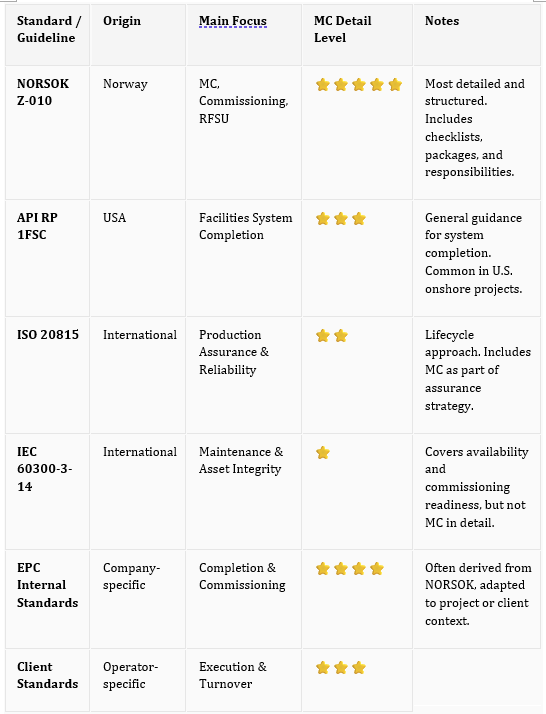
While Oil Companies and Main Contractors often rely on internal specifications, the only widely recognized international standard remains NORSOK Z-010, which clearly defines the phases of MC, Commissioning, and Ready for Start-Up (RFSU).
International Standards Overview
Although NORSOK Z-010 is the most structured and widely adopted standard, especially in Norwegian and North Sea projects, other relevant guidelines exist:
Why Mechanical Completion is a Key Phase
Mechanical Completion is not a formality — it is the moment when the facility is certified as correctly built. In complex projects like FPSOs and FLNGs, with thousands of tagged and certified components, MC ensures:
Quality assurance: Every element is verified and documented.
Commissioning readiness: No commissioning can begin without MC.
Control and traceability: Non-conformities and changes are managed systematically.
However, in practice, MC is often schedule-driven rather than quality-driven, leading to premature handovers that create downstream inefficiencies in commissioning.
The Role of Artificial Intelligence in Mechanical Completion
Mechanical Completion is one of the most promising entry points for Artificial Intelligence (AI) in EPC projects due to the structured and data-intensive nature of the process.
Practical applications:
Tag validation and reconciliation across engineering and vendor datasets
Smart punch list management, including classification and closure prioritization
QC support, such as:
AI-based visual inspection of weld surfaces
Machine learning pre-screening of NDE X-ray films
Verification of flange management and torque compliance
Cross-checking registers (ITRs, tags, punch lists, materials)
Completion forecasting, predicting subsystem readiness
Strategic value:
MC data becomes a training dataset for future projects
Transition from progress tracking → predictive execution management
Improved data consistency, transparency, and decision-making
Main Software Tools for Mechanical Completion
Modern projects rely on specialized platforms to manage completion complexity:
ProCoSys – widely used, NORSOK-aligned
PIMS CMS (Omega 365) – modular and scalable
EasyPlant – user-friendly integrated system
ICAPS – integrated commissioning platform
WinPCS – legacy but still widely used
Hexagon CMS – integrated with engineering tools
These systems enable tracking of tags, ITRs, punch lists, and subsystem turnover—but their effectiveness depends on integration with commissioning workflows.
Limitations in MC Software Integration with Commissioning
While many Mechanical Completion tools are robust in managing tags, ITRs, and punch lists, not all of them offer full integration with the commissioning phase, which introduces additional layers of complexity.
Key commissioning functionalities are often missing or poorly integrated:
· Loop Testing Management: Creation and tracking of loop folders, association with systems, and documentation.
· Override & Block Management: Tracking of temporary overrides and approval workflows.
· Software Change Request (SCR) Workflow: Logging and approval of software modifications with audit trail.
After MC, asset ownership shifts from construction to commissioning. However, this transition is often not clearly visible at tag level in completion systems, leading to:
Unauthorized work execution
Permit-to-work conflicts
Interface risks between teams
This highlights that MC is not only a technical milestone, but also a handover of responsibility and control.
Best Practice:
When selecting or configuring an MC system, it is essential to ensure:
Alignment with commissioning workflows
Integration with planning systems
Clear visibility of asset custody status
Full traceability from MC to RFSU
A truly effective system enables a seamless transition from construction to commissioning, not just data collection.
Conclusion
Mechanical Completion is a decisive phase in the delivery of FPSO and FLNG projects—far beyond a simple certification milestone.
Its success depends on the ability to manage three fundamental dimensions:
1. Sequence as the driver of value
The value of Mechanical Completion lies not in how much is completed, but in what order. Subsystems must be delivered according to commissioning logic, prioritizing enabling systems that unlock further progression.
2. Commissionability as the true readiness metric
Mechanical Completion does not automatically mean that a system is ready for commissioning. True readiness is achieved only when a subsystem can be effectively progressed by the commissioning team, with all prerequisites in place (utilities, loops, functional dependencies).
3. Flexibility through risk-based execution
In complex offshore projects, perfect Mechanical Completion is rarely achievable within schedule. Execution must therefore be flexible and risk-driven, allowing controlled exceptions so that commissioning can start as early as possible without waiting for full completion everywhere.
Mechanical Completion should be understood as a dynamic and integrated process, linking construction, commissioning, and planning—rather than a rigid milestone.
Projects that successfully align sequence, commissionability, and execution flexibility will be better positioned to:
Accelerate time to first production
Reduce inefficiencies and rework
Improve safety and control
Deliver complex offshore assets with greater reliability
References (APA style)
NORSOK Standard Z-010. (2012). Mechanical completion and commissioning. Standards Norway.
International Organization for Standardization. (2015). ISO 20815: Petroleum, petrochemical and natural gas industries — Production assurance and reliability management.
American Petroleum Institute. (2019). API Recommended Practice 1FSC: Facilities system completion.
