
Floating LNG Types and Their Place in the Value Chain
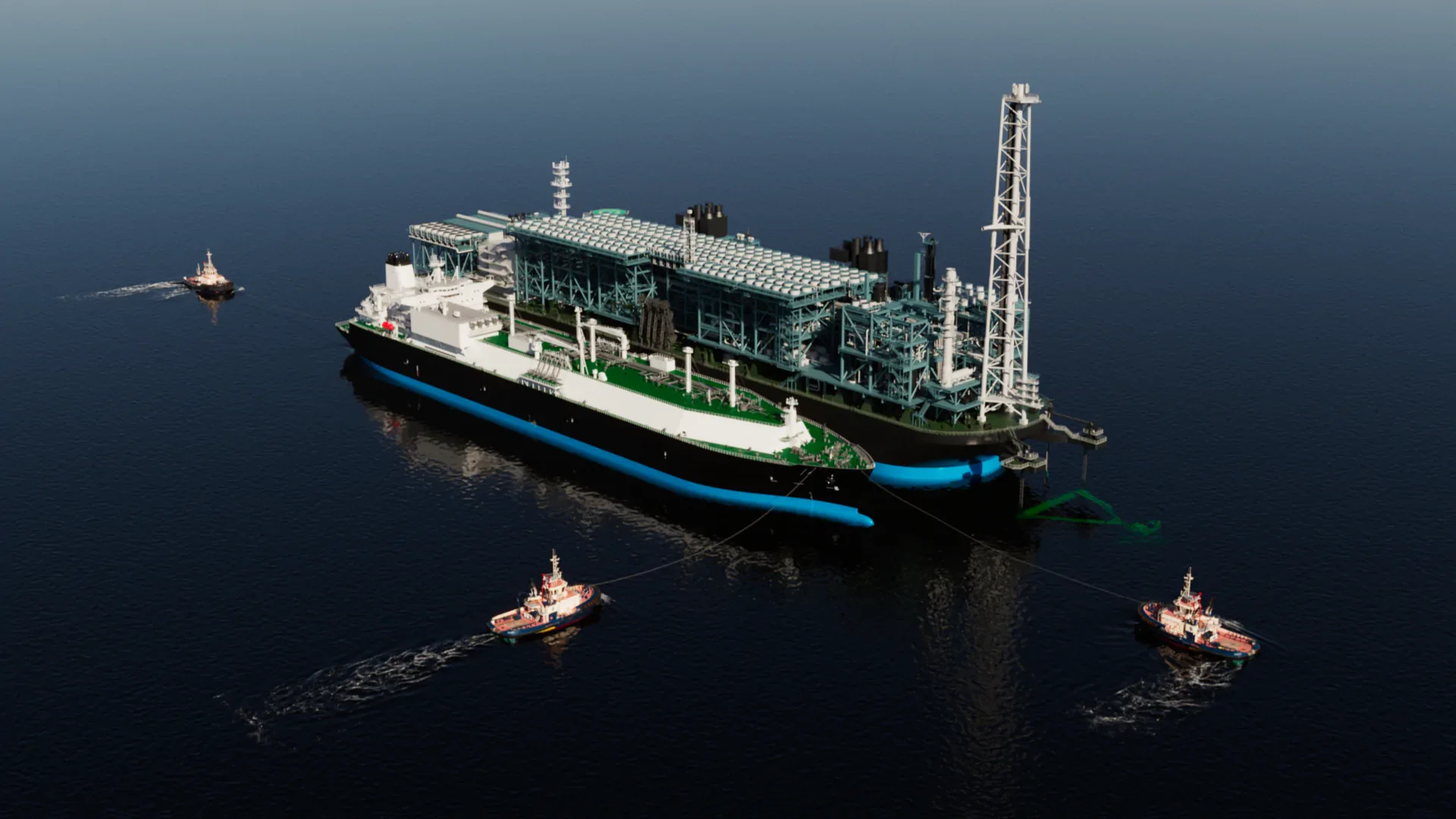
Delfin FLNG rendering. Source: Delfin
Floating LNG (FLNG) has evolved from a niche concept into a viable solution for monetizing offshore gas. Unlike Floating Production Storage and Offloading (FPSO) units, which are traditionally upstream assets that produce and store crude oil to be sold as feedstock for refineries, FLNG units deliver a finished product: liquefied natural gas ready to be regasified and injected into gas networks for direct consumption by industries and households.
As of late 2025, the global FLNG fleet includes a mix of newbuilds, converted LNG carriers, and modular units under construction. These projects fall into two broad categories based on their role in the gas value chain: upstream-integrated FLNG and midstream-only FLNG. This article defines these categories, explains their implications, and provides a comprehensive inventory of FLNG projects — including recent developments such as the Delfin–SHI agreement, Genting FLNG, Nguya FLNG, and Coral Norte FLNG, while noting that Caribbean FLNG was one of the earliest midstream-only units.
Two FLNG Archetypes: Upstream vs Midstream
Engineering Complexity: Upstream-integrated FLNGs require integration of subsea systems, gas treatment, and liquefaction, increasing topside complexity. These units must handle high-pressure, high-temperature fluids directly from the reservoir, which often contain toxic components such as hydrogen sulfide (H₂S) or carbon dioxide (CO₂). This necessitates robust high-pressure protection systems and advanced gas treatment technologies. Midstream-only FLNGs, on the other hand, focus on cryogenic systems and are often modular and standardized.
Project Risk: Upstream FLNGs carry reservoir and drilling risk; midstream FLNGs depend on feed gas contracts and liquefaction uptime.
Commercial Flexibility: Midstream FLNGs enable tolling models and third-party access, while upstream FLNGs are typically tied to specific field developments.Why the Distinction Matters
Engineering Complexity: Upstream-integrated FLNGs require integration of subsea systems, gas treatment, and liquefaction, increasing topside complexity. Midstream-only FLNGs focus on cryogenic systems and are often modular and standardized.
Project Risk: Upstream FLNGs carry reservoir and drilling risk; midstream FLNGs depend on feed gas contracts and liquefaction uptime.
Commercial Flexibility: Midstream FLGs enable tolling models and third-party access, while upstream FLNGs are typically tied to specific field developments.
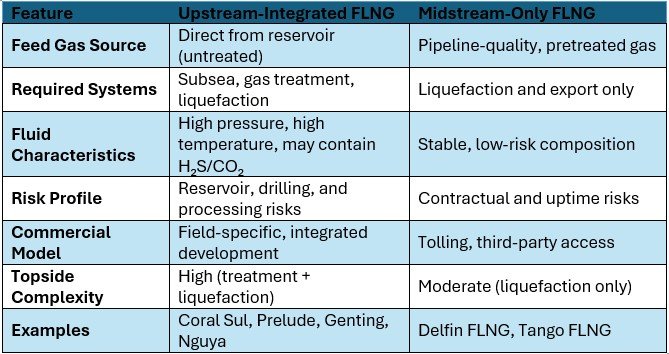
Key differencies between midstream and upstream integrated FLNG
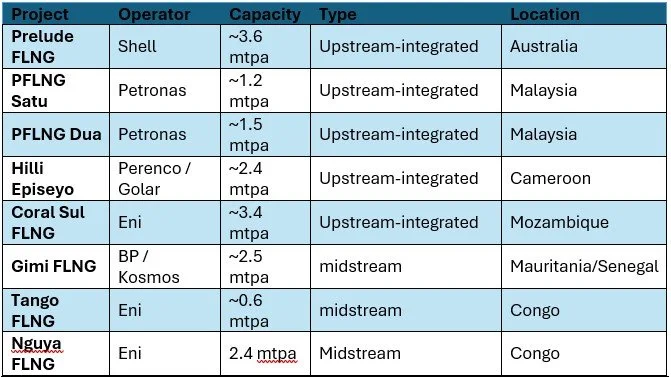
Operational FLNG units
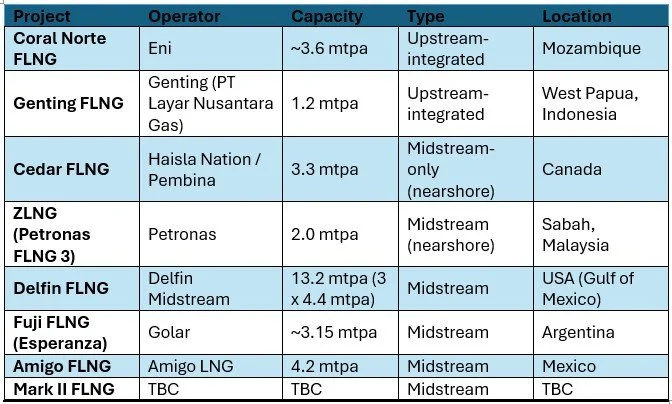
🔄 FLNG under development
🏗️ FLNG Project Spotlight: Delfin–SHI Agreement
In a major step forward for midstream FLNG, Samsung Heavy Industries (SHI) has signed a fabrication agreement with Delfin Midstream to build a new FLNG vessel. This unit will be deployed in the Gulf of Mexico and is designed to receive pretreated gas via pipeline, confirming its midstream-only role. The agreement marks a significant milestone for Delfin’s modular FLNG strategy and reinforces SHI’s position as a key player in offshore liquefaction fabrication.
🔧 Technical Specifications
Liquefaction Capacity: ~4.4 million tonnes per annum (mtpa) per vessel; Delfin plans up to three units for a total of 13.2 mtpa.
Feed Gas: Pipeline-quality natural gas from the UTOS pipeline — no upstream processing required.
Liquefaction Technology: Mixed-refrigerant cycle powered by Siemens SGT-750 gas turbines.
Cooling System: Air-cooled liquefaction and utility systems — no seawater intake or discharge.
Topside Configuration: Modular units with gas treatment, compression, LNG storage, and offloading systems.
Hull Design: SHI-built hull with integrated LNG carrier berth, thrusters for heading control, and MARAD-compliant mooring.
Environmental Strategy: Designed under Best Available Technology (BAT) principles; optional electric-drive variant (e-FLNG) for renewable integration.
Timeline: First vessel expected by 2029, pending FID in Q4 2025.
Conclusion
The FLNG landscape is no longer experimental — it’s diversified and poised for significant growth. Global FLNG capacity is projected to rise from 14.1 Mtpa in 2024 to about 42 Mtpa by 2030 and reach 55 Mtpa by 2035, underscoring its critical role in sustaining LNG supply amid evolving energy markets. FLNG solutions offer flexibility and speed, making them essential for meeting demand in Asia, Europe, and beyond. Midstream-only FLNG units, in particular, will be highly attractive for gas producers with strong pipeline networks such as Canada, the USA, and Qatar, enabling tolling models and rapid deployment without upstream complexity. Recent developments reinforce this trend: alongside projects like Delfin’s SHI-fabricated unit and Cedar FLNG, the landmark AMIGO LNG project awarded to Dubai Drydocks World — the world’s largest FLNG facility off Mexico’s west coast with over 4.2 Mtpa capacity — exemplifies the scale and ambition of midstream-only ventures. As more projects reach FID and fabrication, understanding these dynamics is essential for developers, regulators, and investors navigating the next wave of offshore gas monetization.
✅ APA Reference List
Delfin Midstream Inc. (2025, October 23). Delfin Midstream enters into a Letter of Award with Samsung Heavy Industries. GlobeNewswire. Retrieved from https://markets.businessinsider.com/news/stocks/delfin-midstream-enters-into-a-letter-of-award-with-samsung-heavy-industries-1035418779
AMIGO LNG. (2025, August 25). AMIGO LNG awards landmark EPC contract to Dubai-based Drydocks World for world’s largest FLNG facility. PR Newswire. Retrieved from https://www.prnewswire.com/news-releases/amigo-lng-awards-landmark-epc-contract-to-dubai-based-drydocks-world-for-worlds-largest-flng-facility-302537739.html
