
As the offshore industry accelerates its decarbonization journey, power generation efficiency has become a major design driver for new FPSOs and FLNGs.
Gas turbines remain the dominant source of electrical power offshore, but only a fraction of the energy contained in the fuel is converted into electricity. A significant amount leaves the turbine as hot exhaust gas, creating an opportunity for waste heat recovery.
Historically, the vast majority of floating facilities have adopted Waste Heat Recovery Units (WHRUs), using recovered heat directly for process applications.
More recently, several new-generation FPSOs have started introducing combined-cycle power generation concepts using Heat Recovery Steam Generators (HRSGs) and steam turbine generators to improve overall thermal efficiency and reduce carbon emissions.
The question therefore becomes:
Is the additional complexity of a steam cycle justified offshore, or does the traditional WHRU solution remain the optimal choice?
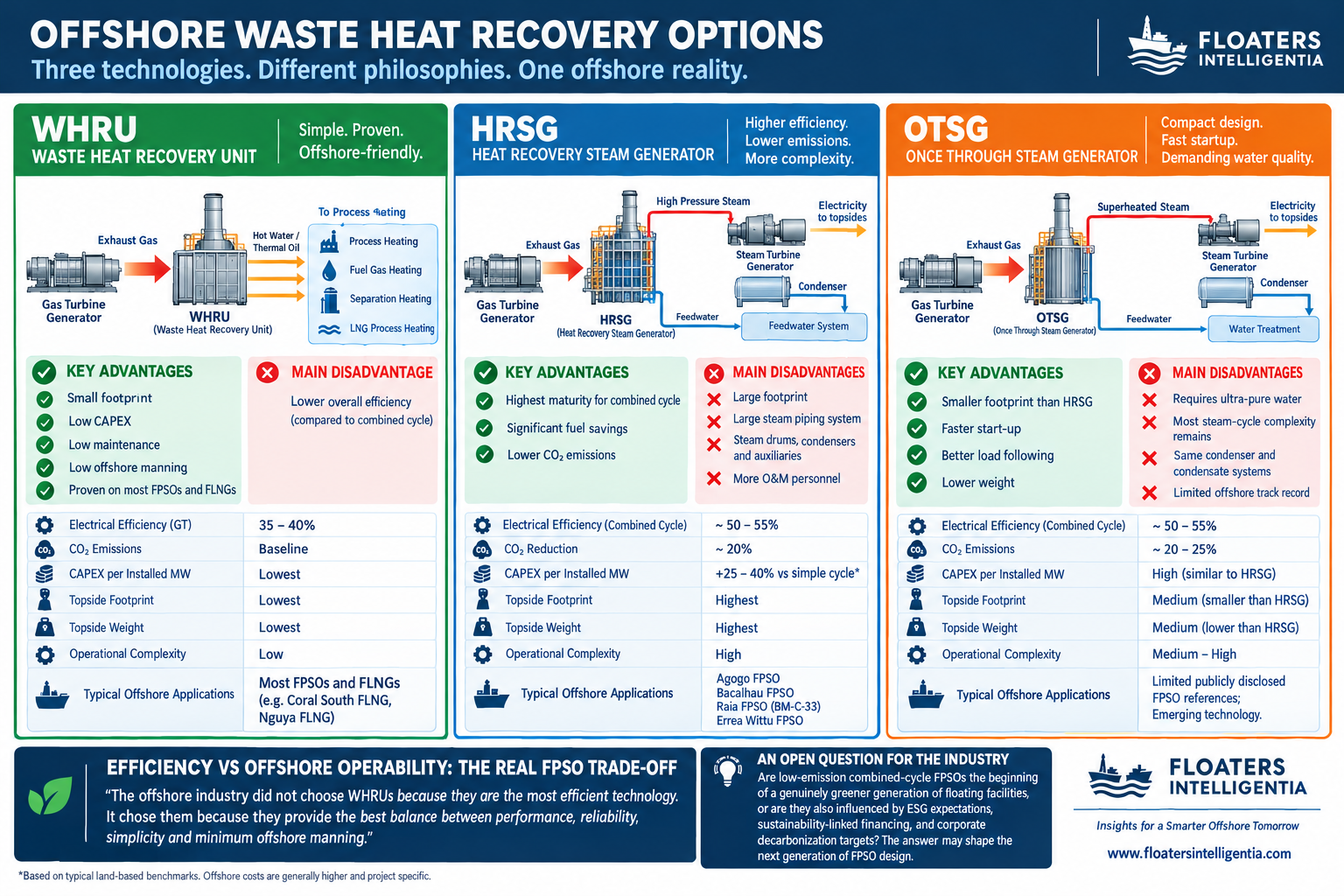
To answer this, it is useful to compare the three available technologies:
WHRU (Waste Heat Recovery Unit)
HRSG (Heat Recovery Steam Generator)
OTSG (Once Through Steam Generator)
and evaluate how they perform against the realities of offshore operations.
Understanding the Technologies
1. WHRU – Waste Heat Recovery Unit
The simplest solution recovers the heat contained in gas turbine exhaust and transfers it directly to a heating medium such as hot water, water-glycol mixture, or thermal oil.
The recovered energy is used for process heating without creating a steam cycle.
Typical WHRU Arrangement
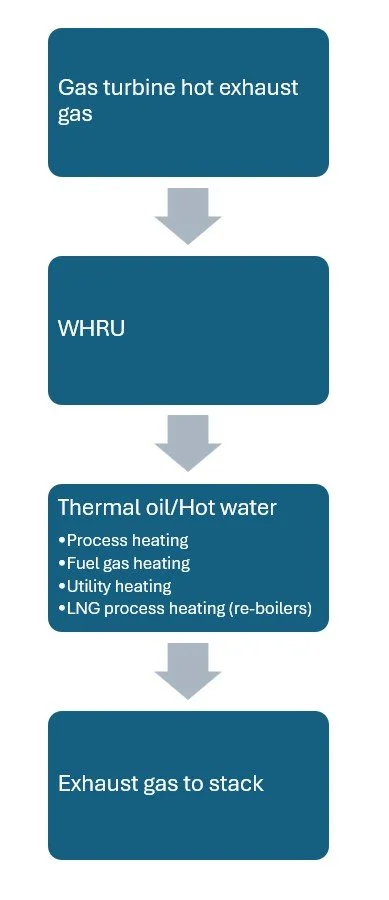
The WHRU acts as a relatively passive piece of equipment requiring limited operator intervention and maintenance.
2. HRSG – Heat Recovery Steam Generator
The HRSG uses gas turbine exhaust to generate steam.
The steam can be used either for process heating or, more commonly in modern low-carbon FPSOs, to drive a steam turbine generator, transforming a simple-cycle power plant into a combined-cycle plant.
Typical HRSG Combined Cycle Arrangement
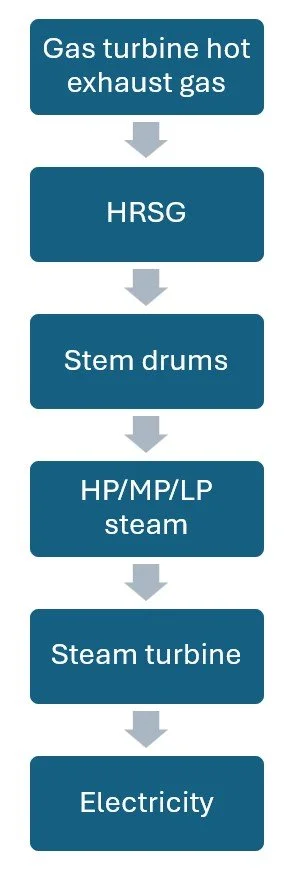
This arrangement significantly improves thermodynamic efficiency but introduces an entirely new process system onboard the vessel.
3. OTSG – Once Through Steam Generator
The OTSG is essentially an evolution of the HRSG.
Rather than using a steam drum to separate water and steam, feedwater passes through the unit only once and exits as superheated steam.
Typical OTSG Arrangement
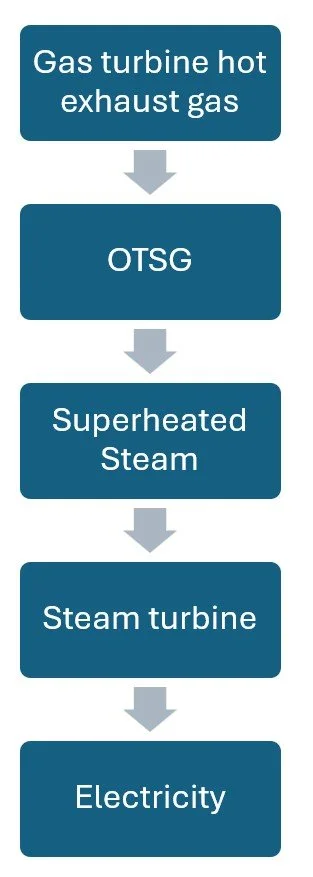
The elimination of the steam drum reduces weight and footprint while improving startup characteristics.
However, the OTSG remains fundamentally a steam-cycle system and therefore inherits many of the challenges associated with HRSG installations.
Real Offshore Applications: An Industry in Transition
A review of floating production facilities delivered over the last two decades reveals a striking trend.
Despite the well-known efficiency advantages of steam-cycle power generation, the overwhelming majority of FPSOs and FLNGs have historically relied on gas turbines operating in simple cycle, supplemented by Waste Heat Recovery Units (WHRUs) for process heating duties.
This approach reflects the traditional offshore design philosophy: maximize reliability and availability while minimizing equipment count, footprint, weight, maintenance burden, and offshore manning.
For many years, this philosophy remained largely unchallenged. However, a new generation of FPSOs is beginning to emerge. Several recently developed FPSOs have adopted combined-cycle power generation systems designed to improve fuel efficiency and reduce greenhouse gas emissions.
The most notable examples currently identified include:
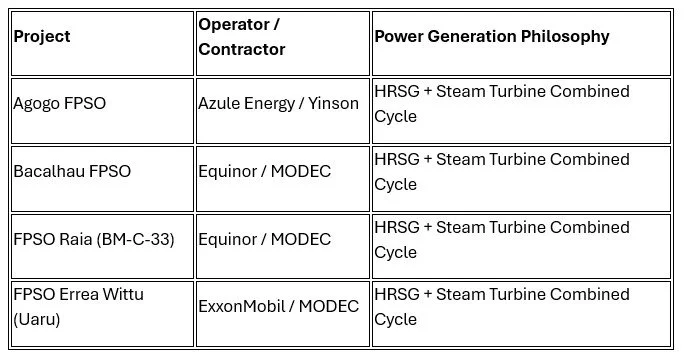
FPSO Agogo is particularly significant because public documentation explicitly confirms the presence of Heat Recovery Steam Generators (HRSGs) feeding a steam turbine generator, making it one of the clearest examples of a true combined-cycle FPSO. The project forms part of a broader low-carbon design strategy aimed at reducing fuel consumption and operational emissions.
Similarly, FPSO Bacalhau and FPSO Raia (BM-C-33) have been publicly described as incorporating combined-cycle power generation systems as part of Petrobras and Equinor's decarbonization initiatives for the Brazilian offshore sector. Publicly available information confirms the utilization of gas turbines and steam turbine power generation, although the specific steam generation technology has not been explicitly disclosed.
More recently, FPSO Errea Wittu, developed by MODEC for ExxonMobil's Uaru Project in Guyana, was announced as incorporating a gas turbine combined-cycle system intended to improve efficiency and reduce CO₂ emissions.
A Geographical Shift
Interestingly, the adoption of combined-cycle concepts is not occurring uniformly across the industry.
The most active projects are concentrated in three regions:
Brazil
Angola
Guyana
These regions are also home to some of the largest and most energy-intensive FPSOs ever developed.
As environmental regulations tighten and operators pursue lower carbon intensity developments, the efficiency gains offered by combined-cycle generation are becoming increasingly attractive.
The Missing OTSG Fleet
One of the most interesting findings during this review is not what was found, but what was not found.
Numerous equipment suppliers actively market Once Through Steam Generator (OTSG) technology for offshore applications, emphasizing reduced weight, smaller footprint, and faster startup capability compared with conventional HRSGs.
However, publicly available evidence of large-scale FPSOs or FLNGs operating with OTSG-based power generation remains surprisingly limited.
This suggests that while OTSG technology is often presented as the future evolution of offshore combined-cycle systems, the industry is still in the early stages of adoption. Concerns related to water treatment requirements, operational complexity, lifecycle maintenance, and long-term reliability may continue to influence owner decisions.
What the Fleet Tells Us
The industry's installed base provides a clear message.
The global fleet contains hundreds of floating production facilities utilizing WHRU-based heat recovery systems, while only a small number of recently sanctioned FPSOs have adopted combined-cycle power generation.
The trend is therefore unmistakable but still emerging.
The offshore industry is no longer asking whether combined-cycle power generation can work offshore.
Projects such as Agogo, Bacalhau, Raia, and Errea Wittu have demonstrated that it can.
The real question is whether the efficiency and emission benefits are sufficient to justify the additional complexity, weight, footprint, and maintenance burden associated with offshore steam systems.
That question will likely define the next generation of FPSO and FLNG power system design.
Quantitative Comparison: What Is the Price of Efficiency?
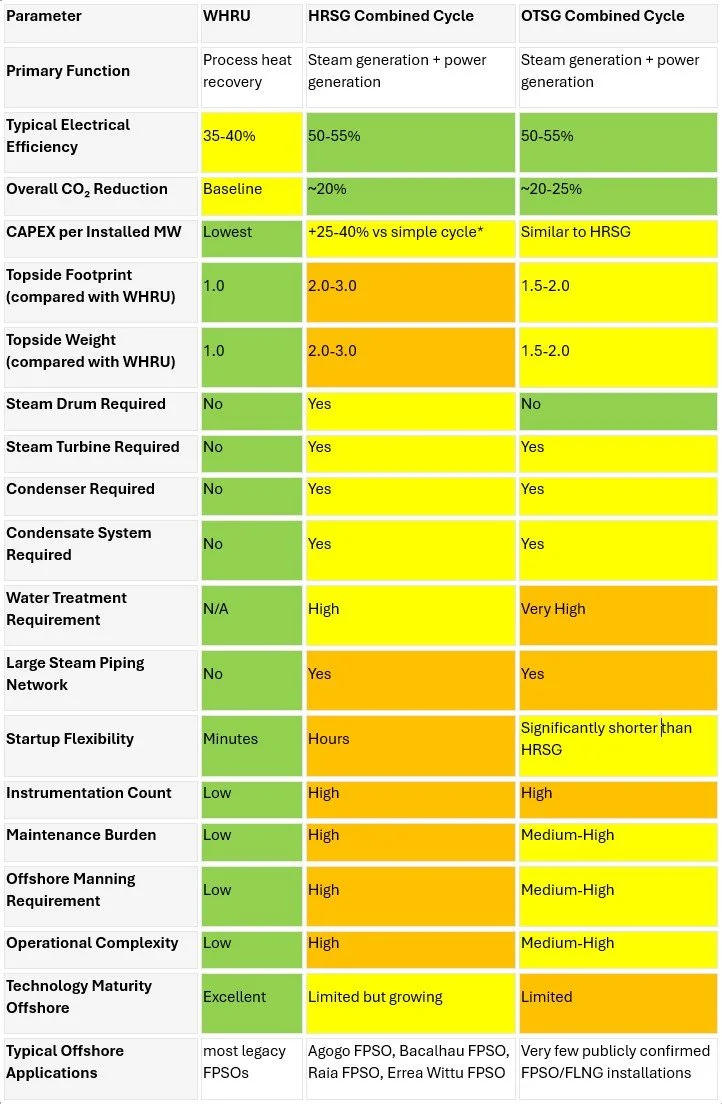
The recent adoption of combined-cycle power generation on FPSOs such as Agogo, Bacalhau, Raia, and Errea Wittu is driven by a measurable improvement in energy efficiency and carbon performance. A conventional offshore gas turbine operating in simple-cycle mode typically achieves an electrical efficiency of approximately 35-40%, with the remaining energy discharged through the exhaust stream. Combined-cycle systems recover part of this energy through a steam cycle, increasing overall electrical efficiency to approximately 50-55%, depending on the turbine configuration and operating philosophy. Industry studies indicate that this improvement can translate into CO₂ emission reductions of around 20%, with some highly optimized projects targeting even greater reductions as part of broader decarbonization strategies.
These benefits, however, come at a cost. Compared with a conventional gas turbine and WHRU arrangement, a combined-cycle installation requires additional capital investment for steam generation equipment, steam turbines, condensers, condensate systems, water treatment facilities, electrical integration, and supporting structural steel. Land-based benchmarks typically indicate a capital cost premium of approximately 25-40% per installed megawatt for combined-cycle systems compared with simple-cycle gas turbine installations. Although offshore-specific figures are rarely disclosed, the premium is expected to be higher due to marine certification requirements, modularization constraints, weight management, and the additional complexity of integrating steam systems into topside modules.
From an offshore perspective, the design decision can therefore be summarized as a trade-off between efficiency and simplicity. The owner may gain approximately 10-15 percentage points of electrical efficiency and reduce fuel-related emissions by around 20%, but must simultaneously accept increased capital expenditure, larger footprint, higher weight, more complex operation, stricter maintenance requirements, and a greater dependence on specialist personnel and water treatment systems. This trade-off explains why WHRUs continue to dominate the global FPSO and FLNG fleet despite the growing interest in combined-cycle technology.
Conclusion
For many years, the debate between WHRU, HRSG, and OTSG technologies remained largely academic within the FPSO and FLNG industry. The overwhelming majority of floating facilities selected the simplest solution: gas turbines coupled with WHRUs for process heating. The rationale was straightforward. Offshore operators consistently prioritized reliability, compactness, maintainability, and minimum manning over maximum thermodynamic efficiency.
Recent projects suggest that this paradigm may be starting to evolve.
New-generation FPSOs have adopted combined-cycle power generation philosophies aimed at reducing fuel consumption and carbon emissions. These projects demonstrate that operators are increasingly willing to accept additional system complexity in exchange for improved environmental performance and higher energy efficiency.
From a purely technical perspective, the benefits are clear. Combined-cycle systems can increase electrical efficiency from approximately 35-40% to 50-55% while reducing fuel consumption and associated CO₂ emissions. However, these gains are achieved through the addition of steam generators, steam turbines, condensers, water treatment systems, larger piping networks, more instrumentation, and a fundamentally more complex operating philosophy.
This raises a broader question that extends beyond engineering.
Are these increasingly sophisticated power generation systems the beginning of a genuinely new generation of environmentally optimized FPSOs?
Or are they also a response to growing ESG expectations from investors, lenders, export credit agencies, and regulators, where lower reported emissions can improve project economics through enhanced access to financing, sustainability-linked loans, and corporate decarbonization targets?
The answer is likely a combination of both.
Reducing emissions is unquestionably beneficial, particularly for large FPSOs expected to operate for 20 to 30 years. At the same time, offshore engineering has historically rewarded simplicity. Every additional subsystem introduces new interfaces, new maintenance requirements, and new opportunities for failure. The willingness to sacrifice some of these traditional advantages suggests that forces beyond pure engineering optimization are now influencing project development decisions.
Perhaps the most interesting question is not whether combined-cycle FPSOs are technically superior.
The real question is whether the additional complexity introduced offshore delivers enough environmental value over the facility lifecycle to justify its capital cost, operational burden, and increased maintenance requirements.
As the next generation of FPSOs enters service, the industry will eventually provide the answer. Until then, the transition from WHRU-based designs to combined-cycle power generation remains one of the most interesting experiments currently taking place in offshore engineering.
The offshore industry did not choose WHRUs because they offered the highest efficiency. It chose them because they provided the best balance between performance, reliability, simplicity, and offshore operability. The question now is whether the pursuit of lower emissions is sufficient to redefine that balance.
References
Baker Hughes. (2021). Baker Hughes awarded turbomachinery equipment contract for Equinor's BM-C-33 project offshore Brazil. Baker Hughes. https://www.bakerhughes.com
Equinor. (2023). BM-C-33 project offshore Brazil. Equinor. https://www.equinor.com
MODEC. (2023). FPSO Raia project overview. MODEC, Inc. https://www.modec.com
Yinson Production. (2024). Agogo FPSO: Carbon reduction through combined-cycle power generation. Yinson Production. https://www.yinson.com
Wison Offshore & Marine. (2024). Nguya FLNG project technical overview. Wison Offshore & Marine. https://www.wison-engineering.com
Saipem. (2022). Coral Sul FLNG: Engineering and construction of the first deepwater FLNG facility in Africa. Saipem. https://www.saipem.com
Babcock & Wilcox. (2023). Once-through steam generation technology for industrial and energy applications. Babcock & Wilcox Enterprises. https://www.babcock.com
BIH Group. (2024). Offshore OTSG solutions for combined-cycle applications. BIH Group. https://www.bih-group.com
Techouse AS. (2024). Compact once-through steam generator (COTSG) technology for offshore applications. Techouse AS. https://www.techouse.com
SINTEF. (2023). Compact steam cycle technologies for reduction of offshore CO₂ emissions. SINTEF Energy Research. https://www.sintef.no
