
Living Quarters: The Heart of Safety and Comfort on FPSO & FLNG Units
When we think of Floating Production Storage and Offloading (FPSO) units or Floating Liquefied Natural Gas (FLNG) facilities, the focus often falls on processing modules, turrets, and topside equipment. Yet, one of the most critical—and often underestimated—components is the Living Quarters (LQ). This is the most “naval” part of these offshore giants, and is crucial for both crew wellbeing and emergency resilience.
Engineering Challenges
Designing LQ involves balancing weight, space, and safety. It must withstand harsh marine environments, meet noise and vibration limits, and comply with SOLAS (Safety of Life at Sea) standards. Fire integrity, HVAC systems for hazardous gas protection, and blast resistance are non-negotiable features.
Beyond accommodation, the LQ integrates telecommunication systems and helicopter logistics, making it a strategic hub offshore.
Purpose and Design Philosophy
Living Quarters function as self-contained safety zones designed to protect personnel during fire, blast, gas release, or piracy. Their design follows stringent class rules (ABS, DNV, Lloyd’s Register, etc.) and project-specific requirements. The primary objectives are:
Crew Welfare: Provide a comfortable environment for rest and recovery, essential for maintaining operational efficiency.
Emergency Protection: Act as a safe haven during emergencies, including fire, explosion, or toxic gas release.
Evacuation Readiness: Facilitate rapid evacuation through lifeboat stations and muster areas.
Capacity and Layout
Typical LQ capacity ranges from 100 to over 300 personnel, depending on the size and complexity of the unit. Inside, you’ll find:
Cabins: typically single or double occupancy, often with en-suite bathrooms.
Recreational Areas: Gyms, lounges, and entertainment rooms to support mental health during long offshore rotations.
Medical Facilities: Fully equipped clinics for first aid and emergency care.
Control Rooms: Sometimes integrated for safety monitoring and emergency coordination.
Helideck Integration
On most floaters, the helideck is structurally integrated with the LQ. This design ensures:
Direct access from the helideck to muster stations and emergency routes.
Efficient crew transfer during normal operations and emergency evacuation.
Compliance with CAP 437 – Standards for Offshore Helicopter Landing Areas, which governs helideck size, safety zones, lighting, firefighting equipment, and approach paths.
Telecommunication Hub
The LQ houses:
Radio Rooms for marine and aviation communication.
Satellite Communication Systems for data transfer and emergency coordination.
Control Interfaces for integrated safety systems and emergency response.
This makes the LQ the nerve center for offshore connectivity, ensuring uninterrupted communication with onshore bases and rescue services.
Safety Beyond Fire and Gas
In certain regions, LQ design must also consider piracy threats. This means reinforced access points, secure communication systems, and sometimes even citadel areas—protected zones where crew can shelter until help arrives.
New Build vs Refurbishment
LQ design strategy depends on the project type:
New Build Floaters (FPSO/FLNG): The LQ is usually a brand-new construction, integrated into the hull design from the start.
FPSO Refurbishment: In many cases, the LQ is extended or upgraded from an existing accommodation block to meet new capacity, safety, and regulatory requirements. Sometimes, even refurbishment projects require a completely new LQ module, especially when the original structure cannot meet modern fire, blast, or HVAC standards.
This decision impacts weight distribution, structural reinforcement, and integration with existing systems, making LQ planning a critical part of conversion projects.
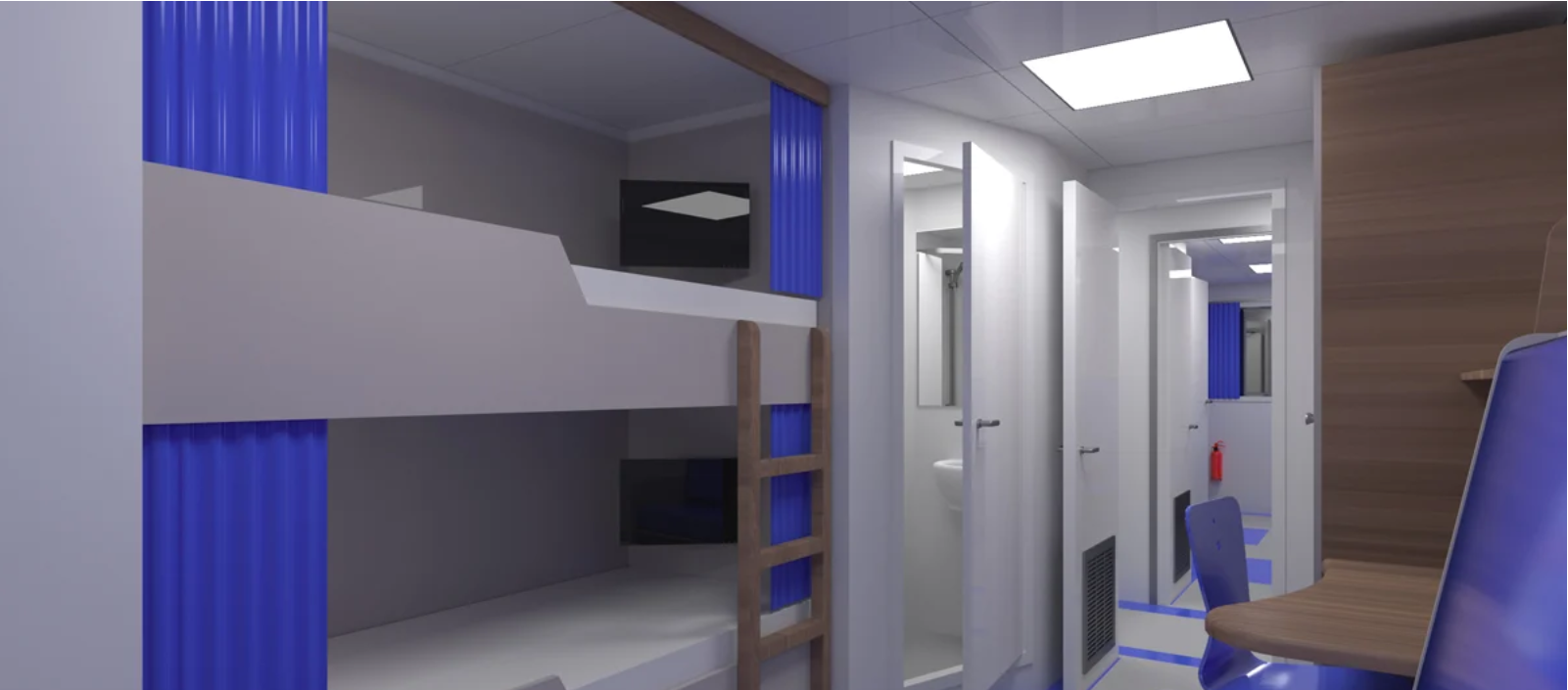
typical LQ room rendering, source: Armoda
Technical Requirements from Class Rules
Living Quarters are governed by strict standards to ensure fire integrity, blast resistance, and HVAC redundancy. Here are some key requirements:
Technical Requirements from Class Rules (examples)
🔥 Fire Resistance
ABS Requirements
A-60 fire protection: External and internal bulkheads and decks around LQ must provide up to 60 minutes of fire integrity in line with the MODU Code, maintaining structural and thermal insulation integrity.
Fire-rated penetrations: Cable, pipe, and duct entries must preserve compartment segregation through fire-rated barriers, firewall doors, and dampers.
DNV Requirements
According to DNV‑OS‑D301, accommodation spaces must be segregated by passive fire barriers, as part of their offshore standard for fire protection.
Ventilation ducts within accommodation and control stations must also comply with passive fire protection rules, enabling isolation in case of fire.
💨 HVAC & Ventilation Redundancy
ABS Requirements
HVAC systems serving accommodation must include dual or standby capacity, with redundant air handling fans and filters. These systems must be powered from dual or emergency power sources to ensure uninterrupted operation during a crisis.
DNV / IMO Guidelines
Per Section 6 (Ventilation) of IMO-aligned DNV rules, LQ must:
Maintain continuous mechanical operation with sufficient standby capacity.
Hold a minimum +50 Pa overpressure relative to external atmosphere or adjacent spaces to prevent gas ingress.
Use non-combustible ducting, with materials suitable for marine environments.
Include independent isolation valves and blowers to purge contaminated rooms.
🛡️ Blast Protection & Emergency Systems
Blast-rated walls exposed to process areas often require protection up to 0.3 bar overpressure, based on risk assessments.
LQ systems must be supported by dedicated emergency generators, ensuring survival essentials like lighting, communications, and HVAC remain operational.
Key takeaways
The Living Quarters might appear as the most polished part of an FPSO or FLNG, but their role is fundamental: they provide the comfort and security that keep offshore teams focused, rested, and mentally resilient in one of the toughest work environments on the planet.
Behind the visible amenities lies a world of engineering complexity. An LQ is not just a canteen and a gym—it’s a fire-rated, blast-protected, pressurized structure equipped with redundant HVAC systems, integrated telecom hubs, and emergency evacuation routes. Every detail is designed to safeguard life and ensure continuity of operations.
In essence, the Living Quarters are where human factors meet advanced engineering, transforming a steel vessel into a livable, safe, and connected environment. Without them, offshore energy projects would simply not be sustainable.
References (APA Style)
American Bureau of Shipping. (2023). Rules for Building and Classing Mobile Offshore Drilling Units (MODU). ABS.
Det Norske Veritas. (2021). DNV-OS-D301: Fire Protection. DNV.
Civil Aviation Authority. (2023). CAP 437: Standards for Offshore Helicopter Landing Areas. UK CAA.
International Maritime Organization. (2020). International Convention for the Safety of Life at Sea (SOLAS). IMO.
