
Aeroderivative Gas Turbines on FPSOs & FLNGs: SAC vs DLE and What Emissions Rules Mean for Your Choice
On modern FPSOs and FLNGs, gas turbines are the true powerhorse. Even as some new floaters explore dual‑fuel diesel generator configurations for auxiliary or hybrid power, the largest duty drivers—especially refrigeration and power generation on FLNG—are typically turbine‑driven to achieve the speed, power density, and reliability required offshore. As a result, the combustion technology you select at project kickoff—SAC or DLE—becomes a pivotal decision, cascading into topsides design, emissions permitting, commissioning effort, schedule risk, and O&M strategies for the entire execution window. OEM data and industry practice on LNG and offshore applications reflect these patterns and trade‑offs, including the widely deployed LM/PGT25+ families and their SAC/DLE options.
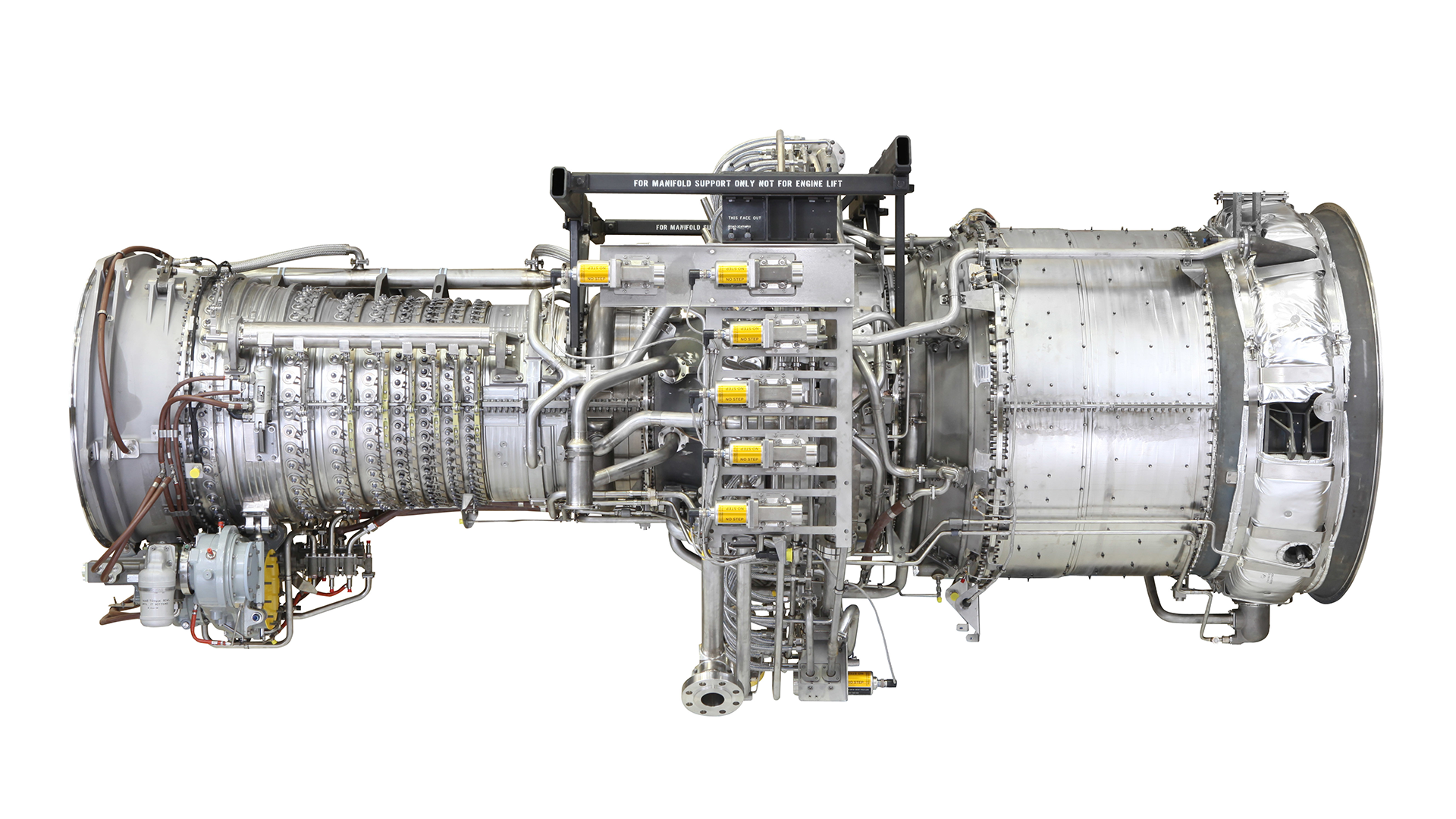
GTG GE LM2500, source: GE Vernova
Why aeroderivatives offshore
Aeroderivative gas turbines (e.g., LM2500/LM6000, PGT25+) are popular on FPSOs and FLNGs because they deliver high efficiency at part load, fast starts, low weight, and modular maintenance—ideal for power generation and mechanical drive (refrigeration and export compression). Published OEM data show typical NOx figures (natural gas, ISO) of ~25 ppm for SAC with water injection and ~15 ppm for standard DLE, with extended DLE options down to ~9 ppm on some variants.
SAC vs DLE—what actually changes
SAC (Single Annular Combustor, diffusion flame)
Strengths: mechanically simpler; robust to fuel quality swings (Wobbe index variability, inerts, minor contaminants).
Trade‑offs: higher intrinsic NOx; compliance often relies on water/steam injection to cool the flame, which adds auxiliary systems, water logistics/quality control, and potential maintenance burden.
DLE/DLN (Dry Low Emissions, lean‑premix)
Strengths: low NOx without water, via lean, premixed staging and precise controls; modern LM/PGT families quote ~15 ppm and even ~9 ppm variants.
Trade‑offs: more sensitive to fuel gas composition and transients (start‑ups, load swings); larger combustor hardware and more advanced control logic than SAC.
Bottom line: SAC = simplicity & fuel tolerance, but needs water/steam or SCR to hit low NOx; DLE = inherently cleaner (no water), but requires disciplined controls and stable fuel management.
The regulatory map: where rules can force DLE (or SAC + SCR)
Unlike ships’ diesel engines, aeroderivative turbines are regulated as stationary sources in many jurisdictions. That means local air permits—and not IMO NOx tiers—usually decide how low your NOx must be.
European Union (EU) — IED & BAT/BREF
Air permits for large combustion/installations (≥50 MWth) under the Industrial Emissions Directive (IED) set emission limit values (ELVs) based on BAT-AEL ranges. For gas‑fired units, 50–100 mg/Nm³ (15% O₂) NOx is a common target range for newer plants; Member States are now pushed by IED 2.0 to set the “strictest achievable” ELV within BAT‑AEL, considering technical/economic feasibility.
Implication: To meet the lower end of these ranges, operators typically need DLE and, in many cases, SCR; SAC with water only often struggles to reach the tightest mg/Nm³ limits.
United Kingdom (offshore PPC/OPRED; post‑Brexit)
The UK’s Offshore Combustion Installations (PPC) framework requires permits that apply BAT/BEP to air emissions from turbines, with monitoring and reporting obligations. In practice, DLE is commonly treated as BAT for new turbines; SAC may require SCR (or water/steam systems with proven performance) to achieve permitted NOx.
Norway — NOx tax + NOx Fund
Norway layers a NOx tax with a NOx Fund that co‑finances emission‑reduction measures (e.g., SCR, low‑NOx burners, LNG fuels) for offshore units and industry—up to ~80% of CAPEX for qualifying projects. This ecosystem strongly incentivizes DLE and/or SCR to minimize tax and access grants.
United States — EPA NSPS for stationary turbines
Stationary gas/combustion turbines are covered by NSPS Subparts GG (pre‑2005) and KKKK (post‑2005). In Nov 2024, EPA proposed a new Subpart KKKKa with tighter NOx limits that explicitly identify SCR (with combustion controls) as BSER for most subcategories. Expect materially lower allowable NOx for many new/modified turbines once finalized.
Implication: For new FPSO/FLNG projects under U.S. jurisdiction, DLE or SAC+SCR will likely be necessary; SAC+water alone may not suffice under the proposed standards.
Australia — NOPSEMA/NOPTA (ALARP framework)
Australia’s offshore environmental regime (OPGGS Act + Environment Regulations 2023) is goal‑based: operators must demonstrate impacts are reduced to ALARP and acceptable. In practice, recent LNG/offshore projects have adopted aeroderivative DLE as best practice; SAC may need water/steam or SCR to justify ALARP in approvals.
And the IMO? Can we use SAC and DLE “without issues”?
Yes—with respect to IMO NOx tiers. MARPOL Annex VI Regulation 13 sets NOx limits for marine diesel engines >130 kW (Tier I/II/III). It does not apply to gas turbines. Thus, your SAC or DLE choice for turbine packages is not constrained by IMO NOx tiers; the IMO focus will still apply to other aspects (e.g., fuel sulfur, IAPP certification, incinerators). If your FPSO/FLNG has auxiliary diesel engines, those must meet the appropriate Tier (and Tier III inside NECAs), but that’s separate from your turbine selection.
Practical project consequences (FPSO/FLNG)
Fuel gas quality & dynamics. DLE is more sensitive to Wobbe index shifts, inerts (CO₂/N₂), traces of H₂ or heavier hydrocarbons, and transient operation. Plan for fuel conditioning, robust staging logic, and premixer hygiene to avoid LBO/CO spikes.
Water systems (if SAC+water/steam). Account for storage, treatment (deionization), control, corrosion, and space/weight—a material penalty on floating topsides.
SCR integration. If permits point to very low mg/Nm³, SCR adds reactor, ammonia/urea handling, CEMS, and layout allowances (isolation, vibration, temperature windows). This is increasingly the expectation in the U.S. proposal (BSER=SCR) and often needed for EU BAT‑AEL minima.
Availability & OPEX. DLE eliminates water consumption and associated maintenance, but demands competence in tuning, transient management, and diagnostics (e.g., LBO prediction).
Selection guidance by scenario
Stringent air permits (EU/UK/USA/Norway): make DLE the baseline; add SCR if the permit targets the low end of BAT‑AEL or new U.S. KKKKa‑style limits. SAC is typically viable only with SCR (or proven water/steam performance) and still faces water logistics penalties.
Challenging fuels / high variability / heavy transient duty: a SAC combustor can be more forgiving—budget for water/steam and/or SCR, and ensure utilities and maintenance regimes align with offshore constraints.
IMO lens: for turbines, IMO does not impose NOx tiers; ensure your diesel auxiliaries and fuel sulfur compliance are covered under Annex VI.
Current Project Scenario: Time-to-Market Pressure
In many FPSO and FLNG projects, schedule is king. When time-to-market is a critical driver, the choice of turbine technology can significantly impact commissioning timelines:
SAC packages generally offer shorter commissioning cycles—often several months faster than DLE systems. This is because SAC combustors are simpler, require less tuning, and have fewer sensitivities to fuel gas composition and transient conditions.
DLE systems, while cleaner, demand extended tuning and validation during commissioning to ensure stable lean-premix operation across all load ranges and fuel conditions.
Adding SCR (Selective Catalytic Reduction) to either SAC or DLE for ultra-low NOx compliance introduces even more complexity and time, often adding months beyond DLE commissioning due to catalyst installation, ammonia/urea systems, and integrated CEMS testing.
Implication: If emissions restrictions are minimal or absent, and the project’s priority is fast first gas, SAC can be the optimal choice. Conversely, if compliance with strict NOx limits is mandatory, DLE or SAC+SCR becomes unavoidable—at the cost of schedule and additional topside footprint.
Conclusion
On floating production units, the SAC‑vs‑DLE decision is not merely about combustor hardware—it’s about where you operate and which regulator issues your air permit.
In jurisdictions with tighter stationary‑source NOx rules (EU/UK/USA/Norway), DLE is often the default for new builds, and SCR is increasingly common to achieve the lowest ELVs. SAC with water is still robust, but can be water‑ and maintenance‑intensive, and may not reach the most ambitious limits without SCR.
Under IMO Annex VI, NOx tiers don’t apply to gas turbines, so both SAC and DLE are acceptable from that perspective—focus your IMO compliance on diesel engines and fuel sulfur.
Rule of thumb: If emissions are a critical constraint or water is scarce, start from DLE; if fuel variability and ruggedness dominate, SAC can still win—just budget for water/steam or SCR and the associated topside/operational impacts.
Sources (selected)
OEM/application data on SAC/DLE performance (LM2500/PGT25+): Baker Hughes/GE Vernova. [bakerhughes.com], [gevernova.com]
Technology fundamentals & operational challenges: Wikipedia DLE; MDPI review (2022). [en.wikipedia.org], [mdpi.com]
Water/steam injection and diffusion combustors: ResearchGate paper on water injection; GE emissions slides. [researchgate.net], [moodle.simac.dk]
EU IED/ELV and IED 2.0 “strictest achievable”: EUR‑Lex/IEA policy note; EUTurbines/EUGINE/EUROMOT brief (2025). [legislation.gov.uk], [iea.org], [euromot.eu]
UK offshore permitting & OSPAR reporting framework: GOV.UK OPRED; OEUK; OSPAR emissions/discharges. [gov.uk], [oeuk.org.uk], [ospar.org]
Norway NOx tax & fund: DNV advisory; NOx Fund guidelines/regs. [dnv.com], [noxfondet.no]
U.S. NSPS (GG/KKKK) and proposed KKKKa (2024–2025): EPA NSPS landing page; Federal Register; Power Magazine summary; eCFR. [epa.gov], [federalregister.gov], [powermag.com], [ecfr.gov]
Australia offshore environment regime (ALARP): OPGGS Environment Regs 2023; Dept. of Industry overview. [legislation.gov.au], [industry.gov.au]
IMO Annex VI (NOx Technical Code, ECA/NECA scope, applicability to diesels): IMO/USCG/EPA. [bing.com], [dco.uscg.mil], [epa.gov]
