
GTT NEXT1: The New Benchmark in LNG Containment Technology
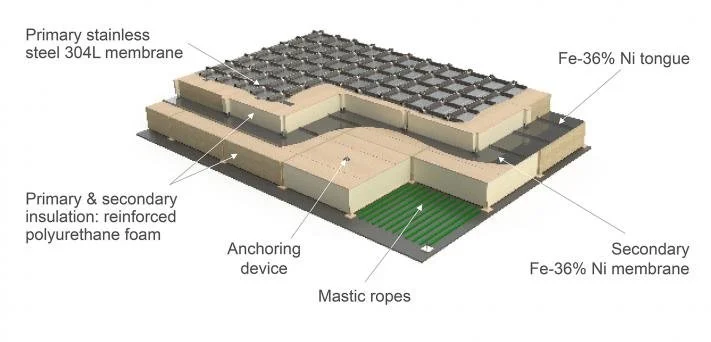
GTT Next1 schematics, source: GTT
The LNG industry continues its rapid evolution as shipowners, EPC contractors, and energy companies seek safer, more efficient, and more thermally optimized storage and transportation solutions. In 2024, Gaztransport & Technigaz (GTT) introduced GTT NEXT1, the latest membrane‑type LNG cargo containment system (CCS). With recent approvals from Bureau Veritas and Lloyd’s Register, NEXT1 is now positioned to become a defining technology for next‑generation LNG carriers and floating LNG (FLNG) applications.
A Hybrid Evolution of Mark III & NO96 Technologies
GTT NEXT1 synthesizes the strengths of Mark III and NO96—uniting the thermal performance target of Mark III Flex+ with the dual‑metallic membrane philosophy of NO96. The system uses two metallic membranes—a corrugated stainless‑steel primary and an Invar (Fe‑36%Ni) secondary—both supported by prefabricated reinforced polyurethane (PU) foam insulation to optimize thermal and mechanical performance.
NEXT1 is engineered to deliver a thermal performance equivalent to Mark III Flex+ (~0.07% V/d BOR on a ~170k m³ reference design) while offering full metal‑metal redundancy.
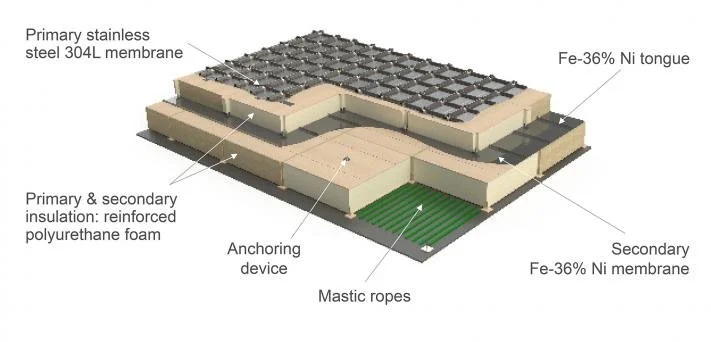
GTT Next1 scematics, source: GTT
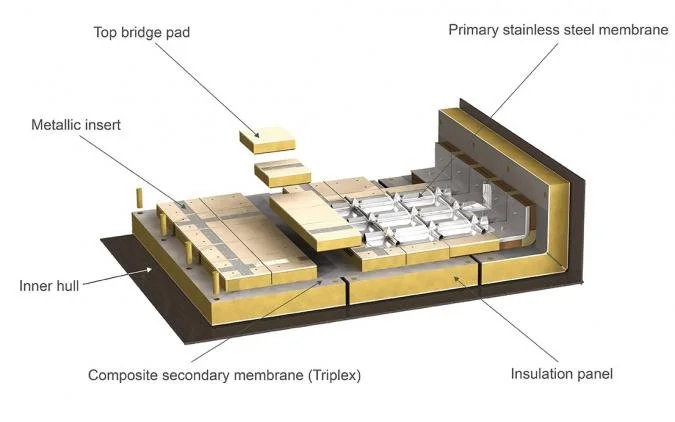
GTT Mark III schematics, source: GTT
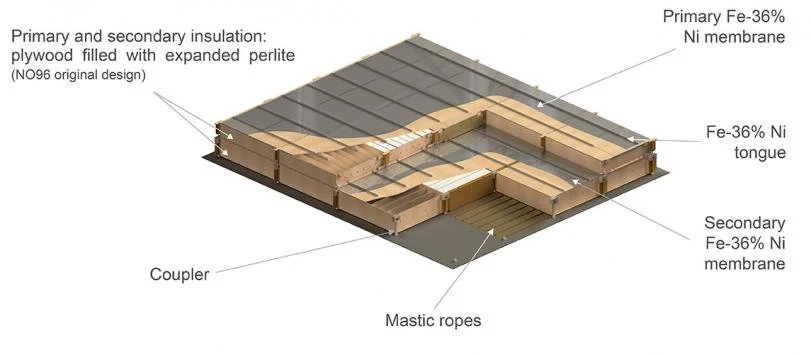
GTT NO96 schematics, source: GTT
Addressing Known Pain Points
While Mark III variants are widely deployed due to strong thermal performance, some installations historically faced concerns around triplex bonding in the secondary barrier. By adopting a dual‑metallic approach, NEXT1 removes glue‑based concepts and directly targets reliability expectations from operators who favor NO96‑style redundancy.
In addition, GTT reports optimized anchoring elements and updated insulation that further reduce heat ingress for lower BOR over the asset life.
Regulatory Acceptance and Commercial Readiness
At Posidonia 2024, NEXT1 obtained:
Design Approval (DA) from Bureau Veritas, and
General Approval for Ship Application (GASA) from Lloyd’s Register,
confirming compliance with the IMO IGC Code and BV guidance on sloshing and structural assessment.
System‑by‑System Comparison
Reference BOR values below reflect GTT’s published figures for a ~170k m³ LNG carrier where applicable. Project‑specific BOR varies with tank arrangement, reinforcements, and scale effects.
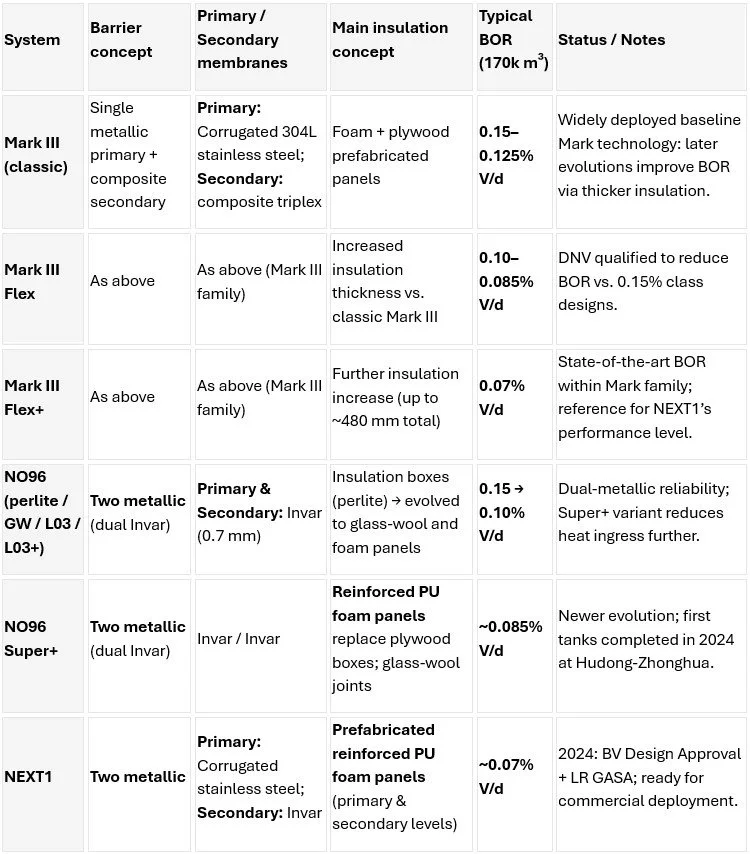
Key takeaway: Comparing the classical Mark III (~0.15%) with NEXT1 (~0.07%) shows a ~53% reduction in BOR—effectively cutting boil‑off roughly in half at reference scale, with the added benefit of dual metallic membranes for redundancy.
Why NO96 Has Been Less Popular Than Mark III
Despite NO96’s strong reliability and its recent thermal gains (NO96 Super+), several factors made Mark III the more common choice in the last decade:
Construction Effort & Schedule
NO96 relies on plywood insulation boxes and extensive Invar membrane welding for both barriers—more labor‑intensive and slower to assemble. Mark III Flex/Flex+ use PU foam panels, a corrugated stainless primary and composite secondary with adhesive bonding, which shortens construction time and increases integration.Thermal Performance Arrived Earlier on Mark III
Mark III Flex (2011) and Flex+ (2017) reached 0.10–0.085% and 0.07% BOR respectively before equivalent NO96 evolutions were fielded, giving Mark III an early market edge when owners shifted to more efficient engines that needed less natural BOG as fuel.Cargo Utilization & Geometry
Mark III’s foam‑based approach typically requires less total insulation thickness than NO96’s box structure (pre‑Super+), enabling slightly higher cargo volume for the same hull envelope—commercially attractive for long‑haul trades.Shipyard Ecosystems & Path‑Dependence
Multiple industry reports note that the Mark III vs NO96 split often follows builder preference. Korean yards that dominate LNG newbuildings invested heavily in Mark III tooling, training, and supply chains, reinforcing Mark III’s market share.Perception & Timing
With Mark III already standardized at major yards and on offshore flagships (e.g., FLNG projects using classic Mark III ~0.15% BOR), the system gained a “default” status. NO96’s later improvements (L03+, Super+) have narrowed the gap (to ~0.085%), but market momentum favors Mark III in many programs.
Bottom line: NO96 is not inferior—it offers metal‑metal redundancy and now competitive BOR with Super+. But earlier thermal upgrades, faster build workflows, and entrenched yard preferences explain why Mark III became the more prevalent choice over the past decade.
Implications for FLNG & Newbuild Strategy
For FLNG: Lower BOR directly reduces reliquefaction duty, flare loads, and fuel burn, improving environmental compliance and OPEX. NEXT1’s dual‑metal membranes enhance redundancy for long‑duration offshore storage.
For shipyards/owners: NEXT1 leverages proven Mark/NO96 materials and prefabricated reinforced PU panels, facilitating efficient build strategies and quality control while delivering Flex+‑class BOR (~0.07%).
Sources
· Bureau Veritas. (2024, June 6). Bureau Veritas delivers design approval for GTT NEXT1 LNG cargo containment system. Marine & Offshore. https://marine-offshore.bureauveritas.com/newsroom/bureau-veritas-delivers-design-approval-gtt-next1-lng-cargo-containment-system
· GTT. (n.d.). GTT NEXT1 system. https://www.gtt.fr/technologies/gtt-next1
· GTT. (n.d.). Mark III systems. https://www.gtt.fr/technologies/markiii-systems
· GTT. (n.d.). NO96 system. https://www.gtt.fr/technologies/no96-systems
· Habibic, A. (2024, June 7). GTT’s NEXT1 LNG cargo containment system wins two major approvals. Offshore Energy. https://www.offshore-energy.biz/gtts-next1-lng-cargo-containment-system-wins-two-major-approvals/
· Hine, L. (2024, June 6). GTT ready to roll with new LNG cargo containment system. TradeWinds. https://www.tradewindsnews.com/gas/gtt-ready-to-roll-with-new-lng-cargo-containment-system/2-1-1657053
· Offshore Energy. (2012, Oct 9). DNV: Upgraded LNG containment system for reduced boil‑off. https://www.offshore-energy.biz/dnv-upgraded-lng-containment-system-for-reduced-boil-off/
· SAFETY4SEA. (2013, Apr 10). Upgraded LNG containment system for reduced boil‑off. https://safety4sea.com/upgraded-lng-containment-system-for-reduced-boil-off-2/
· GTT / Riviera. (2018, May). The march of the GTT membrane. https://www.gtt.fr/sites/default/files/lng_may18_containment_systems.pdf; https://www.rivieramm.com/opinion/opinion/the-march-of-the-gtt-membrane-24807
· Offshore Energy. (2021, Apr 16). GTT evolves NO96 containment system (Super+). https://www.offshore-energy.biz/gtt-evolves-no96-containment-system/
· LNG Prime. (2024, Jan 29). Hudong‑Zhonghua completes first LNG tanks fitted with GTT’s NO96 Super+. https://lngprime.com/vessels/hudong-zhonghua-completes-first-lng-tanks-fitted-with-gtts-no96-super-tech/103380/
· Hudong‑Zhonghua / HZSRI. (2024). Design evolution of NO96 membrane cargo containment system for LNG vessels (summary). Journal of Shanghai Ship and Shipping Research Institute, 47(2), 14–20.
· Hudong‑Zhonghua study (2015). MARK III Flex vs NO96 build process comparison (Chinese). https://www.docin.com/p-1592657357.html
