
Methanol FPSOs: Floating Solutions for Low-Carbon Liquid Fuels
This third article in our series on floating production, storage and offloading (FPSO) units for low‑carbon fuels shifts focus from ammonia to methanol FPSOs (MFPSOs).
Link to first article on Ammonia FPSO, technicalhttps://floatersintelligentia.com/blog/nh3fpso1 foundations.
Link to second article on ammonia FPSO, the economics behind the concept.
Methanol is no longer just a chemical feedstock — it is rapidly becoming a cornerstone of the energy transition. With shipping fleets going methanol‑ready and regulators tightening carbon rules, the question is no longer if methanol will scale, but how.
At Floaters Intelligentia, we see MFPSOs as a decisive answer: floating platforms that synthesize, store, and offload methanol directly at sea. They unlock stranded gas reserves today (via blue methanol + CCS) while paving the way for tomorrow’s renewable‑powered e‑methanol hubs.
Pragmatic now, visionary next: Blue methanol FPSOs monetize gas with lower carbon intensity, while e‑methanol FPSOs integrate offshore wind, solar, and CO₂ capture for true Power‑to‑X.
Engineering breakthroughs: Microchannel reactors and modular distillation shrink entire plants into compact topsides, cutting weight, footprint, and cost.
Strategic flexibility: Redeployable hulls and modular plants reduce risk, accelerate deployment, and align with evolving policy incentives.
Safer, smarter storage: Innovations like sandwich‑plate tanks and inert gas systems make methanol handling offshore both feasible and scalable.
How Methanol FPSOs Differ from Traditional FPSOs
A conventional FPSO is designed to process crude oil, store it in large cargo tanks, and offload to shuttle tankers. By contrast, Methanol FPSOs reconfigure the topsides around chemical synthesis rather than oil separation.
Blue MFPSOs: natural gas is reformed into syngas, methanol is synthesized and CO₂ from the process is captured and reinjected or stored. The hull still provides ambient‑temperature liquid storage, but tanks must be stainless steel or sandwich‑plate designs to handle methanol’s corrosivity.
Green (e‑)MFPSOs: renewable electricity drives electrolyzers to produce hydrogen, which is combined with imported or captured CO₂ to make methanol. Here, the “front end” is power‑to‑X equipment — electrolyzers, hybrid storage, and CO₂ logistics — rather than gas reformers.
This represents a fundamental shift in plant architecture: from oil separation trains to compact, modular chemical reactors and distillation columns:
Methanol Synthesis: Hydrogen and CO₂ are reacted over Cu/ZnO/Al₂O₃ catalysts at 50–100 bar and 220–270 °C, with heat recovery loops to minimize offshore power demand.
Distillation & Purification: Crude methanol is refined in 25–35 m tall distillation towers, requiring reinforced topside structures and careful stability analysis. Offshore designs may adopt divided‑wall or intensified columns to reduce footprint.
Comparative Overview: Blue vs E‑Methanol FPSOs
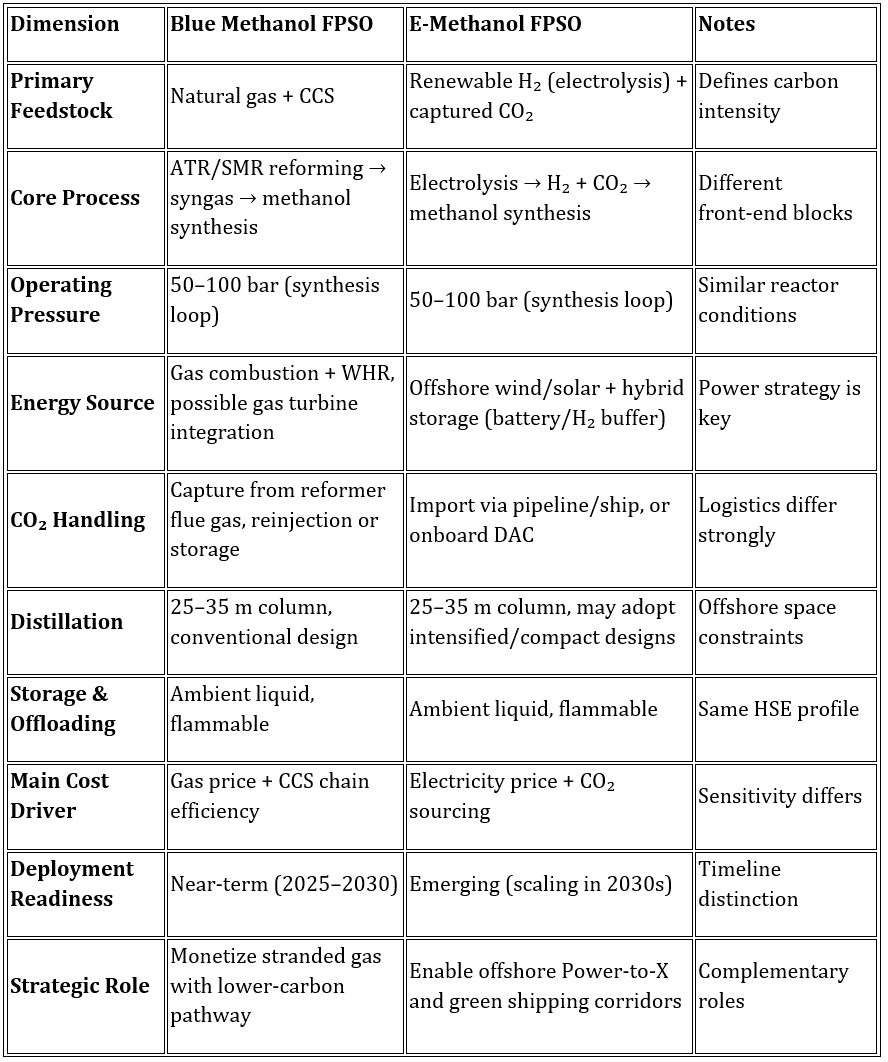
This table makes the contrast immediately clear: Blue methanol FPSOs are pragmatic near‑term solutions where gas and CO₂ storage are available, while E‑Methanol FPSOs are the long‑term green vision, tied to renewable power and CO₂ logistics.
Microchannel Methanol Synthesis Reactors for Offshore Integration
Whether the feedstock is blue methanol (natural gas + CCS) or green/e‑methanol (renewable H₂ + captured CO₂), the heart of a Methanol FPSO is the synthesis loop. In both cases, microchannel reactor technology is emerging as the offshore game‑changer.
Unlike conventional packed or tubular reactors, microchannel systems use millimeter‑scale channels to intensify heat and mass transfer. This delivers several decisive advantages offshore:
Universal applicability: The methanol synthesis step is identical in both blue and green pathways. Microchannel reactors fit seamlessly into either configuration, making them a common enabler across the spectrum.
Compact, modular footprint: By shrinking reactor size and weight, they allow a 1,000 mtpd plant to fit on deck space that would be impossible with conventional designs — critical for vessel stability and topside integration.
Higher conversion efficiency: Staged isothermal blocks (e.g., 250 °C → 225 °C → 210 °C) achieve single‑pass CO conversion rates above 70% without bulky recycle compressors, reducing complexity and power demand.
Synergy with modular systems: Their “number‑up” scalability mirrors electrolyzer skids in green projects and reformer modules in blue projects, enabling phased deployment and redeployment.
Operational resilience: Low pressure drops, reduced water demand, and insensitivity to vessel motion make them well‑suited to offshore conditions.
In short, microchannel reactors are not tied to the color of methanol but to the offshore environment itself. They are the key that makes it possible to transform an FPSO from a crude oil separator into a compact, floating chemical plant.
This version makes it clear that microchannel reactors are shared technology across both blue and green FPSOs, while highlighting their technical and strategic value.
Would you like me to also condense this into a LinkedIn‑friendly “spotlight box” (a short, scannable insert) that you could drop into your post as a visual highlight?
Methanol Storage, Tank Design, and Offloading Systems
Methanol’s physical and chemical characteristics—high polarity, low flash point, and material incompatibility with certain alloys—pose unique design challenges for FPSO storage systems. Recent classification approvals for innovative tank solutions, such as the "Methanol Superstorage" design, demonstrate rapid technological progress:
Material Selection: Stainless steel (300-series) construction is favored for its corrosion resistance and lower life-cycle cost relative to carbon steel, which demands extensive coatings and maintenance to guard against galvanic and under-deposit corrosion.
Coatings and Linings: While epoxy coatings provide temporary protection for carbon steel, their utility is limited (typically under 7 years), and they complicate tank grounding and bonding.
Inert Gas Padding: To mitigate methanol’s hygroscopic nature and contamination risk, tank vapor spaces are often padded with inert gases, such as nitrogen, and equipped with pressure/vacuum (P/V) valves and vent masts for controlled breathing.
SPS (Sandwich Plate System): Regulatory-approved multi-barrier tank technology (e.g., SRC’s design) nearly doubles fuel storage capacity by replacing traditional large cofferdams with thinner elastomer-backed steel sandwich walls, granting up to 85% more storage while maintaining fire, leak, and impact protection. This has key implications for FPSOs with lower hull volume compared to equivalent oil storage.
Offloading Systems: Flexible transfer designs include tandem and side-by-side offloading, augmented with advanced alcohol-compatible hoses, spill management, and vapor handling systems, all of which are subject to rigorous IMO and class society requirements for double barriers, leak detection, and emergency shut-down (ESD) integration.
Dynamic Positioning and Mooring Systems for Methanol FPSOs
Station‑keeping is a critical design factor that directly influences safety, uptime, and project economics. For methanol FPSOs, the choice between weathervaning systems (turret or yoke mooring) and spread mooring follows principles similar to conventional oil FPSOs. The key difference lies in product handling: because methanol can be safely transferred through flexible hoses, both tandem and side‑by‑side offloading configurations remain viable, giving operators flexibility in matching mooring strategy to field conditions and offtake logistics
Health, Safety, and Environmental (HSE) Considerations
Methanol’s properties—combustible, highly flammable, toxic by ingestion and inhalation, and chemically aggressive—require stringent HSE and regulatory controls, as outlined by IMO (MSC.1/Circ.1621), national agencies, and classification societies:
Tank and System Design: Double barriers, inerting, continuous leak detection, emergency ventilation, and ESD systems are mandatory for methanol tanks and piping. Alcohol-resistant foam systems, water mist, and IR flame detectors provide essential fire protection.
Crew Training and Procedures: Comprehensive training encompasses methanol’s toxicology, fire responses, PPE usage, spill and vapor containment, and emergency shutdown operation.
Spill Management: Rapid methanol biodegradability is environmentally favorable, but immediate containment is critical due to water solubility and flammability concerns.
Material Compatibility: Strict control of galvanic and pitting corrosion through material selection and cathodic protection is enforced, particularly in deck piping, tank valves, and loading arms.
Performance Benchmarks: Modern FPSOs, through better HSE and process integration, have reduced incident rates and maintained compliance with OGP/IMO targets for offshore safety.
Strategic Deployment and Project Economics
Methanol FPSOs hold growing strategic importance in the global offshore project pipeline:
Field Monetization: They unlock remote, marginal or otherwise stranded gas reserves, converting gas to easily shipped methanol rather than relying on costly pipeline or LNG value chains.
Deployment and Redeployment Flexibility: Conversion from existing hulls and modular plant architecture empowers rapid deployment, easy redeployment, and reduced decommissioning costs.
Regional Leadership: Malaysia, Brazil, Norway, and Angola exemplify regions championing FPSO innovation and rapid project tendering—leveraging incentives for green FPSOs, CCS integration, and local fabrication to foster competitive advantage in the Southeast Asian and Atlantic basins.
Decarbonization and Regulatory Incentives: Policies including FuelEU Maritime, EU ETS, and national clean energy mandates sharply increase the strategic value of methanol FPSOs:
Penalties for non-compliance with emissions targets vaunt the economic appeal of sustainable/renewable methanol, with projected compliance-driven market prices for e-methanol exceeding €2,000 per ton by 2030, and substantial financial incentives for early adopters of CCS and bio-methanol production.
Innovation Funds and climate-related auction proceeds in the EU are available for methanol FPSO demonstration and fleet upgrades.
Policy Frameworks and Incentives for Methanol FPSOs
Global and regional policies are rapidly underpinning the rationale for investment in methanol FPSOs:
IMO Guidelines (MSC.1/Circ.1621): Mandate four-level safety—in facilities separation, double-barrier containment, leak detection, and automatic isolation—with additional requirements for inerting, bunkering controls, vapor management, and crew training.
EU ETS and FuelEU Maritime: Imposes staged emissions allowances and rewards zero-GHG fuels, with commensurate price signals for e- and bio-methanol to outcompete fossil marine fuels within the 2025–2050 period.
Innovation and Climate Funds: Targeted grants and auction revenues for deployment of net-zero FPSOs, carbon hubs, and upgrades to digital and CCS-ready capabilities.
National Incentives: Fast-track permitting, local content promotion, and direct project finance support in Malaysia, Brazil, and other major production hubs.
Strategic Outlook
E‑Methanol FPSOs could serve as:
Green bunkering hubs near major shipping lanes, supplying e‑methanol directly to methanol‑fueled vessels.
Decentralized export nodes for countries with abundant offshore wind but limited onshore infrastructure.
Bridges to hydrogen corridors, offering a liquid carrier aligned with EU and APAC decarbonization strategies.
In contrast to blue methanol, which may dominate the 2025–2030 window, E‑Methanol FPSOs are positioned for scale‑up in the 2030s, as renewable power costs decline and CO₂ supply chains mature. They transform the FPSO from a hydrocarbon processor into a floating chemical refinery powered by renewables.
This version ties together process detail (pressures, column heights, integration issues) with strategic positioning.
Would you like me to also add a comparative table (Blue vs E‑Methanol FPSO) so readers can immediately see the different design drivers and deployment horizons?
Economic Overview
Capital and operating costs for MFPSOs depend on capacity, process route, and offshore premiums (hull, mooring, safety, and logistics). While public offshore CAPEX benchmarks are scarce, techno-economic literature provides indicative production cost ranges:
• Green methanol (e-methanol): best-site levelized cost has been reported around 1,200–1,500 €/t (2020), potentially falling toward 600–680 €/t by 2030 and 390–430 €/t by 2040 under favorable renewable power trajectories.
• Blue methanol: case studies with natural gas and CCS report levelized costs around $600–700/t at ~100,000 t/yr scale; large U.S. projects target low-carbon methanol via ATR + CCS at world-scale.
For comparison, studies of green/blue ammonia show strong electricity sensitivity for green ammonia and near-term cost advantages for blue ammonia in jurisdictions with incentives, though costs vary widely by region, gas price, and CO₂ storage access.
Economicity Comparison: Methanol vs Ammonia (Blue & Green)
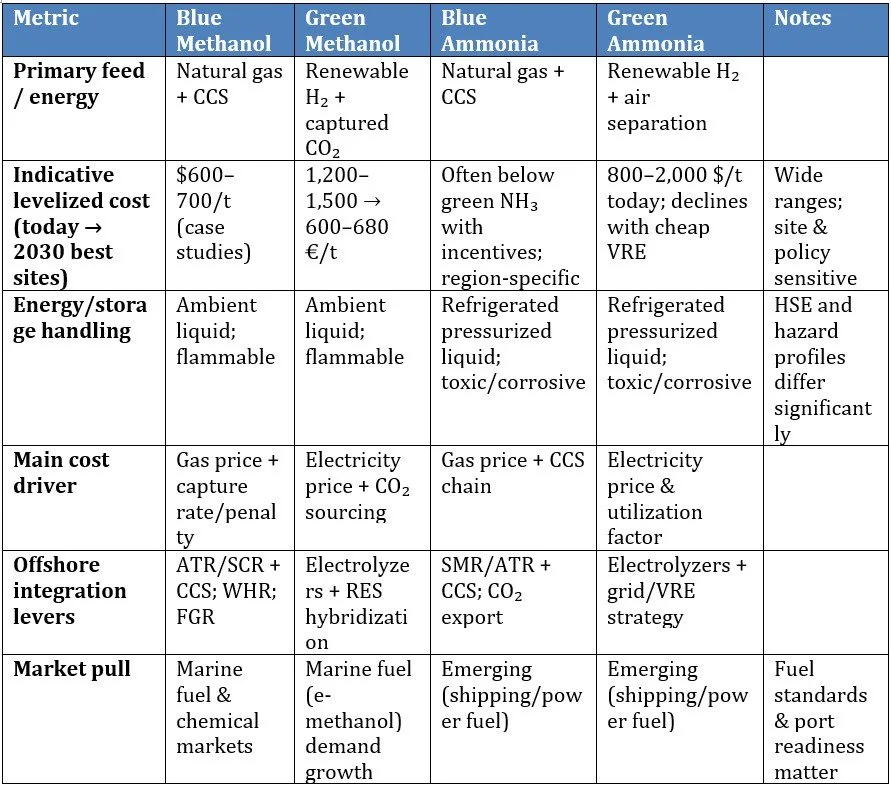
This table summarizes the key economic and technical differences between blue/green methanol and blue/green ammonia for FPSO deployment.
Conclusion
Methanol FPSOs embody the intersection of cutting‑edge offshore engineering, chemical process innovation, and strategic decarbonization. From microchannel reactors and modular separation units to advanced storage systems and CCS integration, they address the challenges of space, safety, and economics offshore.
As the global energy transition accelerates, the Methanol FPSO is not just a technical solution for stranded gas monetization — it is a strategic enabler for sustainable marine fuels, offshore emission abatement, and integrated digital energy ecosystems.
References (APA Style)
1. Joshi, P. (2020). Floating Methanol Production. IHS Markit PEP Review 2020-05.
2. Remeljej, C. (1999). Methanol Floating Production Storage and Offloading (MFPSO). OTC-10763-MS.
3. Tonkovich, A. L., Jarosch, K., Arora, R., et al. (2008). Methanol production FPSO plant concept using multiple microchannel unit operations. Chemical Engineering Journal, 135S, S2–S8.
4. Methanol Institute. (2025). 2025 Milestones: The Methanol Industry in Focus.
5. World Economic Forum. (2023). Is green methanol the clean fuel the world is forgetting?
6. Fasihi, M., & Breyer, C. (2024). Global production potential of green methanol based on variable renewable electricity. Energy & Environmental Science.
7. Aletheia, S. P., & Meyland. (2024). Techno-Economic Analysis of Blue Methanol Production from Natural Gas with Carbon Capture. International Journal of Engineering Continuity, 3(2).
8. Lake Charles Methanol II. (n.d.). Project overview.
9. Mersch, M., Sunny, N., Dejan, R., et al. (2024). A comparative techno-economic assessment of blue, green, and hybrid ammonia production in the United States. Sustainable Energy & Fuels, 8, 1495–1508.
10. International Energy Agency. (2023). Indicative production costs for ammonia via electrolysis.
11. Aletheia, S. P., & Meyland. (2024). Techno-economic analysis of blue methanol production from natural gas with carbon capture. International Journal of Engineering Continuity, 3(2).
12. Fasihi, M., & Breyer, C. (2024). Global production potential of green methanol based on variable renewable electricity. Energy & Environmental Science.
13. International Energy Agency. (2023). Indicative production costs for ammonia via electrolysis.
14. Joshi, P. (2020). Floating methanol production. IHS Markit PEP Review, 2020-05.
15. Lake Charles Methanol II. (n.d.). Project overview.
16. Mersch, M., Sunny, N., Dejan, R., et al. (2024). A comparative techno-economic assessment of blue, green, and hybrid ammonia production in the United States. Sustainable Energy & Fuels, 8, 1495–1508.
17. Methanol Institute. (2025). 2025 milestones: The methanol industry in focus.
18. Remeljej, C. (1999). Methanol floating production storage and offloading (MFPSO). OTC-10763-MS.
19. Tonkovich, A. L., Jarosch, K., Arora, R., et al. (2008). Methanol production FPSO plant concept using multiple microchannel unit operations. Chemical Engineering Journal, 135S, S2–S8.
20. World Economic Forum. (2023). Is green methanol the clean fuel the world is forgetting?
