
How Robotic Welding is Redefining Offshore Construction
Robotic welding in modern shipyards now spans multiple fabrication domains. Robots are increasingly deployed in block assembly, where they perform stiffener welding on plate sub‑assemblies with access from above, as well as stiffener and bulkhead welding during block erection, positioning themselves between bulkheads to handle confined‑space joints. Robots are also used in automated blasting operations, reducing human exposure to hazardous environments as well as membrane welding on LNG carrier.
A major leap forward happened this week (16 March 2026) as Samsung Heavy Industries launched PIPE ROBOFAB, the shipbuilding industry’s first fully automated robotic pipe spool fabrication workshop, capable of producing around 100,000 pipe spools per year and integrating design, logistics, machining, measurement, alignment, and AI‑guided welding into a single automated flow. This represents a decisive breakthrough in the automation of offshore piping welding, setting a new benchmark for safety, consistency, and productivity.
In parallel, Korea’s smart-yard push has reached deck welding—historically among the hardest operations to automate due to uneven surfaces and congestion. In a 2025 mid-October demonstration at HD Hyundai Mipo Dockyard, collaborative robots performed deck-welding tasks live for the press, and the yard targets an increase in deck-block welding automation from 58.6% to about 80%.
The vendor landscape is also expanding. FANUC’s ARC Mate family is now applied to shipyard pre-manufacturing and panel-line welding, where systems scan parts, compute weld paths, and execute sequences autonomously—eliminating manual teaching and accelerating cycle time while improving repeatability.
The core message remains unchanged: robotics will not reduce the total work—it will change it. Roles shift toward higher specialization, risk is significantly reduced, and weld quality becomes more consistent, traceable, and auditable than with manual-only methods.
In this article, we introduce the term cobots (collaborative robots)—robots designed to work safely alongside humans without extensive safety barriers
The following table provides a comparative overview of how major shipbuilding nations are approaching robotic welding adoption. It highlights key yards in Korea, China, and Japan, along with their primary automation focus areas, offering insight into regional strategies and priorities.
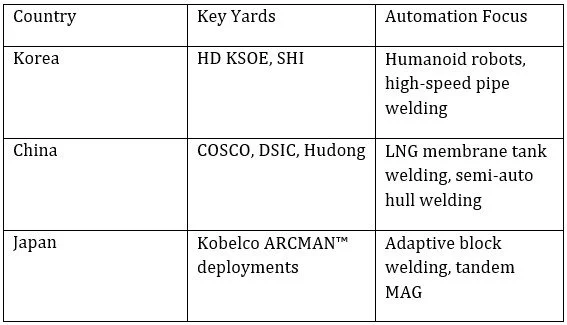
Where Robots Are Used Today in Shipyards
Robotic welding does not introduce new welding processes; it applies the same qualified techniques long used in manual fabrication—typically FCAW for carbon steel and GMAW for stainless steel or aluminum. What changes is not the metallurgy, but the operator: the robot becomes a highly repeatable, fatigue‑free welder using decades‑old, code‑compliant welding technology. This greatly reduces the risk traditionally associated with introducing new processes into the fabrication chain.
Because robots do not require rest and can maintain optimal travel speed, arc stability, and heat input for extended periods, the effective productivity per welding torch typically increases by a factor of 5 to 10 compared with human labour. The result is a step‑change in throughput and schedule reliability, especially in repetitive or ergonomically challenging welds.
In surface‑preparation activities such as blasting, the productivity gap is smaller, but the HSE impact is dramatic. Robotic blasting removes workers from high‑noise, high‑dust, and confined environments while delivering far more uniform surface quality.
Typical robotic applications across shipyards and module fabrication yards include:
Block subassembly and assembly: automated fillet and seam welding of stiffeners on plates (top access) and robotic execution of joints between bulkheads in restricted or enclosed spaces.
Piping fabrication: orbital and autogenous welding for small‑bore lines, and robotic GMAW/FCAW for medium‑bore and large spools—now rapidly advancing toward fully automated spool production lines.
Surface preparation: robotic blasting systems that both minimize human exposure and standardize surface cleanliness and profile.
Block sub-assembly
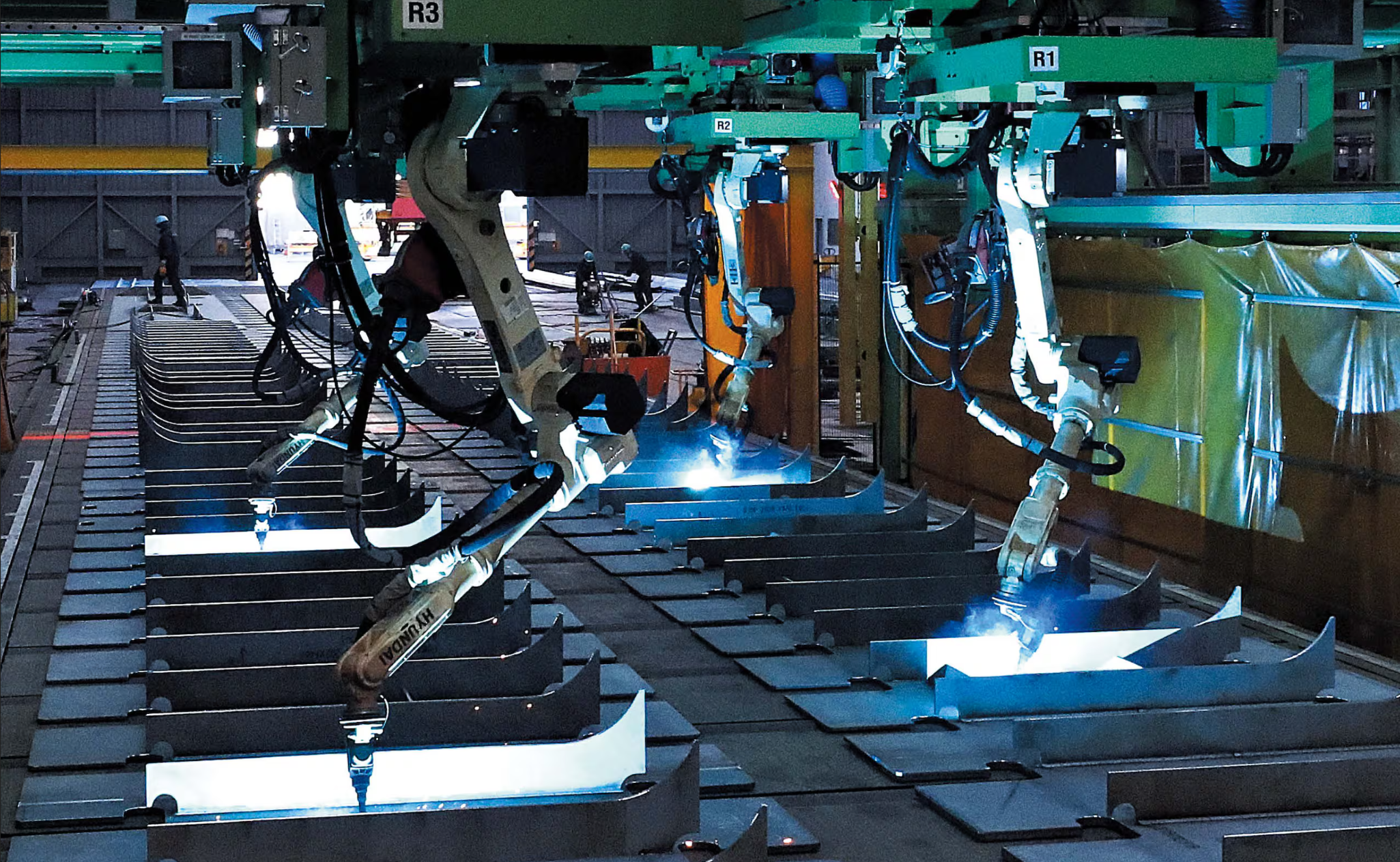
Robot welding in block sub-assembly (panel line), Source: Chosun
Block assembly
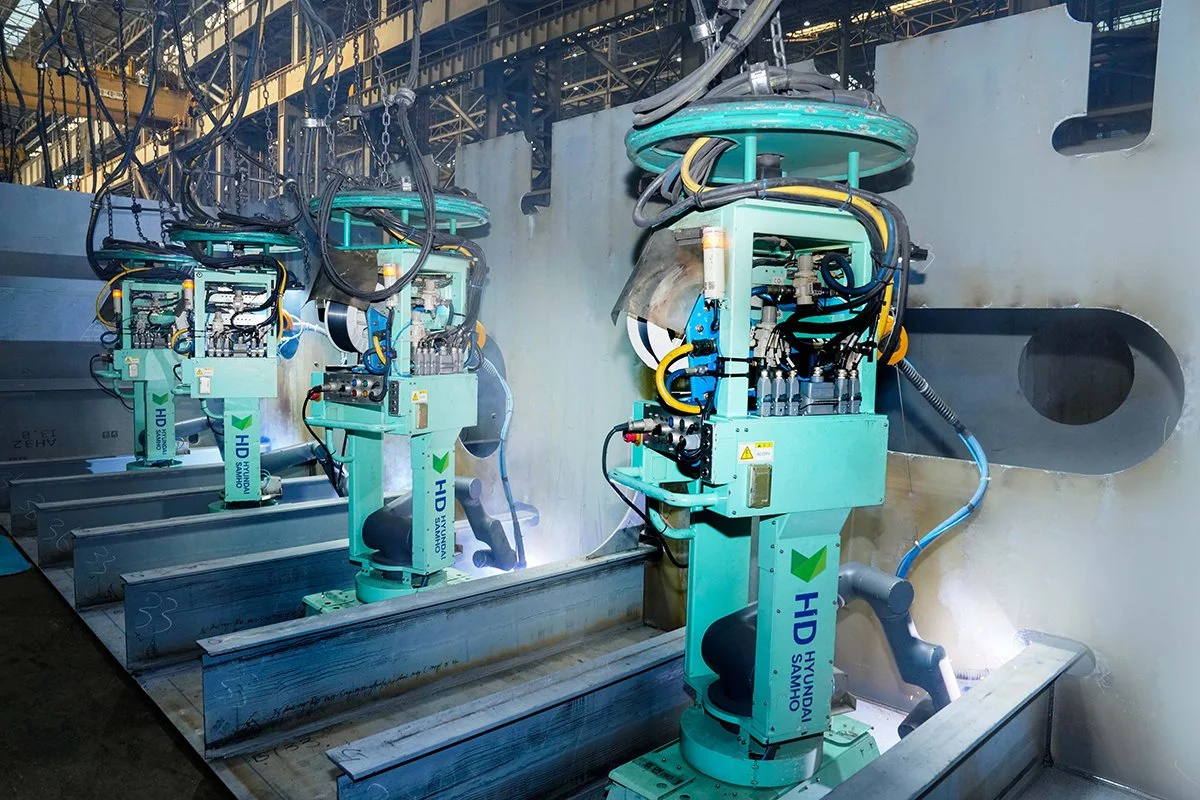
Robot welding in block assembly, Source: DBR
Industry Signals: Why Automation Is Accelerating
Automation in shipbuilding has moved from concept to competitive necessity, driven by a convergence of safety, labor, quality, and efficiency imperatives. Robotic welding addresses critical challenges that traditional methods struggle to overcome, offering measurable benefits across multiple dimensions.
Health, Safety, and Environment (HSE) improvements are a major catalyst. By reducing human exposure to hazardous environments and repetitive strain, robotic systems enhance workplace safety while meeting stringent compliance standards. This is particularly vital in confined spaces and high-heat zones where manual welding poses significant risks.
Workforce availability pressures are accelerating adoption. With skilled welders in short supply, shipyards are turning to automation to maintain throughput. Collaborative robots and adaptive systems bridge the gap, ensuring continuity without compromising quality.
Quality control and consistency are elevated through automation. Integrated sensors, real-time monitoring, and AI-driven adaptive path planning minimize defects and rework, delivering welds that meet or exceed code requirements. This level of precision is especially critical for LNG membrane tanks and structural joints where tolerances are tight.
Cycle-time reduction is transforming project economics, thanks to the increased productivity (5 to 10 times for welding process).
Robotic welding is not just about automation—it’s about creating a safer, more resilient, and more efficient shipyard ecosystem that can meet the demands of next-generation offshore projects.
The Technology Stack—What Works and Where
Case study: piping fabrication: Samsung Heavy Industries: PIPE ROBOFAB
SHI has commenced full-scale operation of PIPE ROBOFAB—described as the shipbuilding industry’s first fully automated robotic pipe spool fabrication facility. The plant integrates the entire chain from piping design to automated logistics, precision machining and measurement, alignment, and AI-driven welding, enabling shorter lead times, consistent quality, and enhanced safety. The facility covers about 6,500 m² and can produce approximately 100,000 spools per year.
Case study block erection: Deck Welding Automation Advances
Deck welding has long been difficult to automate due to uneven surfaces and pipe obstacles. In a mid-October demonstration at HD Hyundai Mipo Dockyard, collaborative robots performed deck welding in front of the press. The yard expects to raise automation for deck-block welding from 58.6% to about 80%.
Case study, block subassembly: FANUC ARC Mate in Shipyards
FANUC’s ARC Mate series (e.g., ARC Mate 100iD/8L, 120iD) is being applied to shipyard pre-manufacturing and panel production. In partnered deployments, systems automatically scan parts, compute welding paths and parameters, and execute without manual programming, supporting fully automated, repeatable welding on large panels and flat sections. The ARC Mate family combines integrated torch-cable routing, slim arms for narrow access, and advanced seam-tracking/vision options to address high-deposition fillet and multi-pass joints typical of hull-block fabrication.
Case Study LNG tanks: Hudong–Zhonghua LNG Membrane Welding Automation
Hudong–Zhonghua Shipyard has implemented robotic and semi-automatic welding systems for LNG membrane tanks (Mark III/NO96), focusing on adaptive welding for corrugated panels and corner seams.
Performance Achievements:
Precision: ±0.5 mm on automated gantry systems.
Throughput: 40,000 m of welds completed during trials without failures.
Quality: 99% acceptance rate for critical seams.
Strategic Impact: Supports increasing LNG carrier output from 6 to 10+ vessels/year.
Strict environmental controls (humidity, temperature) and licensor compliance ensure consistent weld quality and reduced rework, positioning Hudong as a leader in LNG containment automation.
Conclusion
Robotic welding is no longer a niche innovation—it is now a core driver of productivity, safety, and quality in offshore fabrication. Because robots apply the same qualified welding processes used for decades, they minimize integration risk while delivering major gains in consistency and throughput. The biggest impacts emerge in hull block welding and LNG membrane fabrication, where repetitive geometries allow robots to outperform manual work by a wide margin.
More importantly, automation strengthens yard resilience. It reduces dependency on scarce skilled labour, enhances traceability, and stabilizes schedules in ways manual-only workflows cannot match. As shipyards move toward fully integrated automated lines—from design to machining, fit-up, welding, and digital QA—those who adopt early will define the new standard for FPSO and FLNG execution.
Robotics is reshaping the work that we know. The future yard will pair robotic precision with human expertise, creating a safer, faster, and more predictable fabrication ecosystem.
References
ABICOR BINZEL. (2021). EWR 2 and EWR 2 Net: Up to 60% gas savings! https://www.binzel-abicor.com/uploads/Content/USA/PDF-Files/PDF_Files_ROBO/Catalogs/LIT.9261_EWR2-EWR2_Net_10-21_Web.pdf
ABICOR BINZEL. (n.d.-a). EWR 2 / EWR 2 Net—Gas monitoring system. https://www.binzel-abicor.com/US/eng/products/robotic-torches-systems/gas-management-system-ewr-2-ewr-2-net/
ABICOR BINZEL. (n.d.-b). Gas management system EWR 2 / EWR 2 Net. https://www.binzel-abicor.com/DE/eng/products/robotic-systems/sensors/gas-management-system-ewr-2-ewr-2-net/
American Society of Mechanical Engineers (ASME). (2025a). BPVC Section IX—Welding, brazing & fusing qualifications. https://www.asme.org/codes-standards/find-codes-standards/bpvc-ix-bpvc-section-ix-welding-brazing-fusing-qualifications
American Society of Mechanical Engineers (ASME). (2025b). BPVC Section VIII, Division 1—Rules for construction of pressure vessels. https://www.asme.org/codes-standards/find-codes-standards/bpvc-viii-1-bpvc-section-viii-rules-construction-pressure-vessels-division-1
American Society of Mechanical Engineers (ASME). (2025c). Process piping, welding, brazing & fusing learning path (B31.3 + Section IX). https://www.asme.org/learning-development/find-course/process-piping-welding-brazing-fusing-learning-path
American Welding Society (AWS). (2017). AWS D1.6/D1.6M:2017—Structural welding code—Stainless steel. https://pubs.aws.org/Download_PDFS/AWS%20D1.6-D1.6M-2017%20%28Final%29-PV.pdf
American Welding Society (AWS). (2021). AWS D1.6/D1.6M:2017—Amendment 1 (2021). https://pubs.aws.org/Download_PDFS/D1.6-D1.6M-2017-AMD1-FinalPDF-PV.pdf
American Welding Society (AWS). (2025a). AWS D1.1/D1.1M:2025—Structural welding code—Steel (Abstract/preview). https://pubs.aws.org/Download_PDFS/D1.1-D1.1M-2025WebPV.pdf
American Welding Society (AWS). (2025b, April). AWS announces release of D1.1/D1.1M:2025. Welding Digest. https://www.aws.org/magazines-and-media/welding-digest/wd-april-2025-d11/
American Welding Society (AWS). (2025c). D1.1 Code Clinic (online training). https://cm.aws.org/certification-and-education/education/self-paced-online-learning/d1-1-code-clinic/
Bosworth, A. (2025, May 8). HD Hyundai signs deal to develop shipyard welding robots. Baird Maritime. https://www.bairdmaritime.com/unmanned/robotics/hd-hyundai-signs-deal-with-korean-partners-to-develop-shipyard-welding-robots
BusinessKorea. (2024, June 19). Samsung Heavy Industries unveils revolutionary K‑PAW welding technology. https://www.businesskorea.co.kr/news/articleView.html?idxno=219471
Edwards, D. (2025, July 16). Hyundai shipbuilding unit partners with Persona AI to implement humanoid welding robots. Robotics & Automation News. https://roboticsandautomationnews.com/2025/07/16/hyundai-shipbuilding-unit-partners-with-persona-ai-to-implement-humanoid-welding-robots/93094/
Genesis Systems. (n.d.-a). Robotic welding automation in shipbuilding (blog). https://www.genesis-systems.com/blog/robotic-welding-shipbuilding
Genesis Systems. (n.d.-b). Hybrid laser arc welding (HLAW). https://www.genesis-systems.com/robotic-automation-solutions/laser-automation/hybrid-laser-arc-welding
Inrotech. (n.d.-a). Shipbuilding—Adaptive robotic welding. https://www.inrotech.com/shipbuilding/
Kim, J. (2025, May 8). Welding robots to replace humans in HD Hyundai’s shipyards by 2027. Korea JoongAng Daily. https://koreajoongangdaily.joins.com/news/2025-05-08/business/industry/Welding-robots-to-replace-humans-in-HD-Hyundais-shipyards-by-2027/2302697
Lincoln Electric. (n.d.). Inrotech robotic welding systems for shipyards. https://www.lincolnelectric.com/en-gb/products/automation/robotic-automation/standard-robotic-welding-cells/inrotech
Liu, J., Soleimanifar, M., & Lu, M. (2017). Resource‑loaded piping spool fabrication scheduling: Material‑supply‑driven optimization. Visualization in Engineering, 5(5). https://viejournal.springeropen.com/articles/10.1186/s40327-017-0044-3
Morgan Industrial Technology. (2023). Guide to orbital welding (PDF). https://www.morganitech.com/wp-content/uploads/2023/01/Guide-to-Orbital-Welding.pdf
NDT.net. (n.d.). ASME B31.3 Table 341.3.2—Acceptance criteria (discussion/scan). https://www.ndt.net/forum/files/rt-asmeb31.3-withoutsecure.pdf
Novarc Technologies. (2022). SWR brochure—“Weld faster, weld better.” https://www.binzel-abicor.com/uploads/Content/USA/PDF-Files/PDF_Files_ROBO/Brochures/750-001711_SWR_Brochure-2022_1_1.pdf
Novarc Technologies. (2024a). SWR—Spool Welding Robot (product page). https://www.novarctech.com/products/spool-welding-robot/
Novarc Technologies. (2024b, March 28). Seaspan’s Victoria Shipyards installs Novarc’s SWR (press coverage). https://www.automationmag.com/novarc-technologies-welding-robot-seaspan/
Persona AI. (2025, May 7). HD Hyundai and Persona AI sign agreement to deploy humanoid welding robots for shipbuilding automation (press release). https://www.prnewswire.com/news-releases/hd-hyundai-and-persona-ai-sign-agreement-to-deploy-humanoid-welding-robots-for-shipbuilding-automation-302449258.html
Samsung Heavy Industries (SHI). (2024, June 19). SHI develops and deploys K‑PAW to production (Newsroom). https://www.samsungshi.com/En/Notice_news_view.aspx?no=94
Siasun. (n.d.). Industrial robot smart welding solutions for ships. https://en.siasun.com/industrial-robot-smart-welding-solutions-for-ships.html
Swagelok Minnesota | North Dakota | Appleton. (n.d.). Orbital welding—Capabilities & QA. https://minn.swagelok.com/en-us/services/swagelok-design-and-assembly-services/orbital-welding
Wang, P., Mohamed, Y., Abourizk, S. M., & Rawa, A. R. T. (2011). Flow production of pipe spool fabrication: Simulation to support implementation of lean technique. Journal of Construction Engineering and Management, 137(10), 1023–1034. https://williampoon.com/file/postdoc/William%20Jounal%20Paper/flow%20production/%2528asce%2529co%252E1943-7862%252E0000068.pdf
ABICOR BINZEL. (2021). EWR 2 and EWR 2 Net: Up to 60% gas savings! Retrieved from https://www.binzel-abicor.com
American Welding Society (AWS). (2025a). AWS D1.1/D1.1M:2025—Structural welding code—Steel.
American Society of Mechanical Engineers (ASME). (2025c). Process piping, welding, brazing & fusing learning path.
Bosworth, A. (2025). HD Hyundai signs deal to develop shipyard welding robots. Baird Maritime.
BusinessKorea. (2024). Samsung Heavy Industries unveils revolutionary K-PAW welding technology.
Novarc Technologies. (2024a). SWR—Spool Welding Robot.
Persona AI. (2025). HD Hyundai and Persona AI sign agreement to deploy humanoid welding robots.
Yen, Donga. (n.d.). Shipbuilders turn to AI and robots to build smart yards. Retrieved from
https://koreajoongangdaily.joins.com/news/2025-11-07/business/industry/Shipbuilders-turn-to-AI-and-robots-to-build-smart-yards/2438622
The Chosun Ilbo. (2026, January 1). Industry update. Retrieved from
https://www.chosun.com/english/industry-en/2026/01/01/ZX2QNJP6JND5TJ2DQYYS22S7CE/
Donga Business Review. (n.d.). Shipyard automation insights. Retrieved from
https://dbr.donga.com/kfocus/view/en/article_no/2184
