
A Comparative Review of LNG Liquefaction Cycles Among Major Global Licensors: SMR, C3MR, DMR, MFC, IPSMR, and N₂‑Cycle
As the Floating LNG (FLNG) market accelerates into a new era of modularity, efficiency, and global deployment, the choice of liquefaction cycle remains the single most defining decision in the design of any LNG facility. Each major licensor—Air Products/Honeywell, Shell, Linde Engineering, Chart Industries, and Black & Veatch—brings distinct process technologies, cycle architectures, and performance envelopes. Understanding the differences among Single Mixed Refrigerant (SMR), Propane Pre‑cooled Mixed Refrigerant (C3MR), Dual Mixed Refrigerant (DMR), Mixed Fluid Cascade (MFC), IPSMR®, and Nitrogen Expander cycles is essential for choosing the right strategy for baseload or floating LNG.
This article provides the most up‑to‑date, citation‑based comparative analysis of these cycles, with emphasis on FLNG applicability.
It is the first of a series of article dedicated to LNG liquefaction technologies onboard FLNG.
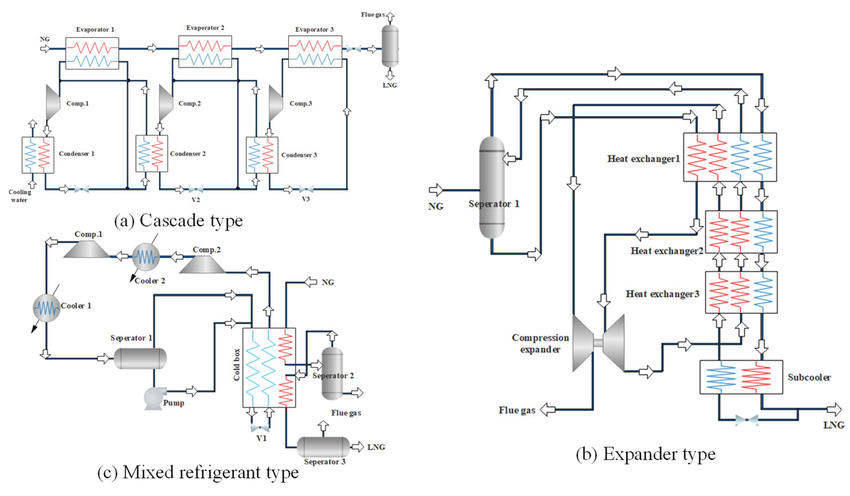
Schematic diagrams of three natural gas (NG) liquefaction processes. (a) Cascade type; (b) expander type; (c) mixed refrigerant type. source: Researchgate
Unified SMR Technologies – PRICO® (Black & Veatch) and IPSMR® (Chart Industries)
Cycle Type: Single Mixed Refrigerant (SMR)
Licensors: Black & Veatch, Chart Industries, Linde (SMR variants), Air Products (C3/SMR segment)
Two of the most prominent SMR‑based technologies globally—Black & Veatch PRICO® and Chart Industries IPSMR®—are increasingly central to mid‑scale FLNG because they combine compactness, simplicity, and modular construction.
Black & Veatch states that PRICO® “uses a single mixed refrigerant (SMR) loop — a blend of nitrogen and hydrocarbons — to liquefy natural gas.”
Chart’s IPSMR® is explicitly defined as Integrated Pre‑cooled Single Mixed Refrigerant, engineered for modular LNG plants and recent FLNG deployments.
Advantages of SMR Cycles
Compact and modular, ideal for FLNG topside constraints; PRICO® is already field‑proven on floating units.
Low equipment count, enabling faster deployment, simpler maintenance, and reduced operational complexity.
Strong scalability: IPSMR® supports >1–3 MTPA per train, with higher outputs possible using IPSMR®+.
Fast‑track project execution, demonstrated by the rapid deployment of the Altamira Fast LNG system.
Limitations of SMR
Lower thermodynamic efficiency than dual‑cycle processes (DMR, MFC), especially at larger scales.
Refrigerant sensitivity requires careful tuning of the MR blend under changing inlet conditions.
Less suited to mega‑scale LNG, where efficiency and train size outweigh modular advantages.
SMR remains the leading technology for mid‑scale FLNG, where compactness, footprint, and deployment speed outweigh absolute efficiency.
C3MR – Propane Pre‑cooled Mixed Refrigerant (Air Products/Honeywell)
Licensor: Air Products (now Honeywell LNG Technologies)
Cycle Type: C3 pre‑cool + Mixed Refrigerant (MR) liquefaction
The AP-C3MR™ cycle is the global standard for large onshore LNG production, consisting of propane precooling and a mixed‑refrigerant (MR) main cycle.
The propane system precools feed gas and MR streams before the MR completes liquefaction. This is evidenced by Air Products’ detailed technical description of the process.
Advantages
Industry workhorse, accounting for over 80% of LNG worldwide due to high reliability.
Supports very large single‑train capacities—5–7 MTPA per train.
Robust and efficient, with stable operation under correct MR tuning.
Disadvantages
Heavier system footprint due to the propane chilling loop, limiting FLNG deployment.
Propane system challenges in cold climates, including risk of condensation issues.
DMR – Dual Mixed Refrigerant (Shell, Air Products/Honeywell)
The Dual Mixed Refrigerant (DMR) architecture is a high‑efficiency, two‑cycle liquefaction system proven in both onshore and floating LNG.
Shell emphasizes that its plants have been “successfully running on Shell Dual Mixed Refrigerant Technology (DMR)” for over a decade, and specifically used DMR on Prelude FLNG.
Air Products’ AP‑DMR™ is similarly deployed for Coral South FLNG, achieving over 3.4 MTPA of LNG production.
Advantages
High efficiency, especially in cold or variable ambient conditions—ideal for regions like Sakhalin and offshore MI environments.
Large‑scale FLNG proven, with Coral South and Shell Prelude as key examples.
Dual-cycle flexibility improves controllability and load-sharing between loops.
Disadvantages
Higher complexity, including increased compressor count and MR blends.
Higher CAPEX and equipment weight, making it less competitive for mid‑scale FLNG.
MFC® – Mixed Fluid Cascade (Linde Engineering)
Linde’s Mixed Fluid Cascade (MFC®), famously deployed at Snøhvit LNG, is a three‑stage cascade cycle where each stage uses a mixed refrigerant.
It is documented that Snøhvit uses “three cascaded mixed refrigerant cycles”, enabling high efficiency and heat integration.
Advantages
Exceptional thermodynamic efficiency, surpassing design capacity at Snøhvit.
Best-in-class heat integration, enabling stable mega‑train operation.
Disadvantages
Extremely complex, with very high equipment count and weight.
Not viable for FLNG due to large footprint and heavy CWHE trains.
Nitrogen Expander Cycles (Linde LICOM®, Chart C100N)
These systems use a pure nitrogen refrigeration loop.
Linde’s LICOM® explicitly uses a “pure nitrogen refrigeration cycle” with integrally geared companders.
Chart’s C100N likewise utilizes a nitrogen cycle as noted in its small‑scale portfolio.
Advantages
No hydrocarbon refrigerants, simplifying permits and safety requirements.
Very low complexity, fewest equipment items of any major LNG cycle.
Disadvantages
Lowest efficiency among all LNG cycles.
Limited to small-scale LNG, unsuitable for FLNG or baseload production.
Current FLNG in operation and in construction
For FLNG developers, the strategic picture has never been clearer:
SMR‑based liquefaction technologies are decisively winning the global FLNG race, with 9 units in operation or construction—6 using Black & Veatch PRICO® (Cedar FLNG, Tango FLNG, Fuji FLNG, Golar Gimi FLNG, Hilli Episeyo FLNG, ZLNG Tiga) and 3 using Chart’s IPSMR® (Nguya FLNG, Amigo FLNG, Genting FLNG)
DMR is powering 3 units (Coral South FLNG, Coral North FLNG, PFLNG Dua),
Remaining 2 units employing other technologies (Shell MR on Prelude, dual‑nitrogen expander on PFLNG Satu).
Conclusion: Choosing the Right Cycle for FLNG
The market trend is therefore unmistakable:
SMR dominates mid‑scale FLNG (<2–3 MTPA) where compactness, modularity, lower equipment count, and replicability are decisive advantages. Availability of more powerful GTG will probably see the application of SMR also to bigger capacity FLNG soon.
DMR (Shell‑DMR and AP‑DMR) remains the benchmark for large‑scale FLNG (>3 MTPA) thanks to superior thermal efficiency and performance across wide ambient conditions, but its higher complexity and footprint limit its applicability.
C3MR continues to anchor large onshore LNG megaprojects, though its size makes it impractical offshore,
MFC is reserved for premium baseload onshore LNG.
Nitrogen expansion cycles maintain their niche in micro‑LNG and RNG systems.
As the industry shifts toward rapid‑deployment, modular, repeatable FLNG architectures, Chart’s IPSMR® and Black & Veatch PRICO® are positioned to dominate the next decade, while Air Products and Shell retain leadership in the high‑capacity baseload segment. The numbers tell the story: SMR is not just leading—it is the new standard.
APA Reference List
Honeywell. (2024, September 30). Honeywell completes acquisition of Air Products' liquefied natural gas process technology and equipment business. https://www.honeywell.com/us/en/press/2024/09/honeywell-completes-acquisition-of-air-products-liquefied-natural-gas-process-technology-and-equipment-business
Honeywell. (2026). Liquefaction Solutions – LNG (ESS). https://ess.honeywell.com/us/en/solutions/lng/liquefaction
Linde Engineering. (n.d.). LNG Technology (Technical document). https://assets.linde.com/-/media/global/engineering/engineering/home/products-and-services/process-plants/sustainable-hydrocarbon-solutions/biolng-plants/lng-technology.pdf
Chart Industries. (2026). Brazed Aluminum Heat Exchangers. https://www.chartindustries.com/Products/Brazed-Aluminum-Heat-Exchangers
Black & Veatch. (2026). PRICO®: Proven LNG liquefaction for onshore and floating modular solutions. https://www.bv.com/what-we-do/fuels/prico
Oil & Gas Process Engineering. (2018, June 20). PRICO (LNG) Process by Black & Veatch Pritchard Inc. https://www.oilngasprocess.com/gas/prico-lng-process-by-black-veatch-pritchard-inc.html
Offshore Engineer Magazine. (2024, November 5). Black & Veatch, Baker Hughes combine tech for optimized mid-scale LNG solution. https://www.oedigital.com/news/518834-black-veatch-baker-hughes-combine-tech-for-optimized-mid-scale-lng-solution
