
Rethinking Power Generation on FPSOs and FLNGs: The Case for Dual-Fuel Diesel Generators and Shore-Based Electrification
Power generation is a critical component of offshore production systems such as FPSOs (Floating Production Storage and Offloading units) and FLNGs (Floating Liquefied Natural Gas units). Traditionally, gas turbines (GTGs) have been the default choice due to their high power density and reliability. However, with the shift from converted tankers to newbuild barge-shaped hulls, and the growing pressure to reduce emissions, there is a strong case for rethinking power strategies—particularly through dual-fuel diesel generators and electrification from shore.
Design Evolution: From Constraint to Opportunity
Converted FPSOs, based on tanker hulls, have limited machinery space, often requiring topside GTG modules.
Newbuild FPSOs and FLNGs, particularly with barge-shaped hulls, offer significantly more space in the machinery room.
This allows for the installation of larger, modular diesel generator sets within the hull, simplifying topside layouts and improving maintainability.
To reduce CO₂ emissions, some FPSOs have adopted GTG + HRSG systems (e.g., Agogo FPSO), which improve efficiency by recovering waste heat. However, this comes at the cost of:
Increased system complexity
Higher inertia and slower load response
Greater space and maintenance requirements
These trade-offs highlight the need for simpler, more flexible solutions—such as dual-fuel generators—especially in newbuild designs.
Real-World Examples
✅ GTG-Only System
FPSO Cidade de Ilhabela (Brazil): Uses aeroderivative gas turbines for power generation, chosen for high power density and reliability.
✅ GTG + HRSG System
Agogo FPSO (Yinson, Angola): Uses a GTG + HRSG configuration to reduce CO₂ emissions by recovering waste heat to generate steam.
✅ Steam Turbine-Based System
Prelude FLNG (Shell): Uses three 40 MW steam turbine generators powered by process heat. While efficient, the system is complex and slow to respond, making it challenging during shutdowns and partial load operations.
⚠️ Dual-Fuel Diesel Generators
As of now, no FPSO or FLNG uses dual-fuel diesel generators as the main power source. However, the concept is gaining traction in design studies and OEM offerings, especially for newbuilds with barge-shaped hulls.
Efficiency and Emissions: A Comparative View
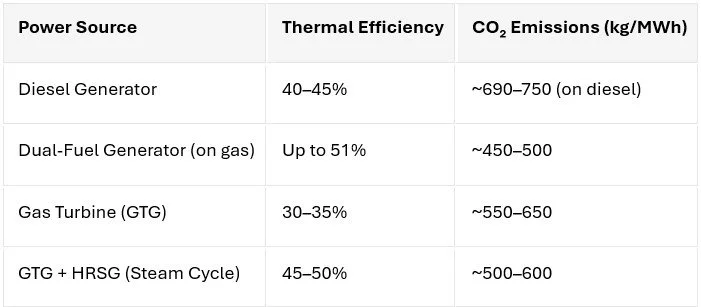
Dual-fuel generators, such as the Wärtsilä 46TS-DF, now achieve electrical efficiencies up to 50.7%, surpassing traditional GTGs and even some combined-cycle systems.
These engines also offer fast load response, low methane slip, and IMO Tier III compliance in gas mode—making them ideal for future-ready offshore applications.
GTG + HRSG systems improve efficiency but add complexity and inertia, making them less responsive and harder to manage during dynamic operations.
Case in Point: Wärtsilä 46TS-DF Dual-Fuel Engine
The Wärtsilä 46TS-DF is a state-of-the-art dual-fuel engine designed for high efficiency and operational flexibility:
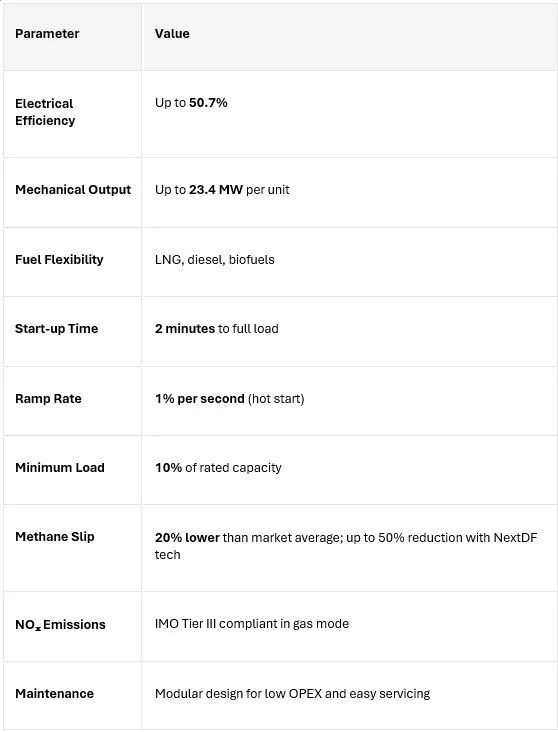
This engine exemplifies the next generation of offshore-compatible power systems, offering a compelling alternative to traditional GTGs—especially for newbuild FPSOs and FLNGs seeking to balance efficiency, emissions, and operational agility.
🔍 Understanding Methane Slip
Methane slip refers to the unburned methane (CH₄) that escapes into the atmosphere during combustion in gas or dual-fuel engines. It’s a critical factor in evaluating the true climate impact of natural gas-based power systems.
Methane is a potent greenhouse gas, with a global warming potential 28–36 times higher than CO₂ over 100 years.
Even small amounts of methane slip can offset the climate benefits of switching from diesel to natural gas.
⚙️ Methane Slip Comparison
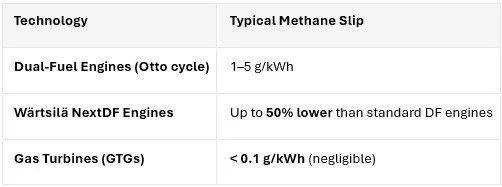
Gas turbines have very low methane slip due to their high combustion temperatures and continuous combustion process.
Dual-fuel engines, especially older designs, can have higher slip, but modern technologies like NextDF significantly reduce this.
This comparison highlights that while dual-fuel engines offer superior efficiency, methane slip must be carefully managed to ensure overall climate benefits—especially in emissions-sensitive offshore environments.
⚙️ Mitigation Strategies
Engine manufacturers like Wärtsilä and MAN Energy Solutions are actively reducing methane slip through:
Advanced combustion control
Optimized fuel injection timing
Aftertreatment systems (e.g., oxidation catalysts)
Next-generation engine designs (e.g., Wärtsilä’s NextDF tech claims up to 50% methane slip reduction)
Load Response and Operational Flexibility
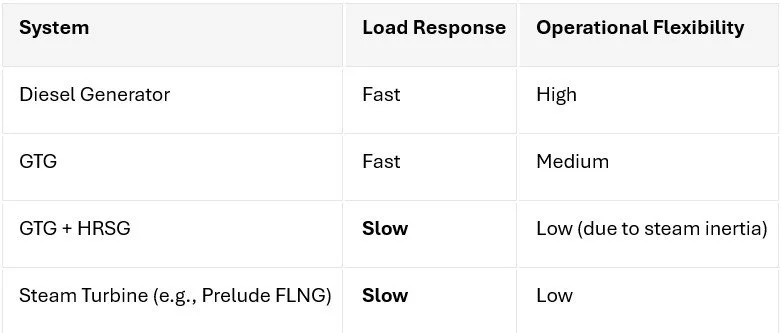
Diesel generators and GTGs respond quickly to load changes.
Steam-based systems, including GTG + HRSG and steam turbines, have high inertia, making them less responsive and harder to manage during shutdowns or partial loads.
Lead Time and Project Schedule Impact
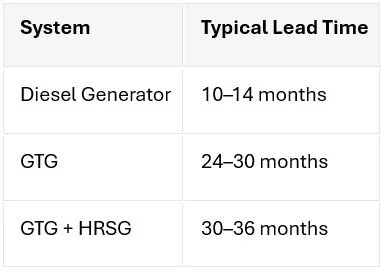
Diesel generators have shorter procurement timelines, improving project schedules and reducing supply chain risks.
GTGs and HRSG systems require longer engineering, fabrication, and integration periods.
Cost Implications
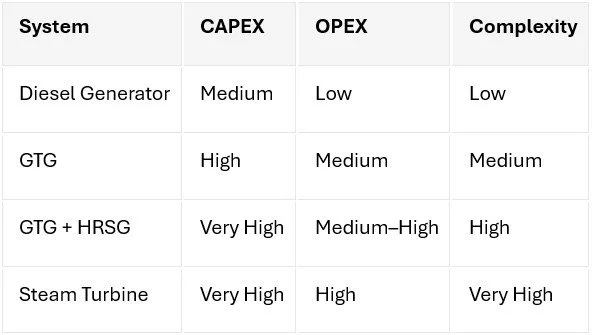
Diesel generators are modular and cost-effective, both in capital and operational terms.
GTG + HRSG and steam turbine systems require extensive auxiliary systems, increasing both CAPEX and maintenance burden.
Future Trends in Offshore Power Generation
⚡ Electrification from Shore (Power-from-Shore, PFS)
Goliat FPSO (Norway) was the first FPSO globally to be fully powered from shore via a subsea cable.
Johan Castberg FPSO is following this model, further validating the feasibility of PFS in harsh offshore environments.
Cedar LNG (Canada) will be the first FLNG powered entirely by renewable hydroelectricity, setting a new benchmark for low-carbon floating production.
Benefits:
Zero emissions at the point of use
Reduced noise and maintenance
Challenges:
High infrastructure cost
Limited to regions with strong onshore grid access
🌱 Alternative Fuels and Fuel Flexibility
Interest is growing in ammonia, hydrogen, and biofuels as low-carbon alternatives.
Dual-fuel engines are being developed to accommodate these fuels, though safety and storage remain key challenges.
⚙️ Modular and Standardized Power Packages
OEMs are offering modular generator systems that reduce engineering time and simplify integration into newbuilds.
🧠 Smart Power Management and Digitalization
Use of digital twins, predictive maintenance, and AI-based load optimization is improving reliability and reducing emissions.
♻️ Carbon Capture Integration
Future FPSOs may incorporate carbon capture and storage (CCS) systems directly into their power generation units.
Conclusion
The offshore industry’s push for lower emissions, higher efficiency, and faster project delivery is reshaping power generation strategies. While gas turbines and steam systems have been the standard, dual-fuel diesel generators offer a compelling alternative—especially for newbuild FPSOs and FLNGs—thanks to their higher efficiency, shorter lead times, and simpler integration.
However, the most transformative trend lies in electrification from shore and the integration of offshore renewable energy. Projects like Goliat FPSO, Johan Castberg, and Cedar LNG demonstrate that power-from-shore using green electricity can eliminate onboard emissions entirely, making it the most effective decarbonization strategy currently available.
Looking ahead, a hybrid approach—combining modular onboard generation, alternative fuels, and clean shore-based power—may offer the optimal balance between resilience, efficiency, and sustainability for the next generation of FPSOs and FLNGs.
Floaters Intelligentia
Reference List
Cedar LNG. (2023). Project overview. Retrieved from https://www.cedarlng.com
Eni. (2016, March). Eni starts production at Goliat field in the Barents Sea. Retrieved from https://www.eni.com/content/dam/enicom/documents/press-release/migrated/2016/03/PR_Eni_Goliat.pdf
Shell. (n.d.). Prelude FLNG. Retrieved from https://www.shell.com/about-us/major-projects/prelude-flng.html
Yinson Holdings. (2023). Agogo FPSO project overview. Retrieved from https://www.yinson.com
Wärtsilä. (2022). Energy efficiency and emissions performance of dual-fuel engines. Technical white paper. Retrieved from https://www.wartsila.com
ABS. (2022). Decarbonization of the Offshore Industry: Pathways to 2050. American Bureau of Shipping. Retrieved from https://www.eagle.org
Wärtsilä Corporation. (2025, April 30). Wärtsilä expands methane slip reduction capabilities by introducing NextDF technology for third engine. Wärtsilä. https://www.wartsila.com/media/news/30-04-2025-wartsila-expands-methane-slip-reduction-capabilities-by-introducing-nextdf-technology-for-third-engine-3580185
Wärtsilä Corporation. (n.d.). Wärtsilä 46TS-DF dual fuel engine. Wärtsilä. https://www.wartsila.com/energy/solutions/engine-power-plants/wartsila-46TS-DF-dual-fuel-engine
MAN Energy Solutions. (n.d.). Methane slip. https://www.man-es.com/marine/campaigns/methane-slip
