
LNG Containment Technologies in FLNG: Comparing GTT, SPB, and MOSS Tanks
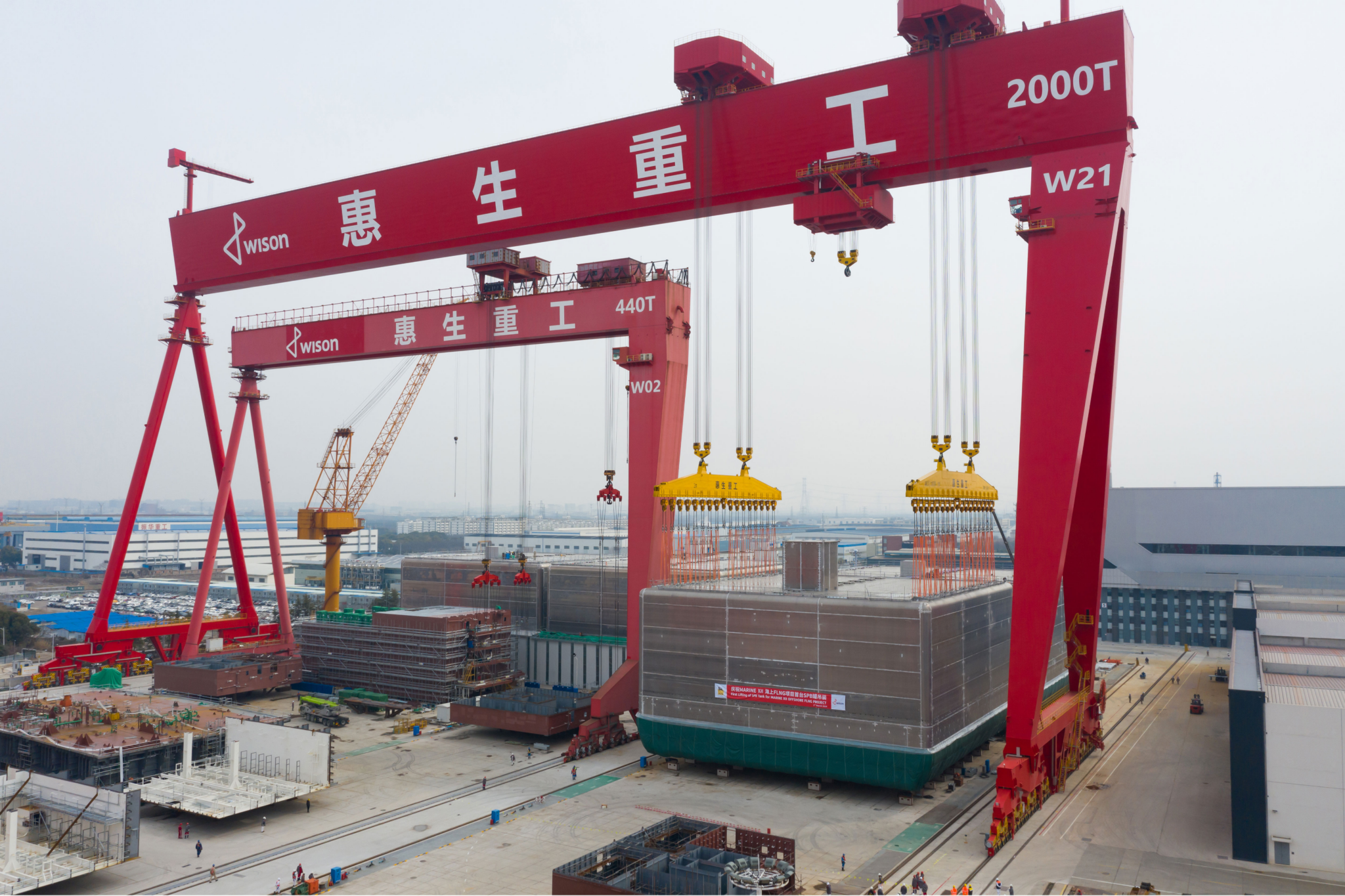
SPB tank, Source: Wison New Energies
As the global LNG market expands, Floating LNG (FLNG) units have become a vital solution for monetizing offshore gas reserves. Central to their design is the choice of LNG containment system. This article compares the three main technologies—GTT membrane, SPB prismatic, and MOSS spherical tanks—highlighting their differences, construction strategies, insulation design, and real-world applications in FLNG projects.
Executive Summary
GTT membrane remains the default for newbuild FLNG due to high volumetric efficiency, cost competitiveness, and superior schedule parallelization (hull completion + in‑hold panel installation). Membrane insulation panels are industrially prefabricated by licensed suppliers (primarily in South Korea/Asia), not in France, while GTT provides the engineering, licensing, and services.
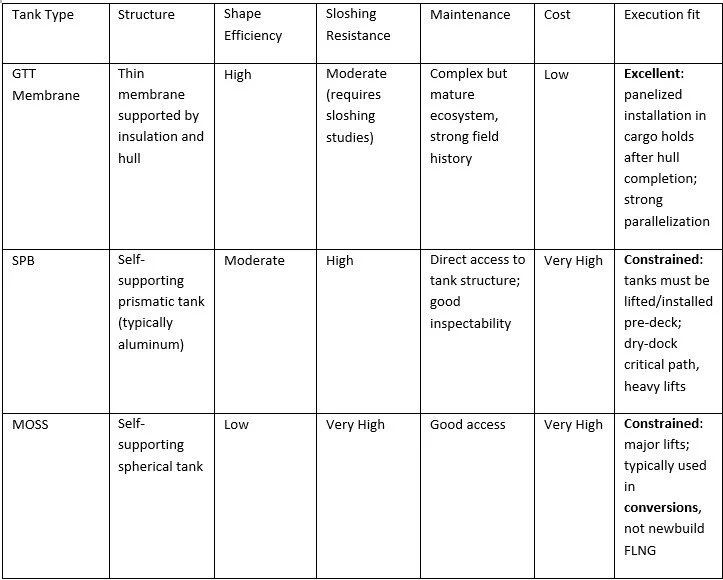
SPB (Self‑supporting Prismatic, IMO Type B) has re‑entered the market in FLNG through Wison’s Nguya FLNG for Eni. SPB’s robust sloshing tolerance and direct access for maintenance are attractive; however, the tank must be installed before main deck closure, putting it on dry‑dock critical path and demanding heavy-lift capability.
MOSS spheres are rare in newbuild FLNG but remain highly relevant for conversions (e.g., Gimi). They offer excellent sloshing resistance but the lowest shape efficiency, typically increasing hull size and cost.
Thermal management differs materially: membranes require cofferdam heating to protect the adjacent hull; SPB/MOSS are thermally isolated from the hull but require void-space management and piping expansion provisions for large thermal displacements at the tank top.
Mark III evolutions (Flex / Flex+) have improved BOR down to 0.07% V/day for large carriers—underlining ongoing performance gains that also benefit FLNG storage design choices.
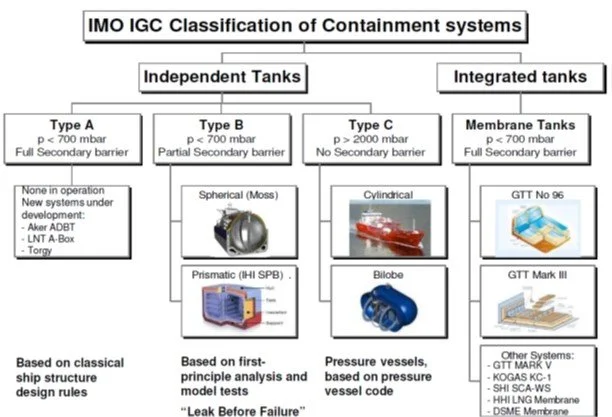
Construction, Integration, and Insulation Considerations
In this section, we analyze the key differences in construction and integration between GTT membrane and SPB prismatic tank technologies. These differences significantly influence project scheduling, yard strategy, and modularization potential.
We will focus on newbuild FLNG applications, where MOSS-type tanks are no relevant, as they have not been used in new construction for several decades. We do need to keep in mind that are still used for few cases of FLNG conversion from existing tankers only.
Construction & Integration Strategy
GTT Membrane (Mark III family)
Build strategy: The hull is erected as a conventional ship (tight dimensional control), then the prefabricated insulation panels and membranes are installed inside the cargo holds. This enables parallelization with topside integration, compressing schedule.
Supply chain: Prefabricated components come from licensed panel makers (mainly Korea/Asia); GTT provides design, qualification, and in‑service support.
Materials: Minimal exotic metal tonnage vs independent tanks, as the hull carries the loads; membranes accommodate thermal contraction via corrugations.
SPB
Build strategy: Tanks are fabricated as standalone modules, usually off‑hull, and installed before deck closure/launch—a predecessor to many hull and topside milestones. Execution requires high‑capacity dry‑dock cranes and careful management of post‑installation hot work near insulation.
Materials: Aluminum alloy tanks act as both primary barrier and load‑bearing structure—implying far higher specialty metal tonnage than membranes for the same LNG volume (two orders of magnitude more than GTT per storage of LNG)..
MOSS
Build strategy: Large spherical shells lifted into partially completed hulls; excellent sloshing behavior offsets low shape efficiency. Today, most new FLNG MOSS applications are conversions (e.g., Gimi).
Insulation & thermal management
GTT membrane:
Insulation is structural + thermal. Cofferdam heating protects adjacent hull from cryogenic embrittlement; ballast water often acts as a thermal well where applicable. Mark III Flex/Flex+ increase insulation thickness, lowering BOR to 0.10–0.085% and 0.07% V/day respectively (170k m³ carrier reference), illustrating performance headroom applicable to FLNG storage options.
SPB/MOSS tanks:
Insulation is non‑load‑bearing, primarily external to the tank (SPB). Tanks are thermally isolated from the hull—no cofferdam heating—but voids require inerting. Expect >100 mm equivalent thermal movement at the tank top in large SPB tanks, driving expansion loops and supports on deck lines
Sloshing & Operational Envelope
GTT:
Requires project‑specific sloshing analysis (fill limits, reinforcements, anti‑sloshing features) tied to site motions; continuous design evolution through Mark III Flex/Flex+ has strengthened performance margins.
SPB/MOSS:
Higher inherent sloshing tolerance due to geometry and internal structure (SPB swash bulkheads; MOSS spheres). This makes them attractive for harsh motions/partial fills, albeit with volumetric penalties (MOSS) or execution constraints (SPB).
Industrial Adoption & Yard Experience
GTT Membrane dominance: Korean and Chinese yards have deep experience with GTT Mark III and NO96 systems across LNG carriers and FLNG (Prelude, Coral Sul, PFLNGs).
SPB heritage & revival: Developed by IHI (Japan); proven on early SPB LNGCs (Polar Eagle/Arctic Sun), with modern SPB licenses held by JMU. Eni’s Nguya FLNG brings SPB into newbuild FLNG execution.
MOSS today: Primarily conversion candidates (e.g., Gimi for GTA) rather than newbuild FLNG.
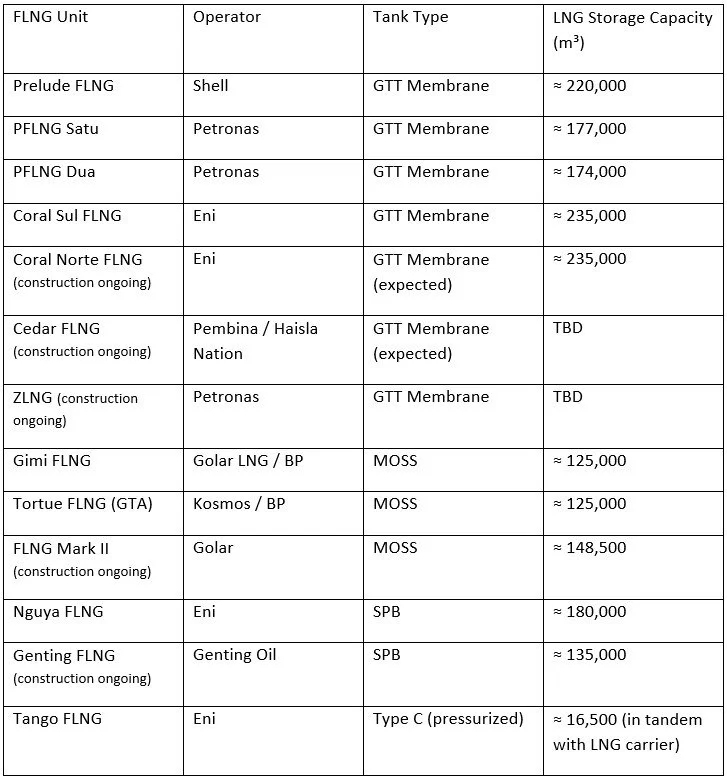
FLNG Units and Their LNG Tank Technologies
Note: Capacities listed below refer to LNG storage only.
🧭 Decision Criteria for Selecting LNG Tank Technologies in FLNG Projects
Choosing the optimal LNG containment system for an FLNG unit involves balancing technical, economic, and operational priorities. The following criteria can help guide the selection process between GTT membrane, SPB prismatic, and MOSS spherical tanks:
Schedule & Parallelization
Need fast‑track delivery with parallel topside integration? → GTT membrane allows in‑hold panel installation after hull completion; best for parallel execution.
Tolerance for sequential dry‑dock critical path and heavy lifts? → SPB or MOSS feasible, but increases execution risk and yard constraints.
Yard Capability & Licensing
Membrane: widespread know‑how in Korea/China; mature QA/QC and service ecosystem.
SPB: fewer yards; specialized aluminum fabrication and pre‑deck installation required.
Storage Efficiency vs Motions
Need maximum storage per hull envelope? → GTT membrane.
Expect harsh motions/partial fills where inherent sloshing robustness is critical? → SPB/MOSS.
Thermal & Piping
Accept cofferdam heating (power, maintenance) with minimal exotic materials? → GTT.
Prefer hull thermal isolation but willing to engineer large expansion allowances at deck? → SPB/MOSS.
Cost & Lifecycle
CAPEX sensitivity and proven supply chain → GTT.
O&M access priority and sloshing tolerance → SPB/MOSS, acknowledging CAPEX/weight penalties.
Project Timeline and Execution Strategy
Fast-track or modular execution?
→ GTT tanks are ideal due to their offsite fabrication and parallelization with topside integration.
→ SPB tanks are needs to be installed during dry-dock period, potentially extending the schedule.
Nguya FLNG: A New Milestone for SPB Technology in FLNG
The Nguya FLNG, currently under construction by Wison New Energies for Eni, represents a major step forward in the application of SPB tank technology in the FLNG sector.
🔹 Key Highlights:
Operator: Eni
Builder: Wison New Energies (China)
Liquefaction Capacity: 2.4 million tonnes per annum (mtpa)
Tank Type: SPB (Self-supporting Prismatic Type B)
LNG Storage: Estimated ~170,000–180,000 m³
Project Role: Part of Congo LNG Phase 2, complementing Tango FLNG
Launch Milestone: Hull launched in November 2024
Design Features:
Modular construction
Zero-flaring and reduced carbon footprint
Fast-track execution: <3 years from contract to startup
SPB tanks fabricated independently and integrated as a package
🔹 Strategic Significance:
Nguya FLNG is the first FLNG unit to use SPB tanks in a modular, fast-track execution model. It showcases the flexibility of SPB technology, particularly its ability to be fabricated offsite and installed as a complete module, offering schedule and yard optimization advantages.
Here below you can find two interesting videos of how these tanks were fabricated and erected:
https://www.youtube.com/watch?v=HYh0qHFGVgI
https://www.youtube.com/watch?v=5wxXvOTNvGY
Conclusion
The choice of LNG containment system in FLNG projects is a balance between space efficiency, construction strategy, thermal management, and operational resilience:
GTT membrane tanks dominate modern FLNGs due to their high capacity and cost efficiency, parallelization with topside integration, despite requiring cofferdam heating.
SPB tanks offer robust sloshing resistance, but can be a limit to project execution fast tracking due to sequential works with main deck erection and topside erection (tank lifting into hull, main deck lifting). Limited number of shipyard that can do the fabrication and installation.
MOSS tanks, while structurally resilient, are now mostly found in converted units due to their low shape efficiency and high cost.
Bottom line
For newbuild FLNG, GTT membrane is typically the lowest‑risk, fastest‑to‑market choice thanks to panelized installation and mature yard ecosystems. Ongoing Mark III evolutions (Flex/Flex+) continue to reduce BOR and strengthen performance margins.
SPB offers high sloshing resistance and excellent maintainability and is now field‑proven in FLNG (Nguya). The trade‑off is higher CAPEX/weight and a sequential installation that can elongate the critical path unless mitigated by early planning and crane capacity.
MOSS remains a strong conversion option (e.g., Gimi, and Golar’s Mk II conversion pipeline), but its low shape efficiency discourages newbuild FLNG applications unless driven by specific project constraints.
APA Reference:
GTT / Mark III & Membrane Technology
GTT. (n.d.). Mark III systems. Retrieved from https://www.gtt.fr/technologies/markiii-systems [ihiap.com]
Prelude FLNG
GTT. (2017, October 23). GTT announces a contract award for membrane cargo containment system services for Shell’s Prelude FLNG facility. Retrieved from https://www.gtt.fr/news/gtt-announces-contract-award-membrane-cargo-containment-system-services-shells-prelude-flng [lngindustry.com]
Shell. (n.d.). Floating LNG. Retrieved from https://www.shell.com/what-we-do/oil-and-natural-gas/liquefied-natural-gas-lng/floating-lng.html [kongsberg.com]
Shell Australia. (n.d.). Prelude FLNG factsheet. Retrieved from https://www.shell.com.au/content/dam/shell/assets/en/australia/documents/shell-prelude-factsheet.pdf [petronas.com]
Coral Sul FLNG
GTT. (2024, October 21). GTT signs a service contract for Eni’s Coral Sul FLNG in Mozambique. Retrieved from https://gtt.fr/sites/default/files/CP_FLNG%20Coral%20Sul_EN.pdf [eureka.patsnap.com]
LNG Industry. (2024, October 22). GTT signs service contract for Coral Sul FLNG. Retrieved from https://www.lngindustry.com/floating-lng/22102024/gtt-signs-service-contract-for-coral-sul-flng/ [stg-gtt.com]
Energy Capital Power. (2024, October 23). GTT wins FLNG services contract offshore Mozambique. Retrieved from https://energycapitalpower.com/gtt-wins-flng-services-contract-offshore-mozambique/ [Insulation...Insulation]
PFLNG SATU
Riviera Maritime Media. (2019, May 22). FLNG technology speeds LNG production in Malaysia field. Retrieved from https://www.rivieramm.com/news-content-hub/news-content-hub/flng-technology-speeds-lng-production-in-malaysia-field-54609 [rivieramm.com]
Petronas. (2021, October 5). PETRONAS Floating LNG SATU delivers milestone 50th LNG cargo. Retrieved from https://www.petronas.com/media/media-releases/petronas-floating-lng-satu-delivers-milestone-50th-lng-cargo [marinepulse.com]
PFLNG DUA
Riviera Maritime Media. (2019, December 20). Malaysia adds second FLNG to monetise stranded gas from deepwater. Retrieved from https://www.rivieramm.com/news-content-hub/news-content-hub/malaysia-adds-second-flng-to-monetise-stranded-gas-from-deepwater-57287 [ihi.co.jp]
Petronas. (2021, March 25). PETRONAS becomes world’s first to produce LNG from two floating facilities. Retrieved from https://www.petronas.com/media/media-releases/petronas-becomes-worlds-first-produce-lng-two-floating-facilities [lntmarine.com]
SPB Technology / IHI
Ishikawajima‑Harima Heavy Industries (IHI). (n.d.). SPB Technology. Retrieved from https://www.ihi.co.jp/offshore/spbmenu_e.htm [oilcor.com]
Japan Marine United (JMU). (n.d.). Intrinsically safe cryogenic cargo containment system of IHI‑SPB LNG tank. Retrieved from https://www.ihi.co.jp/en/technology/techinfo/contents_no/__icsFiles/afieldfile/2023/06/17/9840ca942c5306f428ff05e26c57b4b0.pdf [wartsila.com]
SPB / Nguya FLNG
Eni. (2024, November 23). Eni launches the hull of Nguya FLNG, confirming the schedule of Congo LNG’s Phase 2 startup. Retrieved from https://www.eni.com/en-IT/media/news/2024/11/eni-launches-the-hull-nguya-flng-of-congo.html [investors....energy.com]
Upstream Online. (2024, November 24). Wison delivers Eni’s Congo FLNG, first gas on track for 2025. Retrieved from https://www.upstreamonline.com/rigs-and-vessels/wison-delivers-eni-s-congo-flng-first-gas-on-track-for-2025/2-1-1743619 [seatrium.com]
Offshore Energy. (2025, August 26). New unit ready to complete FLNG pair at Eni’s Congolese project. Retrieved from https://www.offshore-energy.biz/new-unit-ready-to-complete-flng-pair-at-enis-congolese-project/ [shell.com]
MOSS / FLNG Gimi
LNG Industry. (2023, November 20). Seatrium delivers second floating liquefaction vessel conversion for Golar LNG. Retrieved from https://www.lngindustry.com/liquefaction/20112023/seatrium-delivers-second-floating-liquefaction-vessel-conversion-for-golar-lng/ [offshore-energy.biz]
Offshore Technology. (2025, June 24). FLNG Gimi starts commercial operations at Greater Tortue Ahmeyim project. Retrieved from https://www.offshore-technology.com/news/greater-tortue-ahmeyim-flng-operations/ [theenergyyear.com]
Golar MK II (MOSS‑based conversion)
LNG Industry. (2024, September 24). Golar LNG reaches FID on MK II FLNG. Retrieved from https://www.lngindustry.com/floating-lng/24092024/golar-lng-reaches-fid-on-mk-ii-flng/ [cleanshipp...tional.com]
The Energy Year. (2024, September 18). Golar reaches FID on $2.2‑billion FLNG conversion. Retrieved from https://theenergyyear.com/news/golar-reaches-fid-on-2-2-billion-flng-conversion/ [ports.marinelink.com]
GTT Panel Fabrication / Kangrim
Kangrim. (n.d.). LNG cargo tank insulation (GTT Mark III panel). Retrieved from https://www.komachine.com/en/companies/kangrim/products/119167-lng-cargo-tank-insulation-gtt-lng-mark-panel-plant-offshore-division [wison.com]
Kangrim. (n.d.). Insulation solutions. Retrieved from http://kangrim.com/sub/insulation01.php [energynews.africa]
Genting FLNG (Kasuri, Indonesia)
LNG Prime. (2024, June 20). China’s Wison wins Indonesian FLNG gig from Genting. Retrieved from https://lngprime.com/asia/chinas-wison-wins-indonesian-flng-gig-from-genting/115155/ [lngindustry.com]
Upstream Online. (2026, January 5). Hull completed for Indonesian FLNG project. Retrieved from https://www.upstreamonline.com/rigs-and-vessels/hull-completed-for-indonesian-flng-project/2-1-1922821
