
Mooring System Evolution in FPSO and FLNG Units (2015–2025)
Over the past decade, the offshore industry has seen a clear divergence in mooring strategies between Floating Production Storage and Offloading units (FPSOs) and Floating Liquefied Natural Gas units (FLNGs). This article explores the transition of FPSOs toward spread mooring systems and the continued reliance of FLNGs on turret and yoke-based mooring. The analysis highlights how operational requirements—particularly offloading configurations—drive these choices, with a focus on heading control, cryogenic transfer constraints, and mooring system types.
Mooring systems are critical to the safe and efficient operation of floating production units. They ensure station-keeping, enable offloading, and influence the overall design and cost of the facility. While FPSOs and FLNGs share similarities in hull design, their mooring philosophies have diverged significantly due to differences in offloading methods and operational sensitivities.
FPSO Mooring Trends: The Rise of Spread Mooring
In the last decade, spread mooring has become the dominant configuration for FPSOs, particularly in benign to moderate sea conditions such as offshore Brazil, West Africa, and Southeast Asia. This shift is driven by:
- Lower cost and design simplicity compared to turret systems.
- No need for heading control during offloading, as the shuttle tanker is not moored to the FPSO.
- Operational flexibility, especially for large topside modules and heavy hulls.
Turret mooring systems, once common, are now primarily used in harsh environments (e.g., North Sea, Barents Sea) where weathervaning is essential for survivability.
FLNG Mooring Trends: Turret and Yoke Systems Dominate
FLNG units, in contrast, continue to rely on turret and yoke-based mooring systems due to the operational sensitivity of cryogenic LNG transfer. LNG is offloaded via cryogenic loading arms in a side-by-side configuration with LNG carriers. These arms:
- Allow limited movement, but require low relative motion to remain within safe operating envelopes.
- Demand precise heading control to minimize pitch, roll, and yaw during transfer.
As a result, FLNGs are typically moored using:
- Internal or external turrets for weathervaning,
- Soft yoke systems for semi-rigid heading control.
Offloading Operations and Heading Control
FPSO Offloading
- Uses floating or submerged flexible hoses.
- The shuttle tanker is not moored to the FPSO and can freely align with wind and waves.
- No heading control is required for the FPSO during offloading.
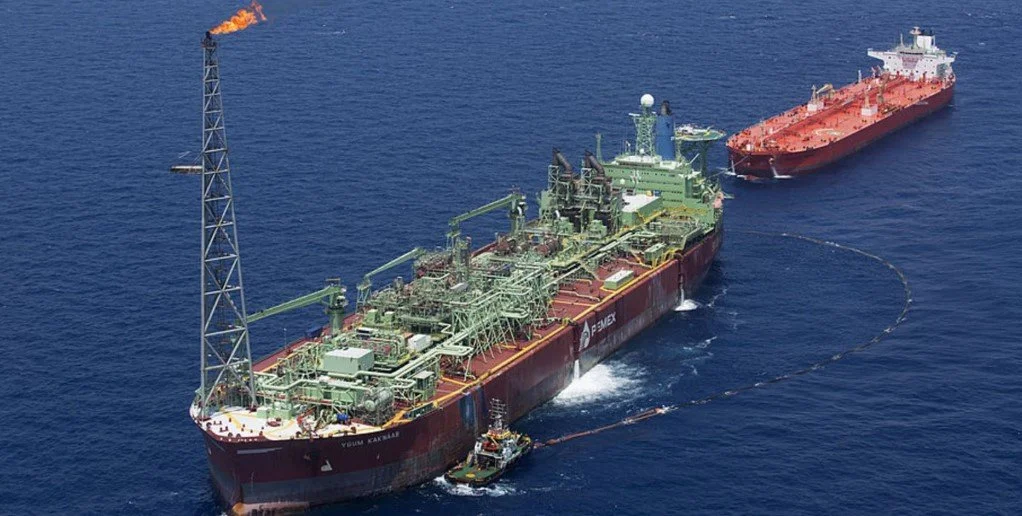
FPSO during offloading
FLNG Offloading
- Uses cryogenic loading arms with limited flexibility.
- Requires side-by-side mooring with the LNG carrier.
- Demands heading control to maintain alignment with the sea state.
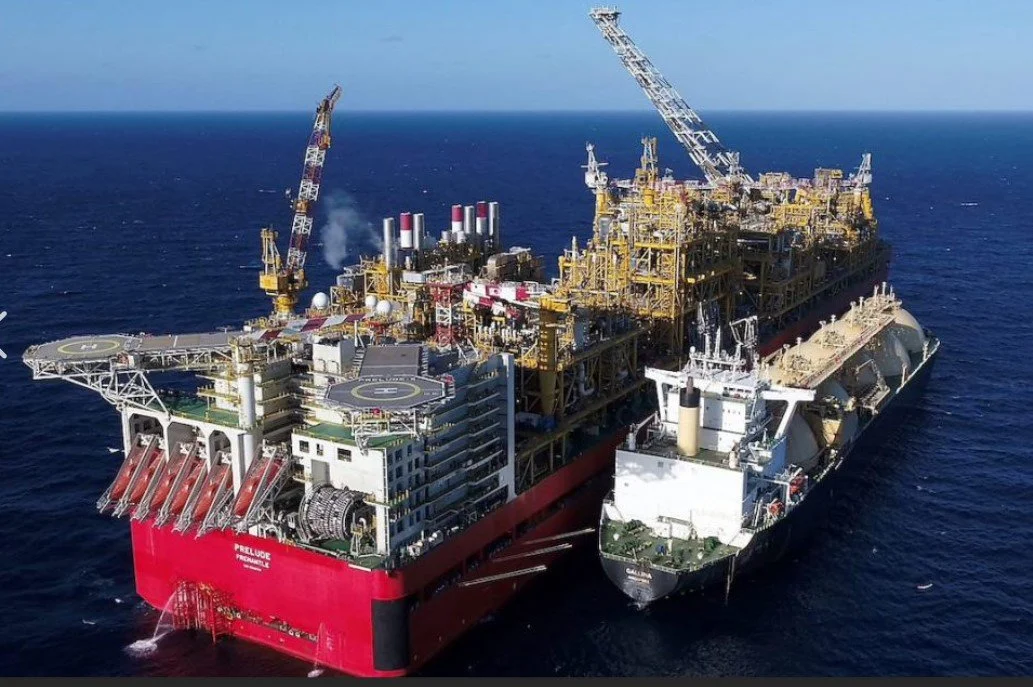
Prelude FLNG during offloading
What is Heading Control?
Heading control refers to the ability of a floating unit to maintain a specific orientation relative to environmental forces. It can be achieved through:
- Free weathervaning (via turret mooring).
- Semi-rigid yoke systems.
- Thrusters or dynamic positioning (DP).
- Tug assistance during offloading.
Types of Turret and Yoke Mooring Systems
Internal Turret Mooring
- Located inside the hull.
- Allows full weathervaning.
- Uses a dry swivel.
- Example: Johan Castberg FPSO, Prelude FLNG, Coral Sul FLNG.
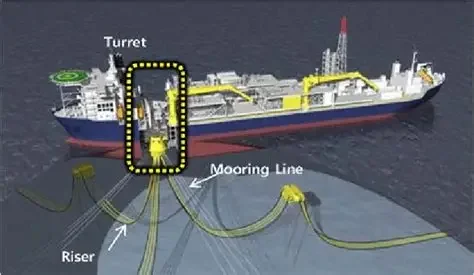
Internal turret section view
External Turret Mooring
- Mounted outside the hull.
- Easier to retrofit; can be disconnectable.
- Uses a dry swivel.
- Example: PFLNG SATU, PFLNG DUA (Petronas).
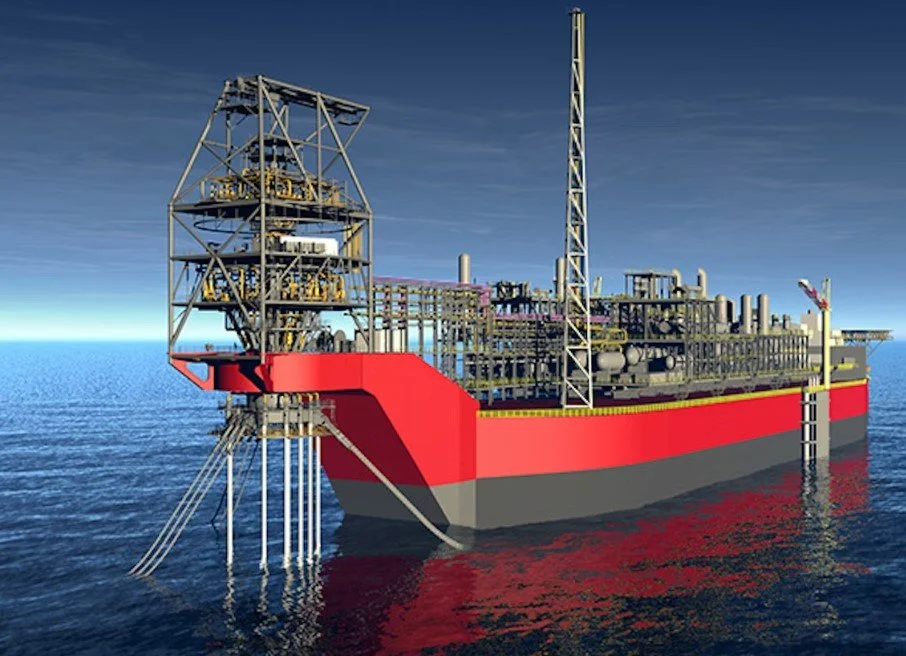
External turret, source: Sofec
Soft Yoke Mooring System (SYMS)
- Semi-rigid arm connected to a fixed base.
- Allows limited motion; maintains heading.
- Uses a dry swivel.
- Typically used for FPSOs, not FLNGs.
- Example: MV34 FPSO (Mexico).
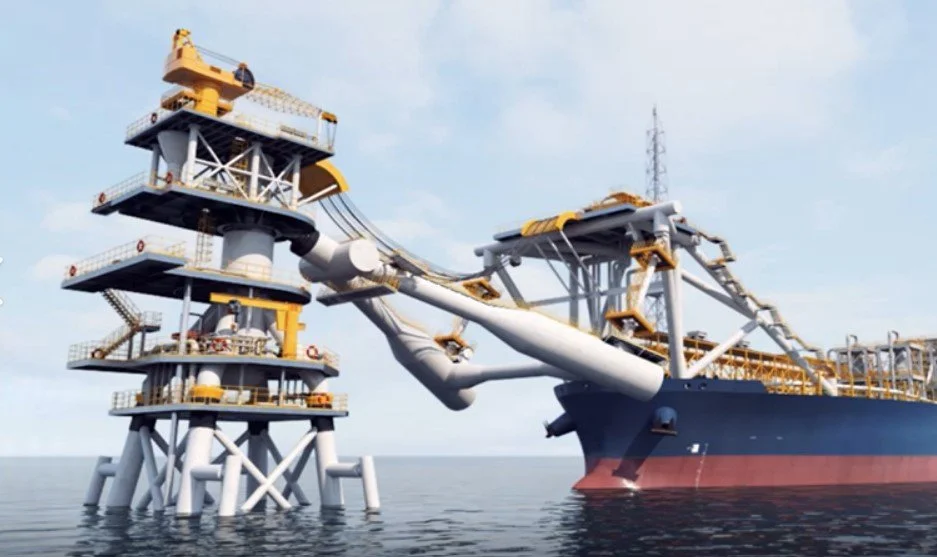
Soft yoke
Submersible Soft Yoke Mooring System (SSYMS)
- Lighter foundation; suitable for shallow waters.
- Uses a subsea swivel (not dry).
- Not disconnectable and cannot accommodate a wellhead.
- Applicable to both FPSOs and FLNGs in mild environments.
- Example: Nguya FLNG, Golar Hilli.
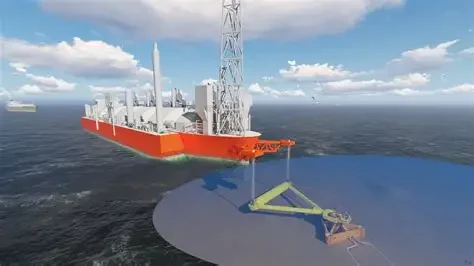
Submersible Soft Yoke Mooring System, source: NOV
Conclusion
From 2015 to 2025, the offshore industry has seen a clear divergence in mooring strategies:
- FPSOs have transitioned toward spread mooring, driven by cost, simplicity, and flexible offloading.
- FLNGs continue to rely on turret and yoke systems to meet the stringent requirements of cryogenic LNG transfer.
Understanding these trends is essential for future project planning, especially as offshore developments move into deeper waters and more complex environments.
Floaters Intelligentia
