
The proposed privatization of Yinson Holdings by a consortium comprising MISC, Yinson Legacy and the Employees Provident Fund (EPF) may become one of the most significant transactions the floating production industry has witnessed in recent years.
While the market has understandably focused on the RM7.31 billion (USD 1.8 billion) offer to take Yinson private, the strategic implications extend far beyond a delisting. The transaction potentially creates a new Asian floating energy champion with the scale, financial strength and technical capability to compete across FPSOs, FSOs, LNG shipping and potentially Floating LNG (FLNG).
At a time when offshore developments are becoming more capital intensive and increasingly dependent on creative financing structures, scale matters. This transaction could elevate the combined organization into the top tier of global floating production companies.
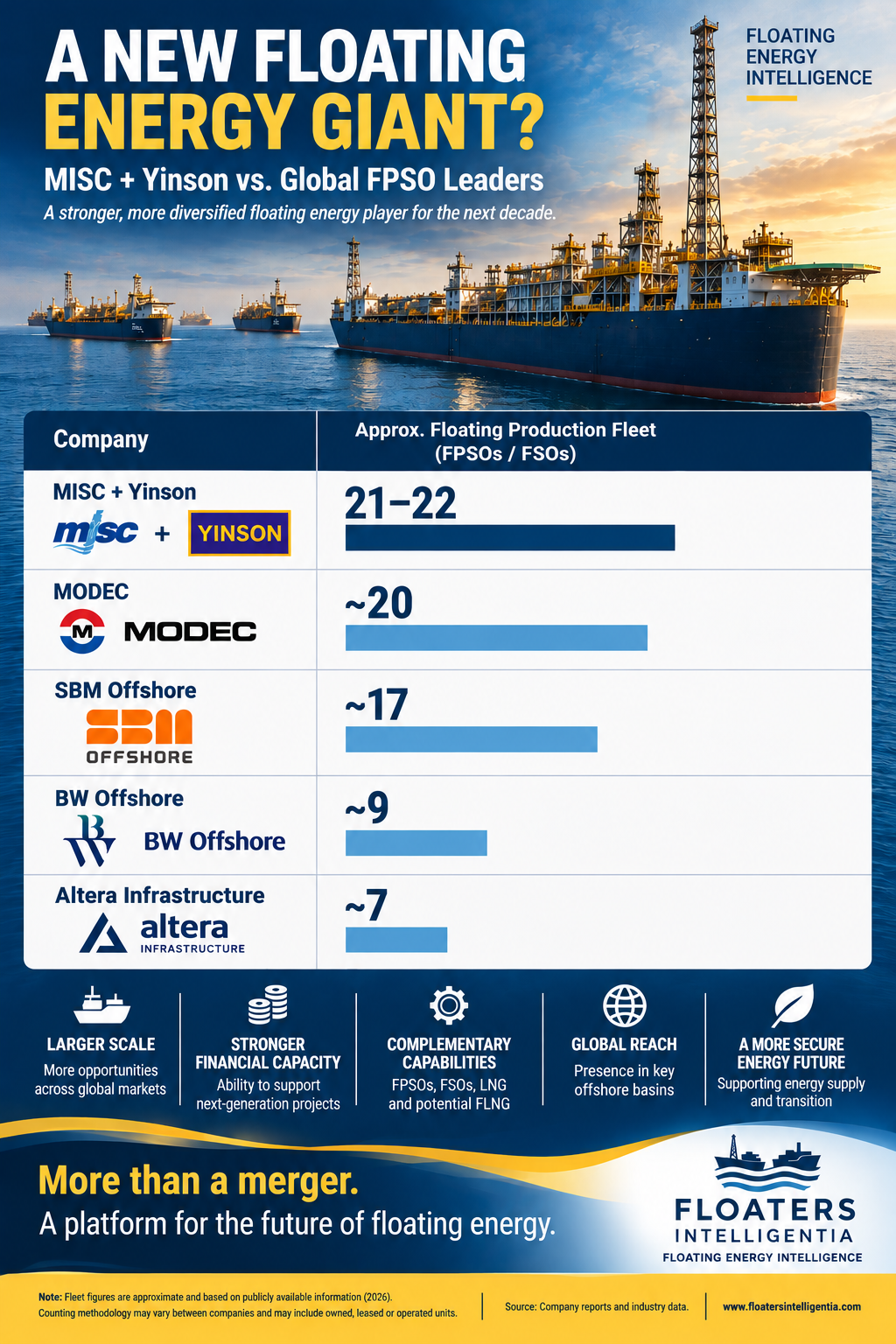
A Combination Built on Complementary Strengths
Yinson has established itself as one of the fastest-growing independent FPSO owners and operators globally, with assets deployed across Brazil, Angola, Ghana, Nigeria, Vietnam and Malaysia.
MISC, meanwhile, brings a very different but highly complementary set of capabilities. Through its offshore and maritime businesses, the company combines offshore production experience, LNG shipping expertise, strong financial resources and longstanding ties to Petronas.
Unlike many industry consolidations that seek cost synergies between similar businesses, this transaction combines two organizations that strengthen different parts of the floating energy value chain.
Yinson and MISC by the Numbers
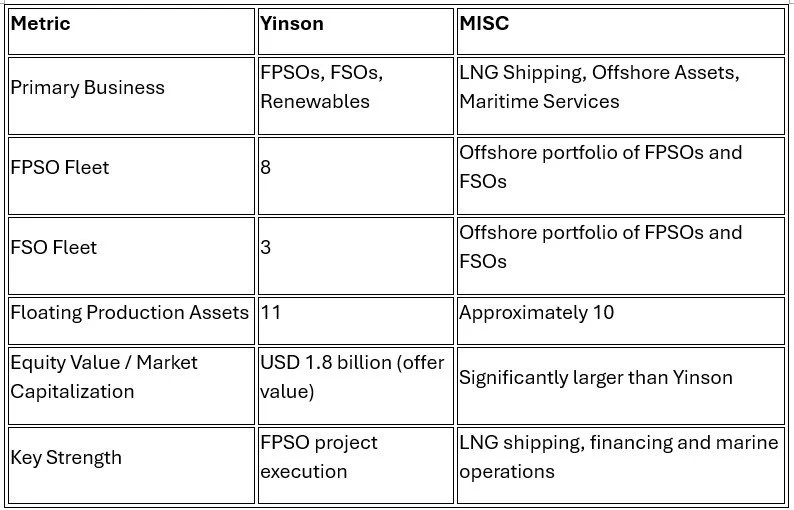
One of the World's Largest Floating Production Fleets
Together, MISC and Yinson could control more than twenty floating production and storage assets, immediately positioning the group among the largest floating production operators globally.
A comparison with industry leaders highlights the significance of the combination:
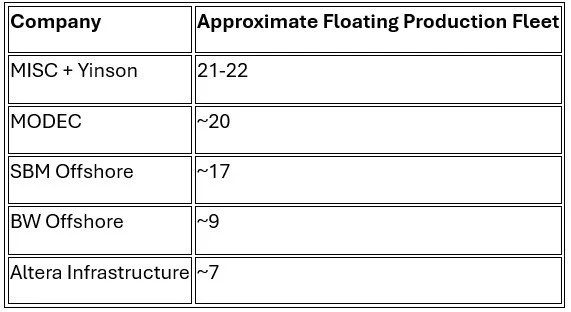
Fleet counting methodologies differ between companies and may vary depending on whether owned, leased or operated units are included. Nevertheless, the trend is clear: the proposed MISC-Yinson combination would rival or exceed the scale of some of the industry's most established players.
This matters because scale increasingly translates into competitive advantages in:
Project financing
Procurement leverage
Access to engineering resources
Operational benchmarking
Digitalization initiatives
Access to future project opportunities
The deal is therefore not simply creating a larger company. It is creating a platform capable of competing for the next generation of offshore developments.
Why Going Private Matters
FPSOs are among the most capital-intensive assets in the energy industry.
New developments frequently require investments measured in billions of dollars, with payback periods extending over decades. Public markets do not always reward these long investment cycles.
For Yinson, operating as a private company could provide greater flexibility to pursue strategic opportunities, optimize financing structures and take long-term decisions without the constraints of quarterly market expectations.
At the same time, MISC gains exposure to one of the fastest-growing FPSO platforms in the market and an established portfolio of offshore production assets.
The Real Story May Be FLNG
While the transaction has been presented primarily as an FPSO story, the longer-term opportunity may lie elsewhere.
It may lie in Floating LNG.
The FLNG sector is entering a new growth phase driven by emerging opportunities in:
Argentina
Canada
Mozambique
West Africa
Southeast Asia
Selected stranded gas developments worldwide
These projects increasingly require a combination of capabilities that few organizations possess simultaneously:
Offshore production expertise
Asset ownership capability
LNG transportation know-how
Project financing strength
Long-term asset operation experience
The combined MISC-Yinson platform has the potential to offer all five.
A Future FLNG Division?
Industry observers have noticed increasing interest across the offshore sector in floating gas monetization solutions.
As more gas discoveries prove too small to justify large onshore LNG plants, FLNG becomes increasingly attractive as a flexible development option.
If the combined organization chooses to establish a dedicated FLNG business or division, it would enter the market with several advantages:
Proven offshore asset ownership experience
FPSO project development expertise
Access to LNG shipping know-how
Strong banking relationships
Established relationships with national oil companies and major operators
This combination could position the group as a future competitor to existing FLNG leaders such as Golar LNG, Technip Energies, Black & Veatch, KBR and other established floating gas solution providers.
Unlike many engineering contractors, MISC and Yinson would also bring the perspective of long-term infrastructure owners and operators.
The Emergence of a New Asian Floating Energy Champion
For decades, the floating production market has been dominated by a relatively small group of Western and Japanese players.
The proposed MISC-Yinson combination may signal the rise of a new generation of Asian floating energy champions.
On a fleet basis, the merged organization would rival MODEC and exceed SBM Offshore in terms of floating production assets. More importantly, it would combine FPSO expertise with LNG shipping capabilities under a single corporate umbrella, creating a uniquely positioned floating infrastructure platform.
For FPSOs, the transaction creates one of the industry's largest asset owners.
For LNG shipping, it strengthens an already significant market participant.
For FLNG, it may represent the first step toward creating a new competitor just as a new wave of floating liquefaction projects begins to emerge across the globe.
The ultimate significance of this deal may therefore not be the privatization of Yinson itself.
It may be the birth of a future integrated floating energy major.
References
Yinson Holdings, Bursa Malaysia filing regarding the privatization proposal submitted by MY Offshore Holdings, November 2026.
"MISC and major shareholders offer to take Yinson private for $1.8bn", Baird Maritime, November 2026.
"MISC-led consortium proposes to privatise Yinson for RM2.50 per share", The Star, November 2026.
"Yinson privatisation bid rises 6.4%", Oil & Gas Middle East, November 2026.
Company annual reports and investor presentations of Yinson Holdings, MISC Berhad, SBM Offshore, and MODEC for fleet benchmarking and industry comparison.
