
For more than a decade, the global FLNG industry was dominated by a relatively small number of pioneering projects. Developments such as Prelude FLNG in Australia, Coral Sul FLNG in Mozambique, Hilli Episeyo in Cameroon, and more recently Congo LNG demonstrated that floating liquefaction has evolved from an engineering experiment into a commercially viable solution for stranded offshore gas resources.
As the global LNG market continues to expand and energy security remains a strategic concern for many importing nations, a new generation of FLNG projects is beginning to emerge.
While traditional LNG exporting regions such as Qatar, the United States and Australia continue to dominate supply growth through large onshore facilities, several countries are increasingly considering FLNG as a faster and more flexible route to monetize offshore gas reserves.
Among the most interesting regions currently attracting industry attention are Argentina, Venezuela, Canada, Mozambique and the broader Central African gas corridor, where both Eni and Perenco are actively pursuing floating LNG developments.
This article reviews the most significant recent developments shaping the next chapter of the FLNG industry.
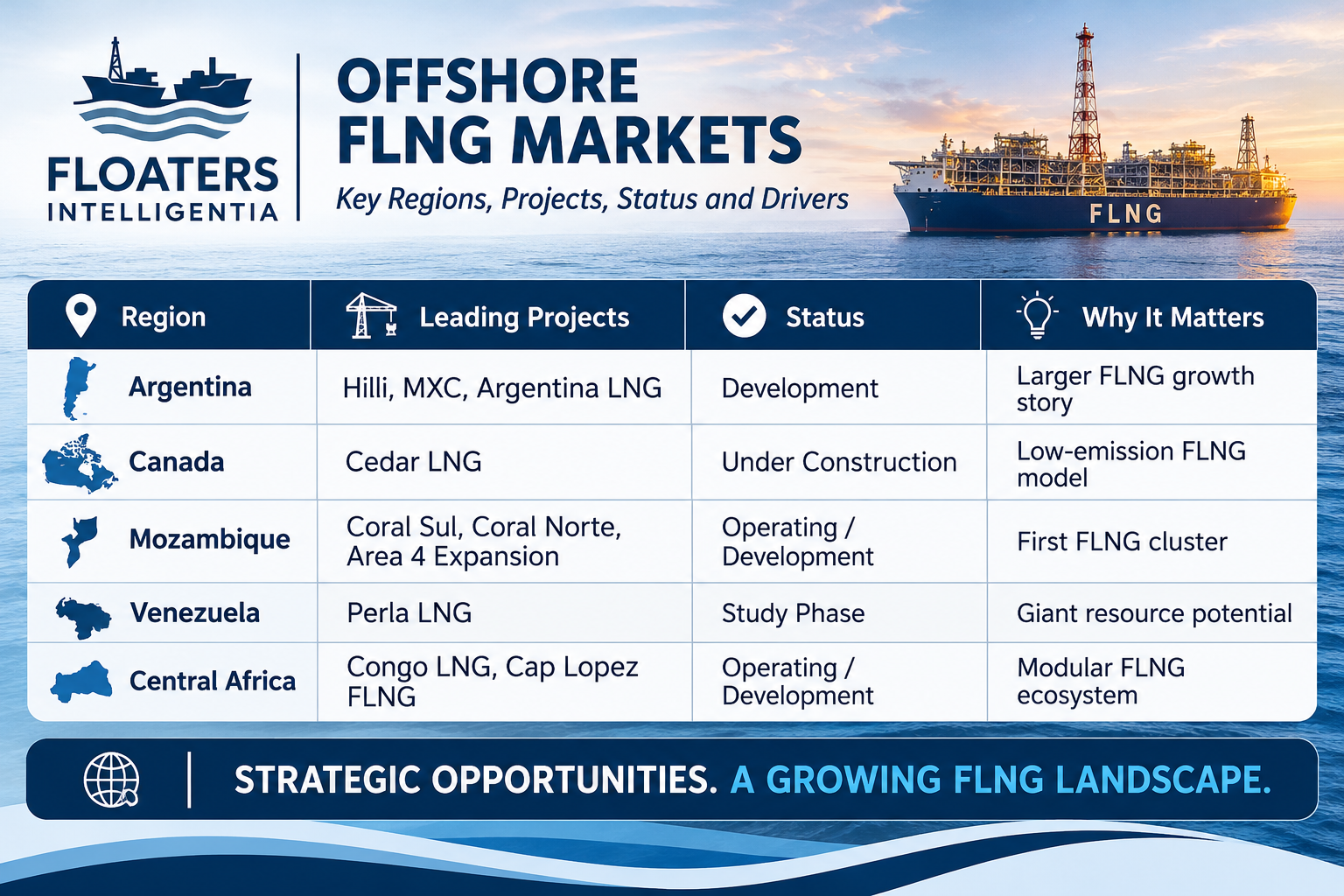
Argentina: The World's Largest Emerging FLNG Hub?
If there is one country attracting extraordinary attention from the LNG industry today, it is undoubtedly Argentina.
What makes Argentina unique is that it is pursuing multiple FLNG developments simultaneously. The first phase of the Argentina LNG export strategy is built around two FLNG units to be supplied by Golar LNG, leveraging the company's growing experience in floating liquefaction following the successful deployment of Hilli Episeyo and the ongoing execution of the MK II FLNG fleet.
The initial development is expected to utilize:
FLNG Hilli Episeyo (approximately 2.45 MTPA)
FLNG MK II (approximately 3.5 MTPA)
Together, the two units would provide roughly 6 MTPA of LNG export capacity, forming the first phase of Argentina's LNG export ambitions.
Beyond Phase 1, YPF, Eni and ADNOC's XRG are studying a much larger Argentina LNG development that could eventually include additional FLNG trains and reach capacities exceeding 12 MTPA, with some scenarios targeting up to 18 MTPA.
This combination of near-term execution and long-term expansion makes Argentina arguably the most dynamic emerging FLNG market anywhere in the world. Rather than developing a single liquefaction facility, the country is creating a scalable LNG export hub capable of growing in stages as Vaca Muerta production increases.
If all announced phases are realized, Argentina could become one of the largest FLNG-based LNG exporters ever developed.
Read also the articles already published on FloatersIntelligentia.com:
Canada: From Cedar FLNG to a Future FLNG Cluster
While Argentina is emerging as the industry's most ambitious new FLNG market, Canada is rapidly becoming one of its most credible growth stories.
Unlike many countries still evaluating floating liquefaction concepts, Canada already has an FLNG project under construction. Cedar LNG, developed by the Haisla Nation and Pembina Pipeline Corporation, is advancing on the west coast of British Columbia and represents one of the most significant FLNG projects currently under execution globally.
The facility, currently under construction by Samsung Heavy Industries (SHI), is expected to produce approximately 3.3 MTPA of LNG and is targeting start-up in 2028. What makes Cedar particularly noteworthy is its low-emission design philosophy. By leveraging British Columbia's hydroelectric grid rather than relying entirely on gas-turbine power generation, the project aims to achieve one of the lowest carbon intensities among LNG export facilities worldwide.
Recent milestones include:
FLNG facility construction underway at Samsung Heavy Industries.
Major permits secured.
Pipeline infrastructure progressing.
First LNG targeted for 2028.
However, Cedar LNG may be only the beginning of Canada's FLNG story.
Several large LNG developments are progressing along the Pacific coast, including Woodfibre LNG, LNG Canada expansion initiatives, and Western LNG's Ksi Lisims LNG project. While many of these developments currently rely on conventional liquefaction concepts, they demonstrate the strong momentum behind Canadian gas exports and create conditions that could support additional FLNG opportunities in the future.
Read also:
Growing Industry Momentum: SHI Promotes FLNG in Vancouver
Further evidence of Canada's growing importance in the FLNG landscape came recently when Samsung Heavy Industries hosted an industry event in Vancouver dedicated to promoting FLNG solutions to Canadian developers, energy companies, and stakeholders.
The event highlighted how floating liquefaction could offer a compelling alternative to traditional onshore LNG facilities by:
Reducing environmental footprint.
Minimizing coastal land requirements.
Shortening project execution schedules.
Offering scalable LNG export capacity.
Accelerating access to Asian LNG markets.
The timing is significant. With Cedar LNG already under construction and additional LNG export projects under evaluation, major technology providers are increasingly viewing Canada as a potential long-term growth market for floating liquefaction solutions.
For Samsung Heavy Industries, the message was clear: Canada possesses many of the characteristics that previously enabled FLNG success in regions such as West Africa and South America, including abundant gas resources, access to export markets, and growing investor interest in lower-carbon LNG developments.
Today, Cedar LNG remains Canada's only sanctioned FLNG project. Yet the combination of active project development, strong LNG demand fundamentals, and increasing engagement from major shipyards and technology providers suggests that Canada could evolve into one of the world's most important future FLNG hubs.
If Argentina represents the industry's most ambitious growth story, Canada may ultimately become its most influential test case for the next generation of low-emission floating LNG developments.
Mozambique: Building the World's First FLNG Cluster
No country better demonstrates the success of floating LNG than Mozambique.
The Coral Sul FLNG facility has already established itself as the benchmark for offshore gas monetization, consistently exporting LNG from the giant Coral reservoir in Area 4 of the Rovuma Basin.
Its success has encouraged operators to replicate the concept rather than pursue entirely new designs.
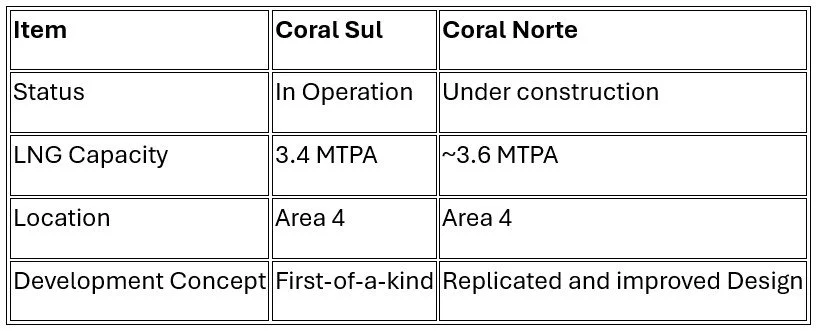
The next step is Coral Norte FLNG, which is expected to become the second floating liquefaction unit in Area 4. Developed by Eni and its partners, Coral Norte follows a "copy-and-improve" philosophy, leveraging the lessons learned from Coral Sul to reduce technical and execution risks.
Key characteristics include:
However, the most interesting development may be what comes next.
Industry discussions increasingly point toward a third floating LNG unit in Area 4 that could be deployed to monetize additional gas resources beyond Coral Sul and Coral Norte. While project details remain under evaluation, the concept highlights the remarkable transformation underway in Mozambique. What started as a single FLNG project is steadily evolving into a floating LNG hub capable of supporting multiple production units within the same basin.
This approach offers several advantages:
Reuse of existing project experience.
Proven local operating model.
Established LNG export supply chain.
Reduced execution risk through standardization.
Potential economies of scale for future developments.
If all three FLNG developments materialize, Area 4 could become the world's largest concentration of floating liquefaction assets, providing a blueprint for future gas provinces seeking phased LNG development strategies.
Mozambique is therefore no longer proving that FLNG works. It is demonstrating how FLNG can be replicated and scaled.
Read also:
Venezuela: The Caribbean Wildcard
Among all emerging FLNG opportunities, Venezuela may represent the largest combination of resource potential and uncertainty.
The country possesses enormous offshore gas reserves, yet decades of underinvestment, sanctions, and political challenges have limited development.
That may finally be beginning to change.
Eni and Repsol have been advancing plans to unlock offshore gas resources associated with the giant Perla field, located in the Gulf of Venezuela. Current concepts include a dedicated FLNG facility capable of exporting LNG to international markets.
Indicative project parameters include:
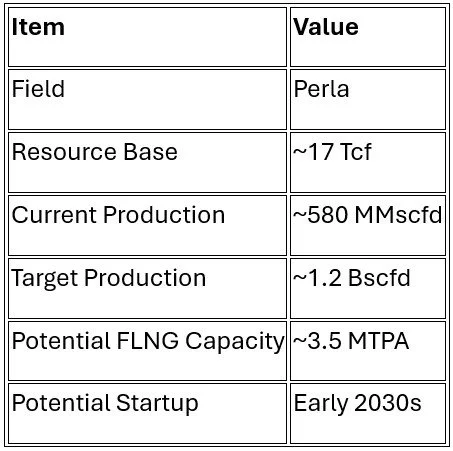
Should the project proceed, it would mark several important firsts:
Venezuela's first FLNG development.
A major step toward transforming Venezuela from a crude oil exporter into a significant natural gas exporter.
The opportunity is substantial, but so are the challenges. Political uncertainty, financing constraints, and international sanctions remain key variables affecting project execution.
For that reason, Venezuela remains the sector's wildcard. The resource base is world-class, and the economics are potentially attractive, but the timing will ultimately depend on factors extending well beyond engineering and project management.
Central Africa: The Rise of a Regional FLNG Ecosystem
While the industry's attention is often focused on mega-projects, some of the most dynamic growth is occurring in Central Africa.
The region has quietly become one of the world's most active laboratories for floating LNG development.
The Republic of Congo provides the clearest example.
Eni's Congo LNG project has rapidly transformed the country into an LNG exporter through a phased development approach centered around floating production and liquefaction facilities. The startup of Tango FLNG and the subsequent deployment of Nguya FLNG demonstrated how FLNG can dramatically shorten the timeline between discovery and first export.
Yet the story extends beyond Eni.
Independent operator Perenco has emerged as one of the strongest advocates of floating LNG solutions for medium-sized gas accumulations that may not justify large onshore LNG investments.
Its Cap Lopez FLNG project in Gabon is particularly noteworthy.
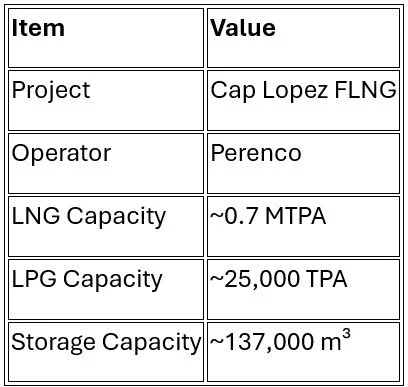
Although considerably smaller than projects in Mozambique or Argentina, Cap Lopez demonstrates an equally important trend: FLNG is no longer reserved for mega-projects.
Instead, operators are increasingly deploying scaled solutions tailored to specific reservoir sizes and market opportunities.
The Central African model may therefore become one of the industry's most influential developments over the next decade.
Rather than relying on a handful of massive LNG projects, countries such as Congo and Gabon are proving that multiple smaller FLNG developments can unlock gas resources incrementally while reducing capital exposure and accelerating project execution.
Together, Eni's developments in Congo and Perenco's initiatives in Gabon suggest that Central Africa could become the world's most diverse FLNG market, spanning everything from large-scale developments to compact, modular floating LNG solutions.
Conclusions: The Next FLNG Hotspots Are Taking Shape
The global FLNG industry is entering a new stage of maturity.
What began as a series of pioneering projects has evolved into a proven development model capable of unlocking gas resources across a wide range of geographies and reservoir sizes.
Several distinct growth stories are emerging:
Argentina is pursuing the most ambitious expansion, anchored by Golar's first two FLNG units and potential future developments with YPF, Eni and XRG.
Canada is positioning itself as a future low-emission FLNG hub, with Cedar LNG under construction and growing interest from technology providers such as Samsung Heavy Industries.
Mozambique is demonstrating the power of replication, with Coral Sul, Coral Norte and potential future Area 4 developments creating the world's first true FLNG cluster.
Venezuela remains the industry's biggest wildcard, combining giant gas resources with significant geopolitical uncertainty.
Central Africa, led by Eni and Perenco, is pioneering scalable FLNG solutions ranging from world-scale projects to smaller, modular developments.
For the industry, the key question is no longer whether FLNG works but instead, the question is where the next cluster of floating LNG developments will emerge and which regions will successfully transform abundant gas resources into long-term LNG export platforms.
The answer increasingly appears to be: not one location, but several. The next decade may well be remembered as the period when FLNG moved from being a niche technology to becoming a mainstream pillar of the global LNG industry.
References
African Energy Research. (2026). Mozambique's LNG investment landscape in 2026. Retrieved from https://africanenergyresearch.org
Cedar LNG. (2026). 2026 project updates and construction milestones. Retrieved from https://www.cedarlng.com
Eni. (2026). Coral North: Gas production development in the Mozambican offshore. Retrieved from https://www.eni.com
Eni. (2026, November 2). Eni announces the beginning of the drilling campaign for the Coral North FLNG Project. Retrieved from https://www.eni.com
Global Energy Network Europe. (2026). Eni and Repsol advance Venezuela FLNG project at Perla Field. Retrieved from https://globalenergynetwork.net
Natural Gas Intelligence. (2026, March 16). Eni eyes Venezuela natural gas exports as Perla pact opens LNG path. Retrieved from https://www.naturalgasintel.com
PortNews. (2026, October 14). Eni and Repsol invite bidders for 3.5 mtpa Venezuela FLNG project. Retrieved from https://en.portnews.ru
Technip Energies. (2026, February 24). Technip Energies awarded a significant contract for the Coral Norte floating LNG project in Mozambique. Retrieved from https://www.ten.com
Technip Energies. (2026, June 8). Technip Energies secures major contract for the Coral Norte floating LNG project in Mozambique. Retrieved from https://www.ten.com
World Oil. (2026, April 20). Offshore Venezuela gas project advances as Eni and Repsol secure export pathway. Retrieved from https://www.worldoil.com
World Oil. (2026, June 23). Congo advances LNG, deepwater projects to attract upstream investment. Retrieved from https://www.worldoil.com
YPF. (2026). Argentina LNG: Integrated LNG export project. Retrieved from https://argentina-lng.ypf.com
Journal of Petroleum Technology. (2025). YPF, Eni, XRG target FID for Argentina LNG export project. Society of Petroleum Engineers. Retrieved from https://jpt.spe.org
Global Flow Control. (2026). Argentina LNG targets FID for US$51 billion export project. Retrieved from https://globalflowcontrol.com
Natural Gas Intelligence. (2026). Cedar LNG construction advances with FLNG vessel nearing completion midpoint. Retrieved from https://www.naturalgasintel.com
Gas Processing & LNG. (2026). Cedar LNG passes 70% construction completion as FLNG hull nears completion at Samsung Heavy Industries. Retrieved from https://gasprocessingnews.com
Prospect Gas & LNG. (2026). Republic of Congo accelerates LNG-led growth as crude nears 500,000 bpd. Retrieved from https://prospect-intel.com
African Energy Week. (2025). Perenco's Cap Lopez LNG project marks gas-driven growth in Central Africa. Retrieved from https://aecweek.com
