
Gastech 2025 Confirms New Energy Trends for the Floaters of the Future
Gastech 2025 confirmed a major shift in the floating energy sector toward decarbonization, diversification, and digitalization. Industry leaders such as SBM Offshore, Wison New Energies, MODEC, and Technip Energies unveiled groundbreaking concepts and secured Approvals in Principle (AiPs) for next-generation floating units. From blue and green ammonia FPSOs to carbon capture-enabled floaters, the event highlighted how floating production is evolving to meet the dual challenge of energy security and net-zero commitments.
What is an AiP?
Approval in Principle (AiP) is an early-stage certification issued by classification societies (e.g., ABS, DNV, Lloyd’s Register) confirming that a new design concept meets fundamental safety and regulatory requirements.
It is not final approval, but it de-risks innovative projects by validating feasibility before detailed engineering.
Common for novel FPSO, FLNG, ammonia, and CCS floater designs.
Why Ammonia is the New Frontier
Ammonia is emerging as a key alternative fuel for the shipping industry and the broader energy transition because of its unique properties and versatility:
Zero-Carbon Potential
When produced as green ammonia (from renewable energy via electrolysis), it emits no CO₂ during production or combustion, making it a true zero-carbon fuel.Energy Carrier for Hydrogen Economy
Ammonia is an efficient hydrogen carrier:It contains 17.6% hydrogen by weight.
It can be cracked back into hydrogen at the point of use, enabling long-distance hydrogen transport without cryogenic storage challenges.
Marine Fuel of the Future
The International Maritime Organization (IMO) targets net-zero GHG emissions by 2050 for shipping. Ammonia is one of the most promising fuels because:It can be burned in ammonia-ready engines (already under development by MAN Energy Solutions and Wärtsilä).
It avoids methane slip, a major issue with LNG as a marine fuel.
Scalable Production Pathways
Blue ammonia uses natural gas with CCS, leveraging existing infrastructure for rapid deployment.
Green ammonia uses renewable power and water electrolysis, offering a fully sustainable solution as renewable capacity grows.
Storage and Transport Advantages
Compared to hydrogen, ammonia is easier to liquefy and store at moderate conditions (-33°C at atmospheric pressure), making it suitable for global energy trade.
Blue vs Green Ammonia: What’s the Difference?
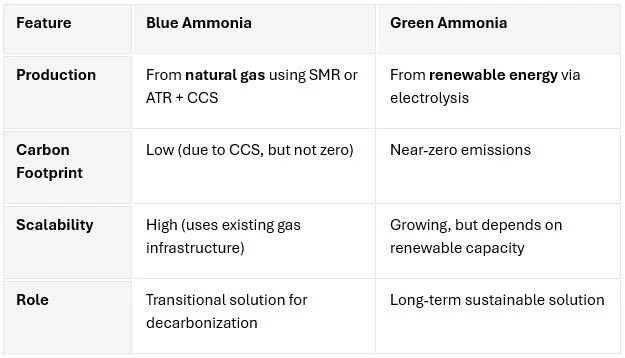
Key Insight:
Blue ammonia leverages existing gas resources and CCS to reduce emissions quickly.
Green ammonia is the ultimate goal for a fully renewable energy system.
Key Announcements and AiPs
1. SBM Offshore: Blue Ammonia and NearZero FPSOs
Blue Ammonia FPSO Concept
SBM Offshore received an AiP from ABS for its floating offshore ammonia production and storage facility. This design converts offshore natural gas into blue ammonia, integrating carbon capture and storage (CCS) to minimize emissions.
Impact: Positions SBM as a leader in low-carbon offshore production, aligning with its TRUE. BLUE. TRANSITION strategy.NearZero FPSO
Earlier this year, SBM secured an AiP for its NearZero FPSO, featuring all-electric topsides, closed flare systems, and CCS integration, targeting up to 80% GHG reduction.
2. Wison New Energies: Partnerships for Green Ammonia and FLNG
MoU with Siemens Energy
Wison signed a strategic MoU with Siemens Energy to co-develop standardized gas turbine and compressor packages for FLNG and FPSO projects, aiming to reduce emissions and shorten lead times.Green Ammonia FPSO with H2Carrier
Wison and H2Carrier announced a 500 MW Green Ammonia FPSO project in Northern Norway. The unit will produce ammonia using renewable energy, marking a major step toward zero-carbon floating solutions.
3. MODEC: Offshore Carbon Capture
LCO₂ Floating Storage and Injection Unit (FSIU)
MODEC received an AiP for a Floating Storage and Injection Unit capable of handling 10 MTPA of CO₂ for subsea injection. This innovation eliminates the need for onshore CO₂ facilities and supports large-scale offshore CCS.
4. Technip Energies: FLNG and Low-Carbon Ammonia
Technip Energies used Gastech 2025 to reinforce its position as a technology-driven EPC leader in the energy transition. Key highlights include:
SnapLNG™ Modular Solution
A fully modular, electrified liquefaction solution designed for fast-track FLNG and onshore LNG projects. Each 2.5 Mtpa train is pre-commissioned and self-contained, reducing construction time and cost while enabling lower carbon intensity through electrification and renewable integration.BlueH₂ and Low-Carbon Ammonia
Technip Energies presented its BlueH₂ by T.EN™ technology, capable of capturing up to 99% of CO₂ emissions from hydrogen production. This solution underpins Blue Point, the world’s largest low-carbon ammonia facility in Louisiana, producing 1.4 million tons/year of blue ammonia and sequestering 2.3 million tons of CO₂ annually.Digitalization and AI
The company also highlighted digital twins and AI-driven predictive maintenance as part of its decarbonization toolkit, ensuring operational efficiency and emissions monitoring across LNG and ammonia assets.
Key Takeaways
Ammonia is the fuel of the future:
It can power ships and serve as a hydrogen carrier.
Green ammonia offers a fully renewable pathway, while blue ammonia provides a transitional solution leveraging CCS.
Energy transition is shaping floater design:
SBM Offshore leads with Blue Ammonia FPSO and NearZero FPSO, integrating CCS and electrification.
Wison New Energies focuses on Green Ammonia FPSOs and modular FLNG through strategic partnerships.
MODEC pioneers CCS-enabled floaters with its LCO₂ FSIU concept.
Technip Energies drives SnapLNG™ modular FLNG, BlueH₂, and low-carbon ammonia technologies.
Decarbonization and diversification are no longer optional—they are the core drivers of innovation in the floating energy sector.
Standardization and modularization will accelerate project delivery and reduce costs, making low-carbon solutions scalable.
References (APA Style)
SBM Offshore. (2025, September 12). ABS approves blue ammonia FPSO concept from SBM Offshore. Retrieved from https://www.sbmoffshore.com/newsroom/abs-approves-blue-ammonia-fpso-concept-from-sbm-offshore/
Wison New Energies. (2025, September 12). Wison New Energies and Siemens Energy sign MoU at Gastech 2025. Retrieved from https://www.wison-energies.com/News/1286.aspx
Wison New Energies & H2Carrier. (2025, September 12). Wison New Energies and H2Carrier to develop green ammonia FPSO. Retrieved from https://scandasia.com/wison-new-energies-and-h2carrier-to-develop-green-ammonia-fpso/
MODEC. (2025, September 11). MODEC awarded AiP from ABS for LCO₂ Floating Storage and Injection Unit. Retrieved from https://www.modec.com/news/2025/20250911_pr_FSIU-AIP_ABS.html
Technip Energies. (2025, September). Gastech 2025 Highlights. Retrieved from https://www.ten.com
