
Coral Norte FLNG Launch Marks a New Chapter in a Rapidly Expanding Global FLNG Market
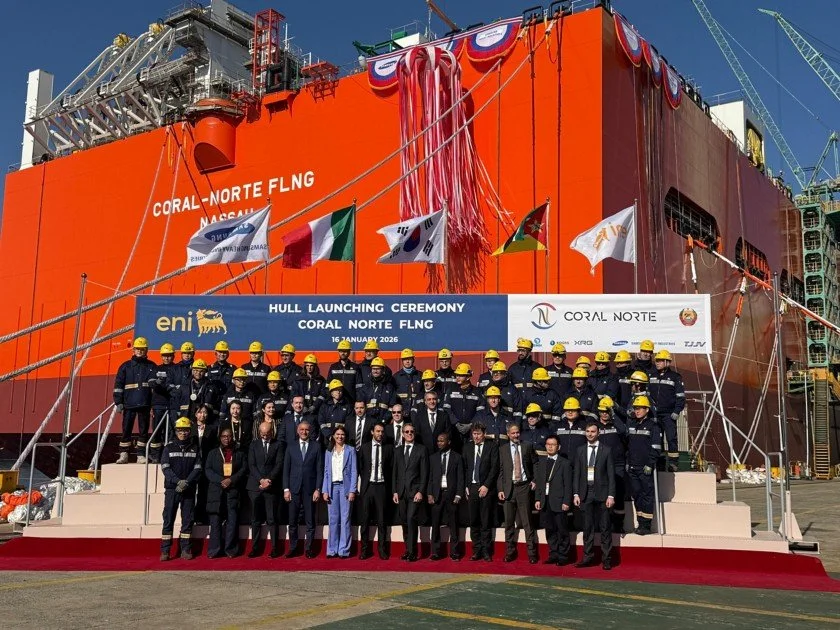
Coral Norte Launching ceremony at Samsung Heavy Industries - South Korea. Source: Eni
The FLNG sector is entering its most dynamic growth phase to date, and the recent launching ceremony of Eni’s Coral Norte FLNG in Geoje, South Korea, stands as a defining milestone for the industry. Hosted by Samsung Heavy Industries (SHI) on 16 January 2026, the event highlights not only the progress of this specific project but also the shifting balance of power within the global FLNG market.
A Landmark Event: Coral Norte FLNG Takes the Water
At Samsung Heavy Industries’ Geoje Shipyard, the hull of the 432‑meter Coral Norte FLNG—Eni’s fourth floating liquefaction vessel—was officially launched in the presence of industry leaders and government officials. Coral Norte, scheduled for completion in 2028, is Eni’s second ultra‑large FLNG after Coral Sul, delivered in 2021.
Designed with a liquefaction capacity of 3.6 MTPA, the vessel will operate offshore Mozambique, doubling the nation’s LNG output and strengthening its position as a strategic African gas exporter. The project builds directly on the success of Coral Sul, which has already delivered over 135 LNG cargoes since 2022.
A Shift Toward Replication: From One‑Off Megaprojects to Semi‑Standardized FLNG Designs
Historically, both FPSOs and FLNG units have been unique, bespoke engineering projects, each requiring extensive custom development. Yet the sector has seen rare but influential moments of replication: ExxonMobil’s Kizomba A/B FPSOs in the early 2000s and TotalEnergies’ Kaombo FPSOs in the mid‑2010s demonstrated how carbon‑copy designs can significantly reduce engineering hours, compress schedules, and de‑risk execution.
Until recently, such standardization had barely touched FLNG—each unit was a pioneering prototype. But Eni’s decision to follow Coral Sul with a near‑replica unit, Coral Norte, marks a potential turning point. Coral Norte applies lessons learned from Coral Sul while benefiting from continuity with the same builder, Samsung Heavy Industries. This may represent the early stages of a standardized series approach, long proven in the FPSO market but novel in FLNG.
If more operators adopt this approach—especially with shipyards like SHI now building multiple FLNGs in parallel—FLNG development could evolve from bespoke mega‑projects to repeatable, lower‑risk industrial products. The resulting benefits would be substantial: shorter cycle times, lower CAPEX, smoother execution, and easier redeployment of assets.
Two Industry Leaders Are Now Clearly Emerging
Samsung Heavy Industries (SHI): The Shipyard Powerhouse
SHI has firmly positioned itself as the global leader in FLNG construction. Out of 14 FLNG units ordered worldwide, SHI has secured six, including Shell’s Prelude and Petronas’ upcoming third FLNG. It is currently building two additional units at its Geoje yard—including Coral Norte—and is preparing to expand further through its strategic partnership with Delfin Midstream.
Delfin has extended its Letter of Award (LOA) with SHI and is approaching a final investment decision (FID), with up to three FLNG vessels expected to be built at the shipyard for deployment in the U.S. Gulf of Mexico.
Eni: The Operator Setting the Pace
Eni has simultaneously become the most active FLNG operator worldwide. Alongside Coral Sul and Coral Norte, the company recently started up the Nguya FLNG in Congo ahead of schedule, inaugurating Phase 2 of the Congo LNG project. This expansion adds 2.4 MTPA of liquefaction capacity, with first LNG exports expected in early 2026.
Between Coral Sul (Mozambique), Tango FLNG (Congo), Nguya FLNG (Congo), and Coral Norte (Mozambique), Eni is now building or operating four FLNG units simultaneously—a scale unmatched in the industry.
Other Major Actors Shaping Today’s FLNG Landscape
Petronas & Golar LNG: Proven Operators, Expanding Footprint
Petronas remains a cornerstone of FLNG global deployment. The company already operates PFLNG Satu and PFLNG Dua, and SHI is currently constructing a third FLNG for the Malaysian operator, named ZLNG.
Petronas is also pursuing expansion offshore Suriname, where multiple feasibility and FEED‑related contracts have been awarded to Wison New Energies.
Golar LNG, a pioneer in FLNG conversions and commercial deployment, continues to operate some of the world’s longest‑running floating liquefaction assets and remains a key commercial innovator in the sector.
Wison: The Rising FLNG Builder
China’s Wison is rapidly emerging as a significant FLNG constructor. The company recently completed the hull for its third FLNG, the Genting project in Indonesia, which will enter operation in 2026 as Indonesia’s first FLNG unit. This project reinforces Wison’s growing global role and its competitive position in medium‑scale FLNG.
Wison also continues its collaboration with Petronas through feasibility studies for future FLNG developments offshore Suriname.
Global FLNG Liquefaction Capacity: Delivered, Under Construction, and Outlook to 2035
The FLNG industry is expanding at an unprecedented pace, not only in the number of vessels but also in total liquefaction capacity, now a central benchmark for assessing offshore gas competitiveness. Based on the current global fleet and the latest projects under execution, the industry today delivers an estimated 18 MTPA of operational FLNG capacity. A further 12 MTPA is under active construction or firm development, bringing the total committed global FLNG capacity to approximately 30 MTPA — equivalent to around 8% of the world’s LNG market.
This growth trajectory aligns with independent market analysis: according to Rystad Energy, global FLNG capacity is projected to reach 55 MTPA by 2035, more than doubling the capacity currently operating or under construction. Such expansion would translate into over USD 30 billion in additional investment, as floating liquefaction continues to shift from bespoke megaprojects to an increasingly scalable, standardized segment of the LNG value chain.
Conclusion: Coral Norte Symbolizes a New Era of Standardized FLNG Expansion
The launch of Coral Norte FLNG is more than a ceremonial milestone—it signals a structural shift:
Samsung Heavy Industries is consolidating its position as the dominant FLNG builder.
Eni is establishing itself as the world’s leading FLNG operator, with four units in parallel.
Petronas, Golar LNG, and Wison continue broadening the supply chain and technical ecosystem.
And, crucially, standardization and replication—long proven in FPSOs—may finally be entering the FLNG domain.
If Coral Norte proves successful as a semi‑replicated follow‑up to Coral Sul, the industry may soon transition from one‑off prototypes to repeatable, lower‑risk FLNG series. This evolution could define the next decade of offshore gas development worldwide.
