
Golar LNG: How One Company Built the World's First FLNG Leasing Fleet
From Shipping Company to Floating LNG Infrastructure Owner
The offshore oil and gas industry has long embraced the leasing model. Companies such as SBM Offshore, MODEC, BW Offshore and Yinson own and operate FPSOs that are chartered to operators under long-term contracts. In the FLNG sector, however, this model has remained elusive.
Most FLNG developments have been conceived as project-specific facilities. Shell's Prelude FLNG, Petronas' PFLNG Satu and PFLNG Dua, and ENI's Coral Sul FLNG were all designed and deployed for specific gas fields, with limited consideration for future redeployment.
Golar LNG took a fundamentally different approach. Rather than developing FLNGs as bespoke field developments, Golar has progressively created a portfolio of floating liquefaction assets designed to operate under long-term charter contracts. Today, the company stands alone as the only dedicated FLNG lease operator with multiple vessels operating or contracted under a repeatable business model, much closer to the FPSO leasing philosophy than the traditional LNG project approach.
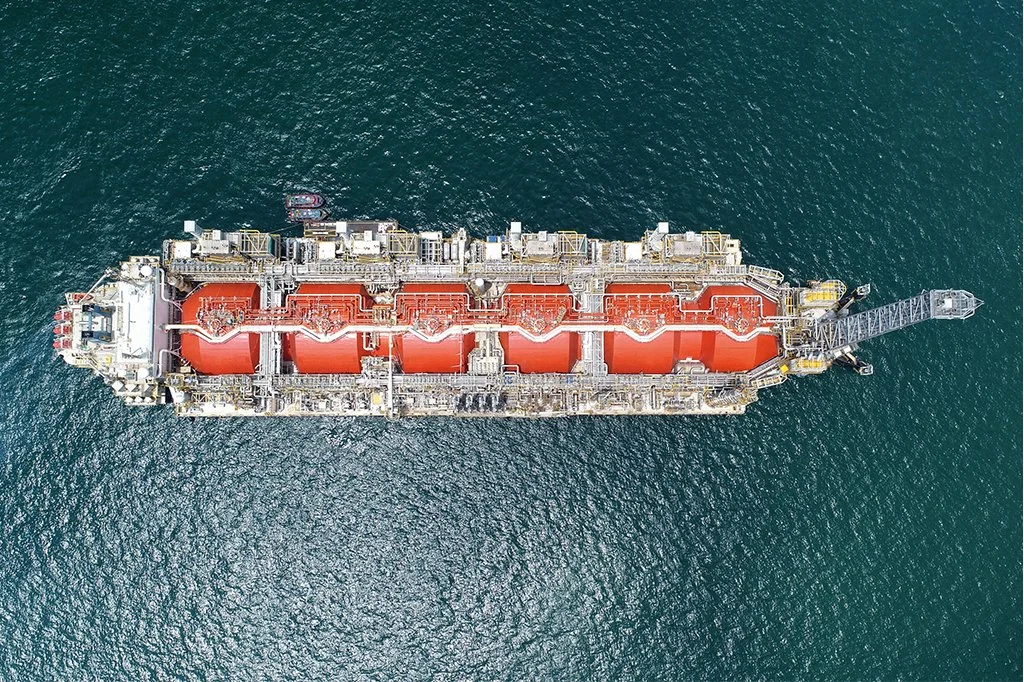
Golar FLNG unit. Source: Golar
Building an FLNG Portfolio
FLNG Hilli
The Hilli Episeyo became the world's first converted FLNG facility to enter commercial operation when it started production offshore Cameroon in 2018.
Over eight years of operation, the vessel achieved an exceptional operational record, demonstrating that LNG carrier conversions could provide reliable liquefaction services comparable to conventional facilities. Golar recently completed the Cameroon contract, reporting 100% economic uptime since startup and 156 LNG cargoes loaded. The vessel is now being repositioned for deployment on its next long-term contract beginning in 2027 in Argentina.
FLNG Gimi
Gimi represents Golar's second generation FLNG solution. The vessel entered service on BP's Greater Tortue Ahmeyim (GTA) development located offshore Mauritania and Senegal.
According to Golar's latest disclosures, Gimi has been outperforming contractual production commitments, producing approximately 15% above guaranteed levels. This performance is particularly noteworthy given the complexity of offshore liquefaction operations and the industry's historical concerns regarding FLNG reliability.
FLNG Esperanza
The third unit, FLNG Esperanza, is currently under construction at CIMC Raffles for Southern Energy's LNG export project in Argentina.
The vessel represents Golar's next-generation MKII design with a nameplate capacity of 3.5 MTPA. Construction is reported to be on schedule and within budget. Once operational, Esperanza will further strengthen Golar's position as the leading independent FLNG lessor.
The Fourth FLNG: A Sign of Market Confidence
In August 2026, Golar announced the execution of an Engineering, Procurement and Construction (EPC) contract with CIMC Raffles for a fourth FLNG conversion project.
Several aspects of this decision are particularly significant.
First, the company approved the investment before securing a finalized charter contract, demonstrating confidence in future market demand.
Second, the fourth unit will be another MKII FLNG, leveraging the lessons learned from Esperanza and creating economies of scale through a standardized design philosophy.
Third, the project further validates the strategic partnership between Golar, CIMC Raffles and Black & Veatch, combining proven liquefaction technology with Chinese fabrication capabilities. The new unit is expected to have a capacity of 3.5 MTPA and be delivered by the end of 2029. A donor vessel for the conversion has already been secured.
The Key Differentiator: Midstream FLNG
What truly differentiates Golar from other FLNG developers is not simply asset ownership or vessel conversion expertise.
It is the deliberate decision to focus on midstream FLNG.
Unlike integrated FLNG projects such as Prelude, where gas treatment, condensate stabilization, LPG extraction and LNG production are all performed aboard a single facility, Golar's units primarily receive pre-treated gas and perform the liquefaction process.
This design philosophy dramatically reduces:
Topside complexity
Equipment count
Vessel weight
Commissioning duration
Operational risks
Field-specific customization requirements
Most importantly, it enhances asset redeployability.
Because the liquefaction plant is largely separated from field-specific gas processing requirements, a Golar FLNG can potentially be relocated from one development to another with relatively limited modifications. This characteristic is essential for a leasing business model, as the residual value of the asset is not entirely dependent on a single gas field.
The Trade-Off: Someone Else Must Process the Gas
The advantages of the midstream approach come with an important limitation.
Golar's FLNG vessels cannot typically receive untreated wellstream fluids directly from subsea wells. Upstream gas treatment must be performed elsewhere before the gas is delivered to the FLNG.
This can be achieved through either offshore or onshore infrastructure.
GTA: Offshore Processing
On BP's Greater Tortue Ahmeyim project, the upstream processing function is performed by a dedicated FPSO (Tortue FPSO).
The FPSO separates and treats production fluids before delivering processed gas to FLNG Gimi for liquefaction and export. In this arrangement, Golar provides the liquefaction service while BP retains responsibility for upstream processing facilities.
Argentina: Onshore Processing
In Argentina, FLNG Esperanza will rely on existing pipeline and onshore gas infrastructure.
Gas treatment occurs onshore before the feed gas reaches the FLNG, allowing the vessel to focus solely on liquefaction and storage prior to LNG export.
This arrangement is arguably even closer to the traditional midstream infrastructure model commonly seen in onshore LNG developments.
From Project to Product
This separation of upstream processing and downstream liquefaction may be Golar's most important innovation.
Historically, FLNG projects have been treated as one-off engineering megaprojects optimized for a specific gas reservoir. The result has often been high capital expenditure, lengthy engineering cycles and limited redeployment opportunities.
Golar has instead transformed FLNG into a standardized product.
Its vessels serve as floating liquefaction factories that can be connected to different upstream developments, whether gas treatment occurs on an FPU, an FPSO, an offshore platform or an onshore processing plant.
The concept mirrors the evolution of the FPSO industry. What began as bespoke floating production systems gradually matured into standardized leased assets operated by specialized contractors. Today, Golar appears to be pursuing the same path in the FLNG sector.
Conclusion
The significance of Golar's success extends beyond the four vessels currently operating, contracted or under construction.
The company's real achievement is the creation of a repeatable leasing model for FLNG.
With Hilli successfully redeployed, Gimi operating at GTA, Esperanza under construction and a fourth MKII FLNG now ordered at CIMC Raffles, Golar is building something the industry has never seen before: a genuine fleet of leased FLNG assets.
By focusing on midstream liquefaction while leaving field-specific gas treatment to separate facilities, Golar has maximized redeployability, reduced project complexity and created a business model that resembles the successful FPSO leasing sector.
The debate is no longer about the technical viability of FLNG. Hilli and Gimi have already answered that question. The real challenge for the industry is whether competitors can replicate Golar's standardized midstream approach before the company secures a dominant position in what could become the offshore industry's next major leasing market.
Sources and Further Reading
Golar LNG Ltd. (2026, August 13). Golar LNG orders 4th FLNG unit for 2029 delivery. Yahoo Finance. https://finance.yahoo.com/energy/articles/golar-lng-orders-4th-flng-094400649.html [finance.yahoo.com]
Golar LNG Ltd. (2026). Second Quarter 2026 highlights. Golar LNG Investor Relations. https://www.golarlng.com/investors/results-centre/highlights.aspx [golarlng.com]
Cavcic, M. (2026, August 13). Golar LNG accelerates FLNG expansion with new $2.45 billion order. Offshore Energy. https://www.offshore-energy.biz/golar-lng-accelerates-flng-expansion-with-new-2-45-billion-order/ [offshore-energy.biz]
Debbarma, S. (2026, August 13). Golar LNG signs $2.45bn agreement for fourth floating LNG vessel. Offshore Technology. https://www.offshore-technology.com/news/golar-lng-fourth-floating-lng-vessel/ [offshore-t...nology.com]
Black & Veatch. (n.d.). PRICO® LNG technology. Black & Veatch. https://www.bv.com
Golar LNG Ltd. (various years). Annual reports and investor presentations. https://www.golarlng.com
