
The Canadian FLNG Model: Low-Carbon Floating LNG in a Midstream-Driven Market
For more than a decade, the global FLNG industry has been associated with the development of remote offshore gas fields. Projects such as Prelude FLNG in Australia, Coral South FLNG in Mozambique, and Petronas PFLNG in Malaysia were designed to monetize stranded offshore resources located far from existing infrastructure.
Canada is taking a very different approach.
A new generation of Canadian FLNG projects is emerging along the coast of British Columbia, not to process offshore gas, but to liquefy natural gas transported from the country's vast inland reserves through existing and planned pipeline networks. This creates a unique model where FLNG becomes an extension of the midstream value chain rather than an upstream field development solution.
The fundamental drivers behind this model are:
Abundant natural gas reserves in Western Canada, particularly the Montney formation.
Extensive pipeline infrastructure connecting producing regions to the Pacific coast.
Access to low-carbon hydroelectric power from British Columbia.
Growing LNG demand in Asia-Pacific markets.
Strong participation and leadership from Indigenous communities.
The result is the emergence of what could be described as a distinctly Canadian FLNG sector, built around low emissions, community participation, and integration with the existing gas transportation network.
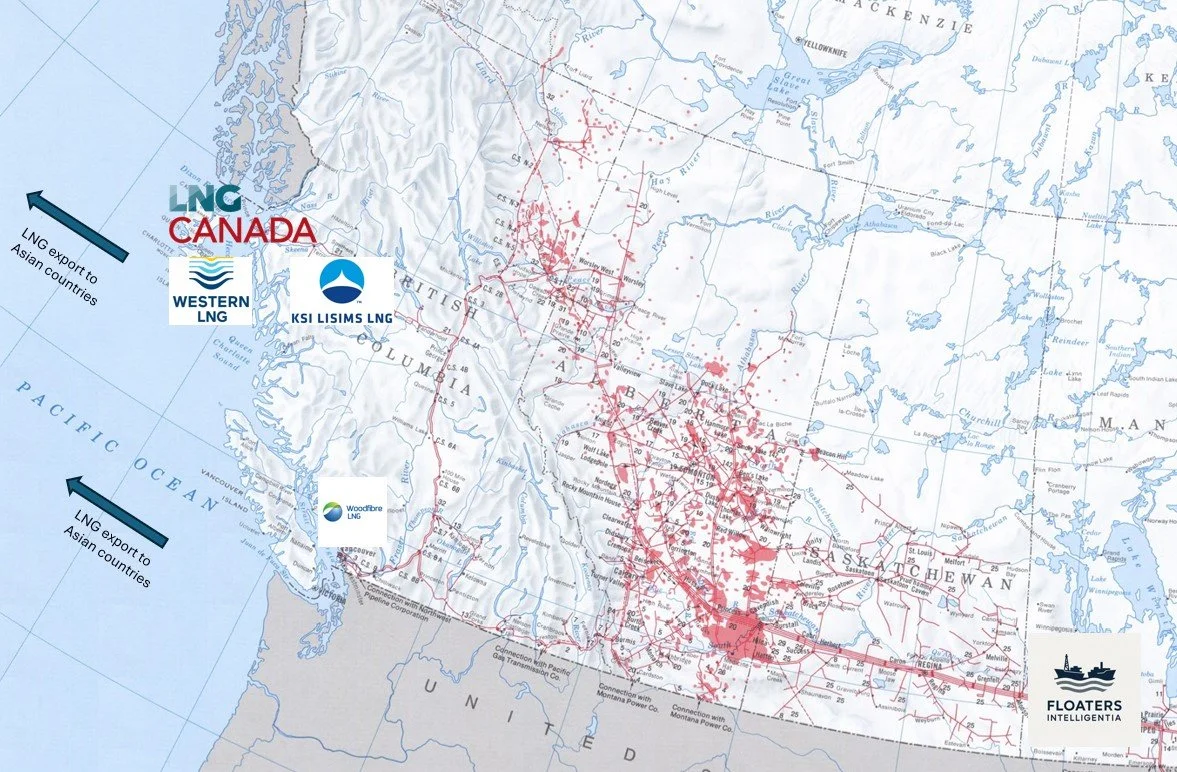
Source: open.canada.ca
Why Canada's FLNG Market Is Different
Traditional FLNG projects are typically developed when offshore gas discoveries are too remote to justify pipelines or onshore processing facilities.
Canadian projects follow the opposite logic.
Gas is produced hundreds of kilometers inland in Alberta and northeastern British Columbia before being transported through major transmission systems to export terminals on the Pacific coast. Once there, floating liquefaction facilities convert the gas into LNG for export to Asian markets.
This makes Canada's FLNG developments fundamentally midstream-focused projects.
Instead of solving a field-development challenge, FLNG technology is being used to:
Reduce coastal footprint.
Minimize dredging and land disturbance.
Accelerate development schedules.
Maintain flexibility compared with large onshore liquefaction facilities.
Perhaps most importantly, British Columbia offers access to one of the cleanest electricity grids in the world, powered predominantly by hydroelectric generation. This enables developers to electrify liquefaction facilities and dramatically reduce greenhouse gas emissions compared with conventional LNG plants that rely on gas-fired turbines.
The Strategic Opportunity: A Massive Export Gap
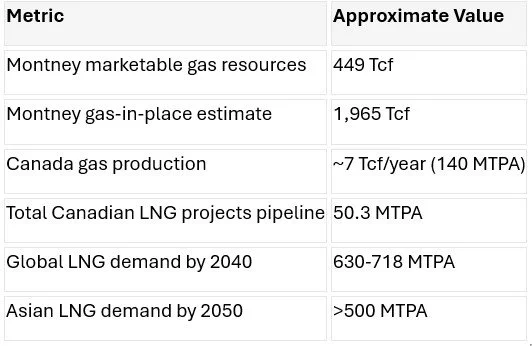
Western Canada possesses one of the largest natural gas resource bases in North America. The Montney formation alone contains an estimated 449 Tcf of marketable natural gas resources, while broader gas-in-place estimates exceed 1,900 Tcf. Recent reserve assessments identified more than 64 Tcf of recoverable unconventional gas reserves in Alberta's portion of the Montney.
To put this into context, Canada produces approximately 7 Tcf of natural gas per year (or roughly 140 MTPA), meaning the Montney resource alone could support decades of production even without additional discoveries.
Yet Canada's LNG export capability remains relatively small compared with the scale of its resources.
Natural Resources Canada estimates that all LNG projects currently operating, under construction, or proposed represent approximately 50.3 MTPA of potential export capacity. This includes LNG Canada, Cedar LNG, Ksi Lisims LNG, Woodfibre LNG and other developments under consideration.
At the same time, LNG demand continues to grow rapidly across Asia-Pacific.
Shell forecasts global LNG demand reaching 630-718 MTPA by 2040, up from approximately 407 MTPA today, with most of the growth coming from Asia.
Wood Mackenzie projects Asian LNG demand increasing from roughly 270 MTPA today to more than 500 MTPA by 2050, driven by China, India, Southeast Asia, and continued LNG imports in Japan, South Korea, and Taiwan.
This creates a remarkable mismatch between available resources and export infrastructure.
This is where FLNG becomes particularly attractive. By fabricating liquefaction facilities in specialized shipyards and deploying them near existing pipeline infrastructure, Canada can potentially accelerate export capacity growth while minimizing environmental impact and coastal disturbance.
From a strategic perspective, Cedar LNG and Ksi Lisims LNG are part of Canada's broader effort to bridge the gap between hundreds of Tcf of available gas resources and hundreds of MTPA of future Asian LNG demand.
Cedar LNG: Canada's FLNG Pioneer
The most advanced project is Cedar LNG, located near Kitimat, British Columbia.
Developed by a partnership between the Haisla Nation and Pembina Pipeline, Cedar LNG became the world's first Indigenous-majority-owned LNG project to reach Final Investment Decision (FID) in June 2024. The facility will also be Canada's first FLNG project.
Key project characteristics include:
FLNG capacity of approximately 3.3 MTPA.
Feed gas supplied through a connection to the Coastal GasLink pipeline.
Renewable power supplied by BC Hydro.
Expected start-up in 2028.
One of the lowest operational carbon intensities in the LNG industry.
Rather than being deployed above an offshore reservoir, the floating liquefaction facility will be permanently moored near shore and supplied through existing pipeline infrastructure, creating a hybrid solution that combines the advantages of floating facilities with the reliability of a mature midstream network.
The project awarded the EPC contract for the floating liquefaction unit to a consortium formed by Samsung Heavy Industries (SHI) and Black & Veatch. Samsung Heavy Industries is responsible for hull construction, LNG containment systems, and topside integration, while Black & Veatch provides liquefaction technology and engineering support.
Construction of the vessel is underway at Samsung Heavy Industries' Geoje shipyard in South Korea, with delivery expected ahead of Cedar LNG's planned start-up in 2028.
Ksi Lisims LNG: Canada's Next FLNG Megaproject
While Cedar LNG is already under construction, the most ambitious Canadian FLNG proposal is Ksi Lisims LNG.
The project is being developed by the Nisga'a Nation, Rockies LNG, and Western LNG on Pearse Island, British Columbia's north coast. The proposed export facility would have a capacity of up to 12 MTPA, making it one of North America's largest FLNG developments.
Unlike Cedar LNG, which consists of a single floating liquefaction facility, Ksi Lisims is expected to utilize two FLNG units supplied with feed gas through the Prince Rupert Gas Transmission pipeline.
The project is designed around three strategic objectives:
Low-carbon LNG production.
Indigenous leadership and ownership.
Direct access to Asia-Pacific LNG markets.
Developers aim to connect the project to the BC Hydro grid through new transmission infrastructure, allowing the facility to operate with among the lowest emissions intensities of any LNG export project worldwide. Once fully electrified, the project targets net-zero operational emissions.
The Growing Role of Western LNG
One company that deserves particular attention is Western LNG.
Although not as widely known as traditional LNG developers, Western LNG has emerged as one of the strongest advocates of the floating LNG concept in North America.
As a core partner in Ksi Lisims LNG, Western LNG brings expertise in project development, financing, engineering strategy, and commercialization. The company's long-standing thesis is that floating liquefaction can significantly reduce construction risk, environmental footprint, and execution complexity compared with large greenfield onshore LNG facilities.
If Cedar LNG proves the viability of the Canadian FLNG model, Ksi Lisims and Western LNG could be the projects that scale it.
Hanwha Ocean, Samsung Heavy and the Korean Connection
An interesting aspect of the Canadian market is that it has become a new arena for competition among South Korea's major shipbuilders.
Recent industry developments indicate increasing involvement from Hanwha Ocean, demonstrating that Canada's upcoming FLNG projects are attracting attention from all major Korean offshore contractors.
The pattern is clear:
Canada provides the gas.
British Columbia provides renewable hydropower.
Pipeline networks provide feed gas transportation.
Korean shipyards provide floating liquefaction expertise.
This combination may ultimately become the blueprint for future low-carbon LNG developments worldwide.
LNG Canada: The Anchor Project
While Cedar LNG and Ksi Lisims LNG attract considerable attention, it is impossible to discuss Canada's LNG future without mentioning LNG Canada.
Located in Kitimat, LNG Canada is the country's flagship LNG export project and the largest LNG investment ever undertaken in Canada. The project receives natural gas from the Montney basin via the Coastal GasLink pipeline and exports LNG to Asia through a conventional onshore liquefaction facility.
Phase 1 alone will provide 14 MTPA of export capacity, with a second phase potentially adding another 14 MTPA.
LNG Canada differs from Cedar and Ksi Lisims because it relies on traditional onshore liquefaction technology. Nevertheless, all three projects share the same strategic advantages:
Access to Montney gas resources.
Pipeline connectivity.
Proximity to Asia-Pacific markets.
Access to low-carbon electricity.
In many ways, LNG Canada has established the infrastructure backbone that is now enabling Canada's emerging FLNG sector.
A New LNG Cluster on Canada's Pacific Coast
Rather than isolated developments, Canada is building a new LNG export cluster along the coast of British Columbia.
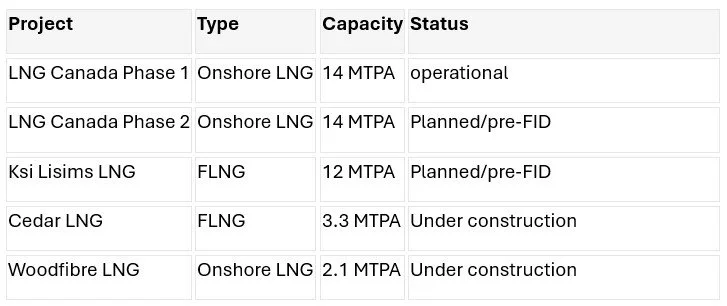
LNG Projects in progress and operational in Canada
Together, these projects could provide more than 45 MTPA of LNG export capacity from British Columbia alone, creating a new Pacific gateway for Canadian gas destined for Asian markets.
Conclusion
Canada is developing a new version of the FLNG business model.
Unlike traditional offshore FLNG projects designed to monetize stranded gas fields, Canadian developments are primarily midstream projects, leveraging abundant inland gas reserves, extensive pipeline systems, and renewable hydroelectric power.
Cedar LNG is already demonstrating how this model can work in practice, while Ksi Lisims LNG seeks to scale it to world-class dimensions. Supported by developers such as Western LNG, Indigenous-led ownership structures, and the engineering capabilities of Korean contractors including Samsung Heavy Industries, Black & Veatch, and potentially Hanwha Ocean, Canada is rapidly positioning itself as a leader in low-carbon LNG exports.
The story is ultimately about connecting supply with demand. Canada possesses hundreds of trillions of cubic feet of natural gas resources, while Asia-Pacific represents the world's fastest-growing LNG market, with demand expected to exceed 500 MTPA in the coming decades.
For the FLNG industry the next chapter of floating liquefaction may not be written above remote offshore gas fields, but along the coast of British Columbia, where pipelines, hydropower, Indigenous partnerships, and floating technology are converging to create an entirely new export model.
References
Alberta Energy Regulator. (2025). Reserves. Government of Alberta. https://www.aer.ca/data-and-performance-reports/statistical-reports/alberta-energy-outlook-st98/reserves
Black & Veatch. (2023). Ksi Lisims LNG FEED contract awarded to Black & Veatch and Samsung Heavy Industries. Retrieved from https://lngprime.com/americas/black-veatch-shi-win-contract-for-canadas-ksi-lisims-floating-lng-project/85769/
Cedar LNG. (2025). First steel cut for Cedar LNG vessel. https://www.cedarlng.com/2025/06/06/first-steel-cut/
Cedar LNG. (2025). Project overview. https://www.cedarlng.com/project/
Government of Canada. (2025, March 21). Government of Canada announces support for Cedar LNG. Innovation, Science and Economic Development Canada. https://www.canada.ca/en/innovation-science-economic-development/news/2025/03/government-of-canada-announces-support-for-cedar-lng.html
Government of Canada. (2026). Ksi Lisims LNG - Major Projects Office. Privy Council Office. https://www.canada.ca/en/privy-council/major-projects-office/projects/national/ksi-lisims.html
Ksi Lisims LNG. (2026). Project overview. https://www.ksilisimslng.com/project
Natural Gas Intelligence. (2019, April 17). Montney's unconventional potential of 1,965 Tcf said barely tapped. https://www.naturalgasintel.com/news/montneys-unconventional-potential-of-1965-tcf-said-barely-tapped/
Natural Resources Canada. (2025). Canadian liquefied natural gas projects. Government of Canada. https://natural-resources.canada.ca/energy-sources/fossil-fuels/canadian-liquified-natural-gas-projects
Offshore Energy. (2024, January 5). Samsung Heavy, Black & Veatch to work on Cedar LNG's FLNG unit. https://www.offshore-energy.biz/samsung-heavy-black-veatch-to-work-on-cedar-lngs-flng-unit/
Offshore Energy. (2024, June 26). Canada's $4 billion hydro-powered floating LNG project is a go. https://www.offshore-energy.biz/canadas-4-billion-hydro-powered-floating-lng-project-is-a-go/
Offshore Technology. (2024, August 9). Cedar LNG project, British Columbia, Canada. https://www.offshore-technology.com/projects/cedar-lng-project-british-columbia-canada/
Offshore Technology. (2025, December 10). Ksi Lisims LNG project, British Columbia, Canada. https://www.offshore-technology.com/projects/ksi-lisims-lng-project-british-columbia-canada/
Pembina Pipeline Corporation. (2024). Cedar LNG. https://www.pembina.com/operations/partnerships/cedar-lng
Resource Works. (2026, August 6). Managing the Montney responsibly: What the science says about water, seismicity and carbon capture. https://resourceworks.com/managing-the-montney-responsibly-what-the-science-says-about-water-seismicity-and-carbon-capture/
Shell plc. (2024, February 14). Global LNG demand to grow beyond 2040, driven by industrial demand in China and economic development in South Asia and South-east Asia. https://www.shell.com/news-and-insights/newsroom/news-and-media-releases/2024/global-lng-demand-to-grow-beyond-2040.html
Shell plc. (2025, February 25). Asian economic growth expected to drive 60% rise in LNG demand to 2040. https://www.shell.com/news-and-insights/newsroom/news-and-media-releases/2025/lng-demand-expected-rise-by-sixty-percent-by-2040.html
The Energy Year. (2026). Hanwha Ocean joins FLNG project in Canada. https://theenergyyear.com/news/hanwha-ocean-joins-flng-project-in-canada/
Wood Mackenzie. (2024). Asia LNG demand assessment: Executive summary (prepared for ANGEA). Australian Natural Gas Energy Association. https://angeassociation.com/wp-content/uploads/2024/12/Wood-Mackenzie-LNG-Demand-Study-Extended-Executive-Summary.pdf
