
Classification and Flagging for FPSO and FLNG — a practical primer
Classification is not an optional badge of prestige — it is the commercial, regulatory and technical scaffold that makes a floater acceptable to flag states, ports, insurers, lenders and off‑takers. This article explains why class matters, why some jurisdictions (notably Norway) can operate a different model, and how owners should decide whether and how to engage class societies for FPSO and FLNG projects.
Why class matters for floaters
Independent technical assurance. Class societies verify design, fabrication and in‑service condition against an agreed rule set and notation. That independent stamp reduces disputes with regulators, insurers and customers.
Statutory acceptance and global portability. Certificates and class notations are universally recognized evidence of seaworthiness, structural fitness and compliance with IMO/MARPOL obligations—helping access ports, terminals and third‑party yards.
Survey and lifecycle discipline. Class prescribes periodic surveys, risk‑based inspection programs (IIP) and rules for modifications. This continuity matters for fatigue management, mooring integrity, drydocking windows and resale.
Insurance and finance prerequisites. Insurers and banks routinely require class certification; absence or non‑standard class arrangements materially increase cost and friction in financing and insurance.
Specialist notations and guidance for novel systems. FLNG and gas FPSO systems (cryogenics, reliquefaction, continuous composition monitoring) often rely on class guidance to translate novel technical risk into verifiable acceptance criteria.
Commercial clarity. Charter parties, offtake agreements and tolling contracts frequently reference class status and survey evidence as contractual milestones.
The importance of flag registration
Flag as statutory authority: For units that are registered as ships, a flag state confers nationality and applies international conventions (e.g., MARPOL, SOLAS, Wreck Removal Convention, MODU Code where applicable).
Class as delegated verifier: Flag administrations rely on class societies to verify compliance with conventions such as:
MARPOL (pollution prevention)
SOLAS (safety of life at sea)
MODU Code (mobile offshore drilling units, applied by analogy to floaters)
Wreck Removal Convention (liability and removal obligations)
Statutory soundness: Without class, flag registration cannot be completed in a way that satisfies international obligations. Class certificates are the evidence flags use to demonstrate compliance.
Norway’s distinction: Under Norway’s function‑based model, many FPSOs/FLNGs are treated primarily as offshore petroleum installations rather than flagged ships; flag registration may be unnecessary for domestically moored units, with the regulator (PSA) providing the statutory framework and acceptance.
Owner’s choice: Outside function‑based regimes, or where international trade, redeployment, or third‑party terminal calls are expected, pursuing flag registration with class is the pragmatic default.
Why Norway appears to be the exception:
Norway’s model emphasizes a strong, function‑based regulatory regime rather than default reliance on a ship‑type class certificate. Key features of that model:
Regulator competence and early engagement. The national regulator (PSA and equivalent bodies) exercises direct technical oversight from FEED onwards and accepts industry standards (NORSOK) as part of the acceptance framework.Operator responsibility. Norwegian practice places more explicit obligations on operators’ management systems and QA/QC, with regulators auditing operator performance rather than outsourcing the entire verification chain.
Targeted use of class services. Even in Norway, class societies are commonly engaged for specialist verifications, surveys, or specific notations; it’s the legal framing that differs, not the technical scrutiny.
Tradeoffs. This model reduces duplication for owners operating domestically under well‑established regulatory relationships, but it requires more operator resources, deeper regulator interactions and can complicate international financing or cross‑jurisdiction redeployments.
How Australia’s model differs
Australia does not replicate Norway’s function‑based approach. Instead, it applies a dual regime:
Mandatory ISM Code compliance
FPSOs/FLNGs must hold ISM certificates:
DOC (Document of Compliance) for the operator
SMC (Safety Management Certificate) for the unit
These are tied to class society rules and international maritime conventions under the Australian Maritime Safety Authority (AMSA).
NOPSEMA oversight
Once connected to the seabed, the unit is legally treated as an offshore petroleum facility.
NOPSEMA requires a Safety Case and audits operator management systems directly.
Operators must demonstrate compliance with both marine regulations and class rules.
Integration rather than substitution
Unlike Norway, Australia requires both class certification and regulator approval.
This layered assurance model provides international portability but can create duplication for operators.
Norway vs Australia — side‑by‑side comparison
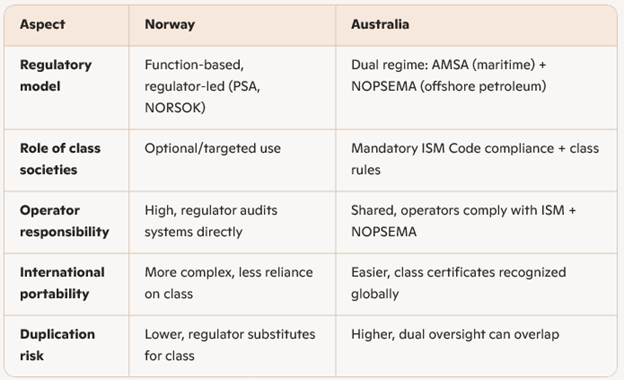
Distinct drivers for FLNG vs FPSO when it comes to class:
Cryogenic and compositional risk (FLNG). FLNG introduces cryogenic storage, BOG management, reliquefaction and composition‑sensitive offloading. Class notations provide accepted design rules, material qualifications (low‑temperature steels, weld procedures), instrumentation requirements (continuous GC, fast sampling) and survey criteria for cooldown and thermal contraction.
Thermal vs hydrocarbon containment (FPSO oil storage). Oil tanks operate near ambient with different survey focus (corrosion, sloshing, cargo treatment). Many oil‑FPSO certification cases are well‑served by standard ship rules plus MARPOL/Annex I interpretation; FLNG needs additional, specialist attention.
Systems integration and safety zoning. FLNG topsides combine process, cryogenics and marine systems; class rules and notations help harmonize safety zoning, explosion protection, ventilation and emergency shutdown logic in a way accepted by commercial counterparties.
Decision framework for owners
Project geography and flag strategy
If the unit will trade internationally or call many third‑party terminals, choose full class certification and international flag to avoid local bespoke approvals.
If operating under a single, permissive national regime with strong regulator engagement (e.g., Norwegian model) and no international port calls, evaluate a hybrid approach with targeted class involvement.
Novelty and technical risk
For novel technologies (new reliquefiers, atypical containment, unproven materials) engage class early for front‑end approval and notation development.
Commercial counterparty and financing demands
Lenders, underwriters and offtakers typically expect class‑backed evidence. If you intend to finance with international banks or sell cargo to global buyers, plan for class.
Operational flexibility and resale
Class facilitates reflagging, resale and redeployment. If lifecycle flexibility matters, class simplifies transferability of technical records and survey histories.
Cost vs duplication
If both regulator and class would duplicate the same surveys, negotiate early to allocate responsibilities and avoid double inspections and delays.
Practical engagement strategy
Engage class at FEED completion. Early involvement avoids late redesign and costly rework; class feedback on materials, notations and survey windows is strategic.
Define scope and split responsibilities in the quality plan. Specify which evidence the regulator will accept versus what must be produced for class certification.
Contractually tie class milestones to finance and offtake triggers. Make acceptance tests, cooldown records, Boil Off Gas curves and gas chromatograph logs binding deliverables.
Use targeted notations for FLNG systems. Specify cryogenic containment, low‑temperature material qualifications, BOG handling and continuous composition monitoring as required notations.
Plan survey windows into construction and commissioning schedules. Reserve surveyor attendance, Test at factory slots and cold‑commissioning periods in procurement and yard contracts.
Pull‑out checklist for project teams
Engage class and regulator at FEED completion.
Specify required notations: cryogenic containment, reliquefaction, continuous gas chromatograph, Inservice-inspection-program for fatigue.
Include FAT and calibration evidence for all cryo and gas‑handling equipment in delivery contracts.
Schedule cold‑commissioning windows with class surveyor attendance and explicit acceptance criteria.
Pre‑define contractual Boil off gas acceptance tests and the data package required for cargo acceptance.
Map insurance/finance requirements to class certificates and list any bespoke regulator waivers needed.
Closing
Class societies are the practical shorthand for independent, internationally recognized technical assurance, and—where flag registration applies—the delegated verifiers of convention compliance. Owners should match the assurance model to the project’s geography and commercial aims: function‑based regulator acceptance for domestic installations; class‑and‑flag pathways for portability, financing, and cross‑jurisdiction operations. The strategic decision is not whether to engage class, but how to balance regulator, class, and flag roles to secure market access, lifecycle flexibility, and credible handovers.
