
Engineering Sanity Checks: The Forgotten Tool for Offshore Project Success
Approvals Don't Guarantee Readiness
In FPSO and FLNG projects, engineering documents typically pass through multiple review cycles before being issued for construction, commissioning, or offshore execution. Unfortunately, an approved document is not always a construction-ready document.
Many of the delays, reworks, offshore campaign interruptions, and commissioning issues experienced on major projects originate from inconsistencies that could have been identified through relatively simple "sanity checks" performed by experienced execution teams.
A sanity check is not intended to replace engineering verification or formal document reviews. Instead, it is a pragmatic assessment performed by construction, commissioning, and offshore execution teams to confirm that engineering deliverables are coherent, complete, and executable.
The objective is simple: identify problems while they are still inexpensive to correct.
The Philosophy Behind Effective Sanity Checks
One of the most common misconceptions in offshore projects is that document quality can be guaranteed through exhaustive reviews. In reality, this approach is rarely practical.
Large FPSO and FLNG projects may involve hundreds of thousands of engineering deliverables, millions of lines of design data, and extremely aggressive execution schedules. Construction and commissioning organizations simply do not have sufficient resources to perform a 100% verification of every document received from engineering.
Attempting to review everything often produces the opposite effect: experienced personnel become overwhelmed by low-value checks and lose focus on the areas where the highest execution risks are concentrated.
The objective of a sanity check is therefore not to certify every detail of a design. Its purpose is to determine whether the documentation is fundamentally sound by examining a limited number of carefully selected high-risk areas.
In other words, a sanity check follows the same logic used in quality control sampling. If the most error-prone interfaces are correct, there is a significantly higher probability that the overall engineering package is robust. Conversely, if obvious inconsistencies are discovered in these critical areas, confidence in the complete document package should immediately decrease.
Risk-Based Verification
The most effective sanity checks focus on interfaces, handovers, and areas involving multiple disciplines.
Typical examples include:
P&ID to Isometric consistency
Stress analysis report to 3D/Isometric consistency
Piping class transitions
Vendor package integration
Instrument grounding philosophy
Safety system interfaces
Mechanical and EICT boundaries
Offshore installation weather criteria
Construction work-pack interfaces
These locations historically generate a disproportionate number of engineering errors because information passes between different teams, contractors, vendors, and software platforms.
A review strategy based on these areas can identify the majority of significant issues while checking only a small fraction of the overall documentation.
Optimizing Scarce Resources
Construction and commissioning teams typically operate with limited engineering support compared with central engineering offices.
A yard may receive thousands of drawings while having only a handful of specialists available to review them.
Under these conditions, success depends less on manpower and more on the intelligent allocation of expertise.
A senior piping engineer should not spend days checking standard support details if the project's major risk lies in package integration. Likewise, an offshore installation specialist should focus on environmental limitations and contingencies rather than reviewing routine formatting details.
The value of a sanity check comes from placing the right expert in front of the right problem.
A Measure of Engineering Maturity
Perhaps the most important outcome of a sanity check is not the discovery of individual mistakes.
Rather, it is the assessment of engineering maturity.
When multiple high-risk checks generate no significant findings, the construction team gains confidence that the engineering process is functioning correctly.
When basic sanity checks reveal numerous inconsistencies, missing interfaces, or unresolved comments, the issue is rarely limited to those specific findings. Instead, they often indicate deeper weaknesses within the engineering management system.
For this reason, sanity checks should be viewed as a diagnostic tool. They do not prove that engineering is perfect, but they provide an efficient and practical method for determining whether the overall documentation can be trusted.
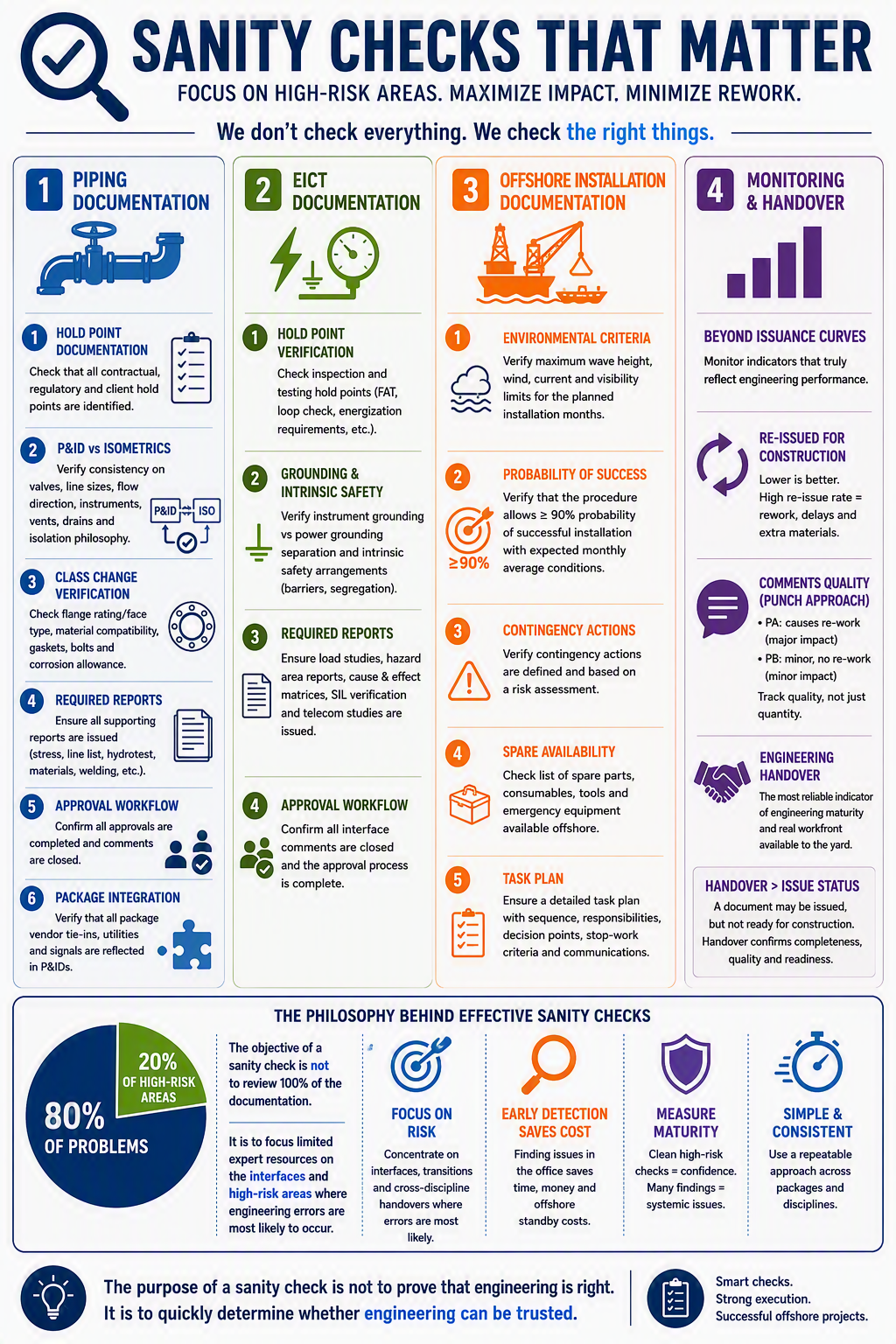
Piping Documentation Sanity Checks
Piping systems represent one of the most interconnected areas of any offshore facility. Small inconsistencies can rapidly develop into material shortages, field modifications, hydrotest delays, or commissioning bottlenecks.
Hold Point Verification
The first step should be confirming that all contractual, regulatory, and quality hold points are clearly identified and correctly incorporated into the applicable documentation.
Typical questions include:
Are inspection hold points reflected in the latest ITP?
Are client witness requirements included?
Are class requirements incorporated?
Are package vendor hold points considered?
Missing hold points frequently become late engineering revisions that disrupt fabrication activities.
P&ID vs Isometric Cross-Check
A surprisingly effective exercise consists of comparing Process & Instrumentation Diagrams with construction isometrics.
Verification should focus on:
Line sizes, slopes, distances required by instruments and process, etc
Valve quantities and types
Instrument connections
Flow directions
Vent and drain arrangements
Isolation philosophy
3D model extract vs engineering MTO
Many commissioning discoveries originate from discrepancies that were already visible between these two documents months earlier.
Piping Class Change Verification
Every piping class transition deserves special scrutiny.
The review should verify:
Flange rating compatibility
Flange face configuration
Gasket selection
Bolt materials
Corrosion allowances
Material compatibility (e.g. galvanic corrosion prevention)
These interfaces are often where engineering errors remain hidden until construction.
Supporting Reports
Construction teams should confirm the availability and completion of all supporting reports, such as:
Stress reports vs support designed in isometrics
Hydrotest documentation
Material reconciliation reports
Interface documentation
Line lists
Missing reports are often an early warning sign of incomplete engineering.
Approval and Workflow Verification
A document may be technically released while still carrying unresolved comments.
Construction teams should understand:
The approval route
Outstanding comments
Applicable deviations
Engineering governance process
Document status should reflect actual maturity rather than administrative progress.
Package Integration Check
One frequent weakness on FPSO and FLNG projects is incomplete integration of package vendor information.
Verification should confirm that all package interfaces have been incorporated into process documentation, including:
Utility connections
Process tie-ins
Shutdown signals
Operating requirements
Late package integration remains one of the most common causes of engineering rework.
EICT Documentation Sanity Checks
Electrical, Instrumentation, Control and Telecommunications systems typically involve multiple interfaces and are therefore particularly vulnerable to hidden inconsistencies.
Hold Point Verification
The same principles applied to piping should be applied to EICT deliverables.
Special attention should be paid to:
FAT requirements
Energization approvals
Loop check prerequisites
Functional test hold points
Grounding and Intrinsic Safety Verification
This is one of the highest-value sanity checks that can be performed.
The review should confirm:
Proper separation of grounding systems
Intrinsically safe circuit segregation
Barrier arrangement consistency
Compliance with electrical philosophy
Grounding issues frequently become apparent only during commissioning.
Verification of Supporting Studies
The team should confirm completion of:
Load studies
Hazardous area studies
Cause and effect matrices
SIL verification reports
Telecommunications studies
Missing studies often indicate incomplete design maturity.
Approval Process Review
Execution teams should understand whether comments from all stakeholders have been properly addressed before equipment installation begins.
Offshore Installation Documentation Sanity Checks
Offshore campaigns typically represent some of the highest daily expenditures in a project. Documentation quality therefore becomes critical.
Environmental Criteria Validation
The installation procedure should clearly define:
Maximum wave height
Wind limits
Current limits
Visibility requirements
More importantly, these limits (that are very sensitive to the season the activity will be performed) should be compatible with the actual offshore campaign period and duration.
Probability of Successful Execution
A procedure should not only be technically feasible. It should be executable.
The team should verify that the selected methodology can realistically achieve approximately 90% execution success when evaluated against the expected monthly environmental conditions during the installation campaign.
Contingency Actions
Every critical operation should be supported by contingency plans developed through formal risk assessment.
Typical scenarios include:
Equipment failures
Vessel downtime
Weather deterioration
Communication losses
Partial installation completion
The absence of contingency plans is often a warning sign of inadequate operational preparedness.
Spare Availability
Documentation should clearly identify:
Spare parts
Consumables
Emergency repair kits
Backup equipment
Availability of critical spares can dramatically reduce offshore downtime.
Task Plan Verification
The procedure should provide a clear description of:
Activity sequence
Roles and responsibilities
Decision gates
Stop-work criteria
Communication requirements
A well-structured task plan reduces uncertainty and improves operational efficiency.
Looking Beyond Document Issuance Curves
Most projects track document issuance using standard engineering progress curves.
While useful, these indicators often hide the true health of engineering.
A much more revealing metric is the number of documents that are re-issued for construction.
Re-Issued for Construction: A Leading Indicator
When a drawing is re-issued after being released for construction, the consequences can include:
Rework
Material scrap
Additional procurement
Construction disruption
Schedule impact
A high number of IFC re-issues often indicates weaknesses in engineering quality, interface management, or review effectiveness.
Treat Engineering Comments Like Punch Items
Projects should also evaluate the quality of comments rather than simply counting them.
A practical approach is to classify comments similarly to commissioning punch items.
PA Comments
Comments capable of causing:
Rework
Material replacement
Fabrication modification
Schedule impact
These should be treated as equivalent to PA punch items.
PB Comments
Comments that do not affect ongoing construction activities and can be closed without rework. These correspond to PB punch items.
Monitoring comment severity provides a far more meaningful measure of engineering quality than monitoring comment quantity alone.
Engineering Handover: The Ultimate Maturity Indicator
Perhaps the most overlooked engineering metric on EPC projects is engineering handover.
Many organizations focus heavily on document issuance status. Construction teams, however, are interested in something different:
Actual workfront availability.
A document can be issued for construction while engineering continues refining the design internally.
This becomes particularly problematic when detail engineering and construction engineering belong to the same contractor. In such situations, engineering delays can be partially hidden because internal handover is postponed while document issuance metrics continue to appear acceptable.
For this reason, the true indicator of engineering maturity is often not document issuance but engineering handover.
Whether achieved through formal document transfer or controlled handover of the 3D model, this milestone demonstrates:
Engineering completeness
Closure of major comments
Construction readiness
Real workfront availability
In many projects, engineering handover is the single most reliable indicator for assessing both engineering quality and actual readiness for execution.
Management of Change: The Hidden Risk Behind Engineering Revisions
Another critical aspect that should be closely monitored during engineering handover is the management of change (MOC) process.
In many projects, engineering revisions continue after documents have been issued for construction or even after construction activities have already started. While not all revisions are significant, some modifications may directly impact completed work, testing records, or mechanical completion dossiers.
For this reason, every engineering change should be evaluated not only from a design perspective but also from an execution and completion perspective.
The key question should always be:
Does the change affect work that has already been inspected, tested, or mechanically completed?
If the answer is yes, the project team must determine whether previously closed construction records need to be re-opened.
Examples may include:
Replacement of valves or instruments
Modification of piping lines
Relocation of supports
Cable rerouting and termination
Changes affecting hazardous area classification
Such modifications may require reassessment of:
Inspection records
Testing records
Mechanical Completion dossiers
Construction acceptance records
In particular, the team should verify whether previously signed ITR-A or ITR-B records remain valid or need to be formally re-opened and re-certified.
Failure to control this process can create situations where the physical installation no longer matches the documentation supporting Mechanical Completion.
This risk becomes especially significant during the transition from Detail Engineering to Construction Engineering, where design modifications are frequently introduced to improve constructability or resolve field issues.
For this reason, one of the most effective project controls is the systematic monitoring of the engineering handover process.
By tracking every handover package between Detail Engineering and Construction Engineering, the project team can:
Identify design changes at an early stage;
Assess potential impacts on completed construction work;
Determine whether inspections must be repeated;
Verify whether ITR-A and ITR-B dossiers must be re-opened;
Protect the integrity of the Mechanical Completion process.
Ultimately, a robust Management of Change process is not merely an engineering control. It is a fundamental safeguard ensuring that construction records, completion systems, and the physical asset remain fully aligned throughout project execution.
Final Thoughts
Approvals demonstrate compliance with a process.
Sanity checks demonstrate readiness for execution.
However, even the highest-quality engineering package can become a source of risk if subsequent changes are not properly controlled.
For this reason, successful FPSO and FLNG projects do not simply focus on document issuance. They continuously monitor engineering handovers, construction readiness, and Management of Change throughout project execution.
Engineering deliverables should not be considered complete once they are issued for construction. They should be continuously assessed to determine whether revisions affect ongoing fabrication, completed inspections, Mechanical Completion dossiers, or previously accepted work.
The most effective projects therefore establish a culture where construction, commissioning, completion, and engineering teams work together to challenge assumptions, identify inconsistencies, and rigorously evaluate the consequences of every change.
In particular, the handover process between Detail Engineering and Construction Engineering provides one of the clearest indicators of project health. It reveals not only the true maturity of engineering, but also whether design changes are being properly assessed for their impact on construction records, Mechanical Completion systems, and the validity of previously signed ITR-A and ITR-B dossiers.
Ultimately, project success depends on maintaining alignment between three elements:
The engineering documentation;
The physical asset being built;
The completion records that certify the work.
When these three elements remain synchronized, projects can progress confidently toward Mechanical Completion, Ready for Start-Up, and First Production.
When they diverge, rework, delays, and costly offshore surprises become almost inevitable.
A one-hour sanity check in the engineering office may prevent days of rework in the yard. A well-managed engineering handover may prevent weeks of schedule recovery. And a robust Management of Change process may ultimately protect the integrity of the entire project.
