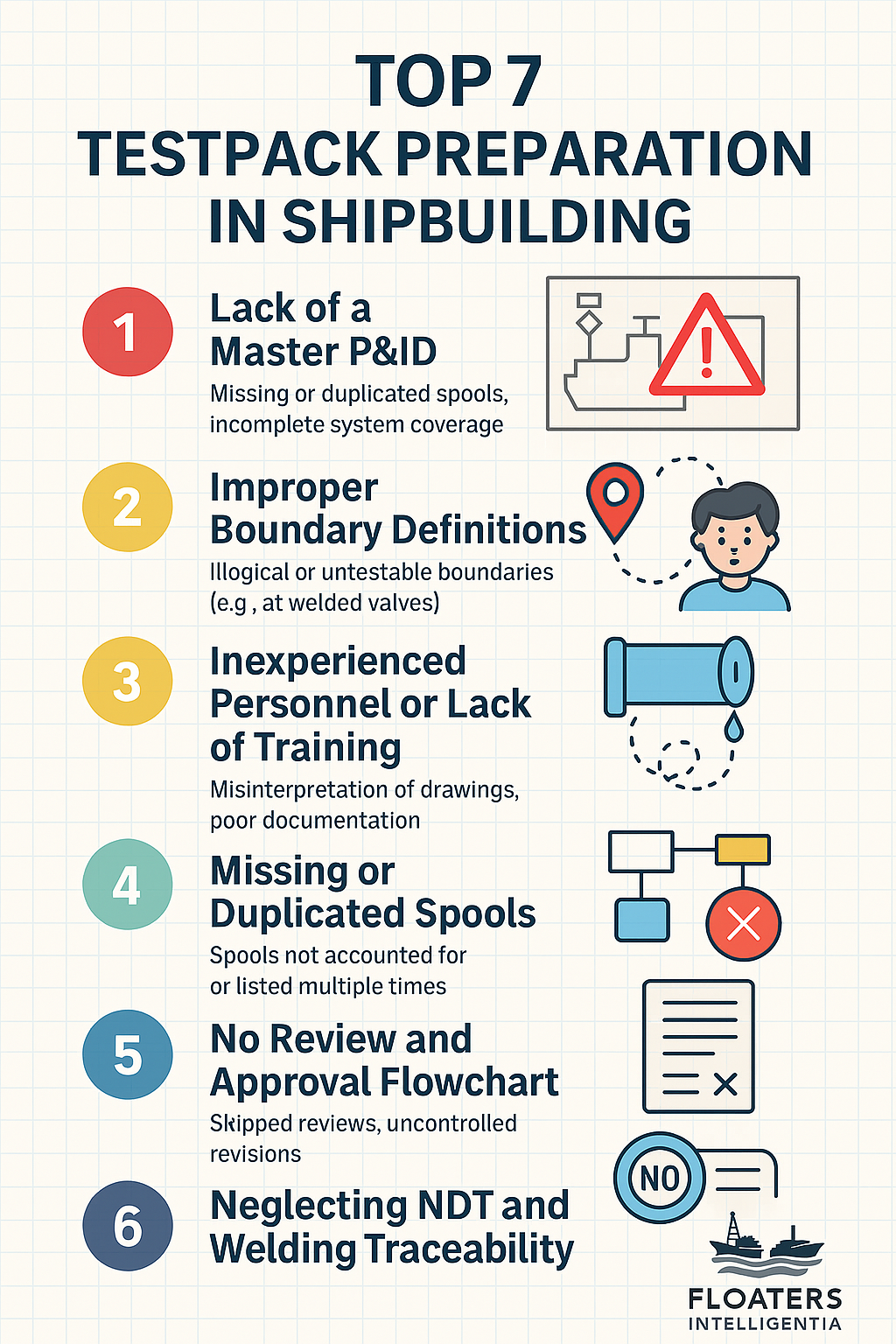
Common Errors in Test Package Preparation in Shipbuilding Yards: Lessons from Oil & Gas
As shipbuilding yards increasingly take on offshore and floating production projects like FLNGs and FPSOs, they face a steep learning curve in adopting oil & gas commissioning standards—especially in the preparation of test packages (testpacks). Unlike traditional shipbuilding, oil & gas projects demand rigorous documentation, traceability, and system integrity verification.
Here are the most common errors encountered during testpack preparation in shipbuilding yards, based on real-world lessons learned:
1. Lack of a Master P&ID During Preparation
Why it matters: The Master P&ID (Piping & Instrumentation Diagram) is the foundation for defining subsystem boundaries and ensuring no lines are missed.
Common mistakes include:
Preparing testpacks without referencing a Master P&ID
Missing or duplicated spools
Incomplete system coverage
Incorrect boundary definitions
Solution: Always prepare and reference a Master P&ID before starting testpack development. Remember, the sooner, the better.
2. Improper Boundary Definitions
Why it matters: Testpack boundaries must be logical, testable, and aligned with system function.
Common mistakes include:
Ending boundaries at welded valves or bulkheads
Including non-testable items like skin temperature elements
Creating boundaries that are impractical for site testing
Solution: Define boundaries based on function and testability. Avoid welded joints as endpoints unless absolutely necessary.
3. Inexperienced Personnel or Lack of Training
Why it matters: Testpack preparation requires understanding of system design, construction, and commissioning.
Common mistakes include:
Assigning preparation to personnel unfamiliar with oil & gas standards
Poor documentation and misinterpretation of drawings
Increased rework and delays
Solution: Involve experienced engineers and provide targeted training for MC (Mechanical Completion) teams.
4. Missing or Duplicated Spools
Why it matters: Every spool must be accounted for exactly once to ensure system integrity.
Common mistakes include:
Spools missing from all testpacks
Spools duplicated across multiple testpacks
Solution: Cross-check spool lists against ISO drawings and maintain a centralized tracking system.
5. No Review and Approval Flowchart
Why it matters: A structured review process ensures consistency and quality. The ideal situation is to use a website with pre-defined step approval, avoid sharepoints (where multiple people can modify at the same time) or even worst hardcopy paper base review (we are no more in 1980!).
Common mistakes include:
Skipping formal reviews
Lacking a documented approval workflow
Uncontrolled revisions and delays during inspection
Solution: Establish a clear review and approval flowchart, and enforce it rigorously.
6. Outdated or Inconsistent Documentation
Why it matters: Testpacks must reflect the latest approved drawings and line lists.
Common mistakes include:
Using outdated ISO drawings or line lists
Incorrect pressure test values
Mismatched weld information
Solution: Always verify document versions with engineering team before finalizing a testpack.
7. Neglecting NDT and welding traceability records Requirements
Why it matters: Non-Destructive Testing (NDT) and Welding Traceability Records (WTR) are critical for quality assurance.
Common mistakes include:
Missing NDT coverage summaries
Incomplete WTRs
Incorrect weld types or WPS (Welding Procedure Specification)
Solution: Include NDT percentage summaries and ensure WTRs are aligned with ISO drawings and material specs.
Final Thoughts
Transitioning from shipbuilding to oil & gas standards is challenging but achievable. By learning from common mistakes and implementing structured processes, shipyards can significantly improve the quality and efficiency of testpack preparation.