
The Importance of Inclining Tests for FPSO and FLNG Units Before Sail Away
Just weeks before sail away, an FPSO or FLNG may represent an investment exceeding USD 1 billion. Thousands of tonnes of equipment have been installed, commissioning activities are underway, and marine operations are being prepared. Yet one fundamental question must still be answered: does the vessel float and behave exactly as predicted by the design models? The inclining test provides that answer and remains one of the most important milestones before sail away.
Does the facility float and behave exactly as predicted by the engineering models?
The inclining test provides that answer. It is one of the most important marine assurance activities performed before sail away, validating the vessel's actual weight, center of gravity, and stability characteristics. The results serve as the foundation for stability calculations, ballast management, transportation studies, mooring analyses, and ultimately the safe operation of the facility throughout its service life.
Why FPSOs and FLNGs Require Special Attention
An inclining test is a controlled experiment conducted on a floating vessel to determine its actual:
Lightship displacement (weight)
Center of gravity (KG)
Initial stability characteristics
During the test, known weights are moved transversely across the deck while the resulting heel angles are carefully measured using pendulums, inclinometers, or other precision instruments.
By comparing the applied heeling moments with the measured vessel response, naval architects calculate the vessel's metacentric height (GM), which is the primary indicator of initial stability. From this information, the vessel's actual center of gravity can be determined and compared against design expectations.
Key Concepts in FPSO/FLNG Stability Analysis
While inclining tests are common for ships, they are especially important for FPSOs and FLNGs.
Unlike conventional vessels, floating production facilities undergo years of modification during detailed design, fabrication, module integration, and commissioning. Throughout this process, thousands of equipment items, piping systems, cable trays, structural supports, and temporary construction facilities are added or modified.
Several factors increase uncertainty in the final weight distribution:
Large topside modules installed late in construction.
Continuous engineering design changes.
Heavy turret and mooring systems.
Extensive piping and cable additions.
Temporary commissioning equipment.
Construction modifications and field changes.
Weight growth accumulated during execution.
Even small deviations in weight distribution can significantly affect stability calculations. Therefore, the inclining test becomes the final validation that the facility's actual condition matches engineering assumptions.
For an FLNG with massive process modules located high above deck, accurate determination of the vessel's center of gravity is particularly critical.
Foundamentals
To understand the inclining test, it's essential to grasp four core concepts in naval architecture:
a. Center of Gravity (G)
The center of gravity is the point through which the total weight of the vessel acts vertically downward. It depends on the distribution of mass across the hull, topsides, equipment, and cargo.
The vertical position of the center of gravity (KG) is calculated during the inclining test using the vessel’s draft readings and hydrostatic data.
For FPSOs and FLNGs, this is particularly sensitive due to heavy topside modules and turret systems.
b. Center of Buoyancy (B)
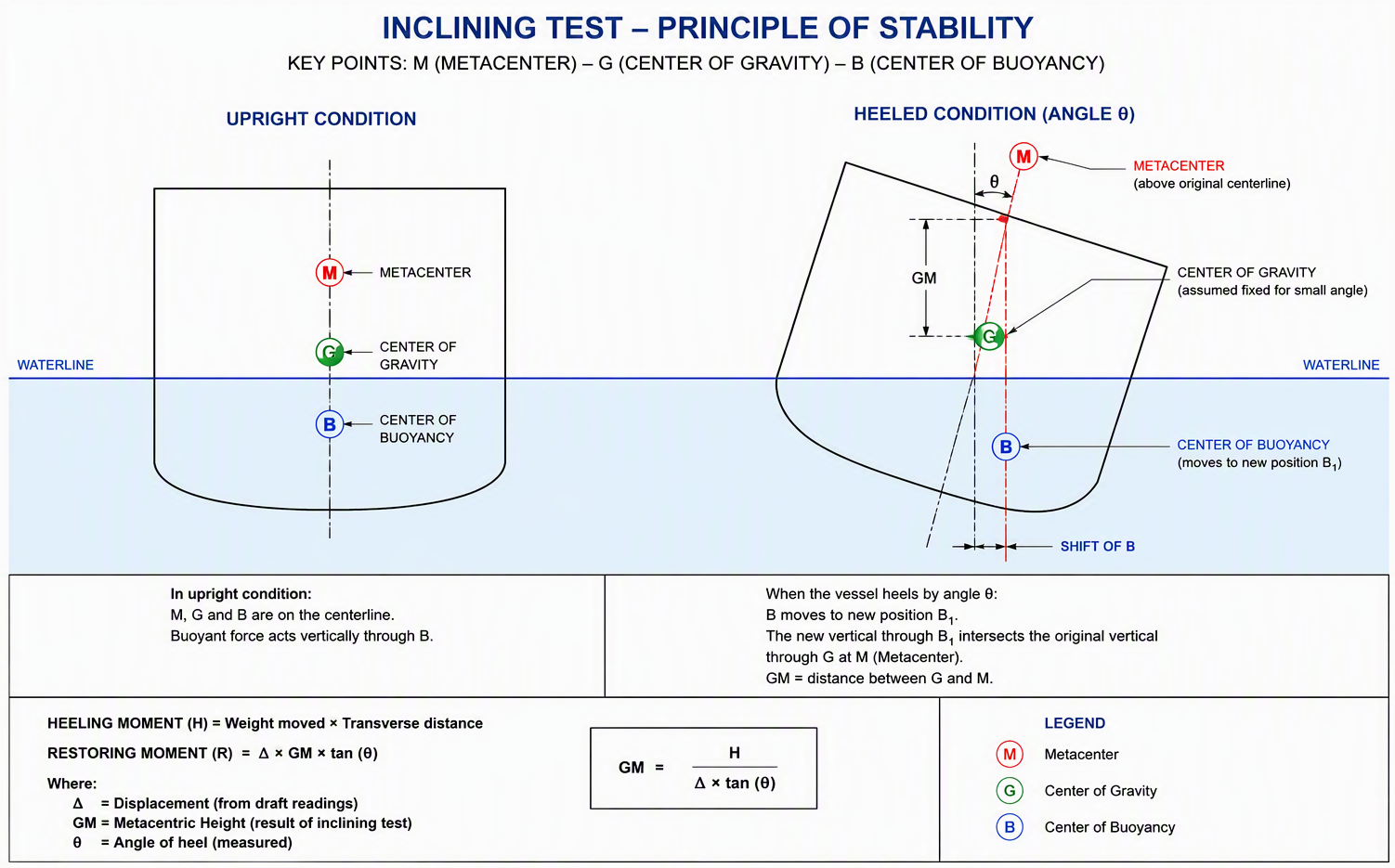
The center of buoyancy is geometric center of the underwater volume of the vessel. It is the point through which the buoyant force acts vertically upward. When the vessel heels, the underwater shape changes and the center of buoyancy shifts accordingly. This movement creates a restoring force that helps return the vessel to an upright position.
c. Metacenter (M)
The metacenter is a theoretical point used to assess a vessel's initial stability. When the vessel experiences a slight heel, the new buoyancy force acts through a shifted center of buoyancy. The intersection of this new buoyancy line with the vessel centerline defines the metacenter.
The distance from the keel to the metacenter (KM) is determined from hydrostatic calculations and depends on:
Hull geometry
Draft
Displacement
KM is not measured during the inclining test. It is obtained from hydrostatic data prepared during vessel design.
d. Metacentric Height (GM)
The metacentric height (GM) is the key result of the inclining test. A vessel with positive GM exhibits positive initial stability and tends to return upright after a small disturbance.
The metacentric height (GM) is determined from the test and the height of the metacenter above the keel (KM) is obtained from hydrostatic tables. KG is derived using:
KG=KM−GM
e. Heel Angle (θ)
The heel angle is the angle through which the vessel rotates when a transverse force or weight shift is applied.
During the inclining test, the heel angle is carefully measured after moving known test weights.
These measurements form the basis for determining GM.
Theoretical Background of inclining test
The inclining experiment relies on a straightforward physical relationship.
When a known weight is shifted across the deck, a heeling moment is created:
Moment=Weight x distance
The vessel responds with an angle of heel.
The relationship between the heeling moment and vessel stability is:
Moment= Δ x GM x tan(θ)
where:
Δ = Vessel displacement
GM = Metacentric height
θ = Heel angle
Rearranging:
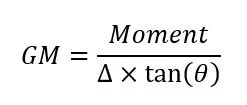
Multiple weight shifts are performed during the test to improve accuracy and eliminate measurement uncertainty.
The results are then reviewed by naval architects and classification representatives before being incorporated into the vessel's approved stability documentation.
Why Is It Critical for FPSO and FLNG Units?
Stability Verification
The most obvious purpose of the test is to verify actual vessel stability.
A mismatch between the calculated and actual center of gravity may indicate:
Construction deviations
Weight growth
Incorrect weight reporting
Unexpected equipment additions
Without accurate stability data, all subsequent marine analyses become questionable.
Regulatory Compliance
Classification societies and flag administrations require verified stability information before approving vessel operation.
Organizations commonly involved include:
ABS
DNV
Bureau Veritas
Lloyd's Register
Relevant Flag State Authorities
The inclining test forms the basis for development and approval of:
Stability Booklets
Loading Manuals
Operating Guidance Documents
Without approved stability information, sail away clearance may not be granted.
Basis for Ballast and Loading Operations
The results of the inclining test establish the baseline condition from which all future loading scenarios are evaluated.
This directly impacts:
Ballast management
Cargo loading plans
Draft limitations
Trim control
Damage stability assessments
For FLNG facilities, accurate stability data is especially important because LNG cargo operations create dynamic loading conditions that must be carefully managed.
Impact on Mooring and Turret Design
For turret-moored FPSOs and FLNGs, accurate vessel characteristics are also required for:
Mooring analyses
Turret alignment verification
Riser studies
Motion response calculations
Errors in weight distribution may affect predicted vessel motions and environmental loading assessments.
Implications of the Results
If GM is too low: The vessel may be unstable, requiring design modifications or additional ballast. Operating envelopes may need revision.
If KG is higher than expected: It may indicate errors in weight estimation or construction deviations.
If lightship weight differs from design: It affects all future loading and mooring conditions and may require re-approval of stability documents.
Inclining Test Procedure and Standards
Inclining tests are typically performed in accordance with internationally recognized procedures such as:
ASTM F1321
IMO Stability Requirements
Classification Society Rules
Flag State Regulations
The process typically involves representatives from:
Shipyard teams
Naval architects
Classification societies
Owners and operators
Marine warranty surveyors (MWS)
Marine Warranty Surveyors play a particularly important role because confidence in the vessel's weight and stability characteristics is fundamental to sail-away approval and marine risk management.
Lessons Learned from Past Projects
Experience across FPSO and FLNG projects has shown that the inclining test often serves as the final validation of years of weight control and construction activities. Even projects with well-developed weight management systems can experience differences between calculated and actual lightship conditions due to cumulative design changes, additional structural reinforcements, piping modifications, cable tray growth, or equipment added during construction.
Another common challenge is the presence of temporary commissioning or construction equipment onboard at the time of testing. Unless the vessel's condition is carefully controlled and documented, these temporary items can influence the results and complicate the determination of the true lightship condition.
The most successful projects are typically those where engineering, construction, marine, and commissioning teams maintain close alignment throughout execution. Effective weight control, accurate as-built records, and thorough preparation for the inclining test help minimize surprises and reduce the risk of delays to sail away. Ultimately, the inclining test is not merely a verification exercise but a confirmation that the floating facility has been built as intended and is ready to safely begin the next phase of its journey.
Conclusion
The inclining test is the moment when years of engineering calculations, weight control efforts, and construction activities are compared against physical reality.
For FPSOs and FLNGs, where enormous topside structures, turret systems, and complex process equipment create unique stability challenges, accurate determination of lightship weight and center of gravity is essential.
The results support stability analyses, ballast management, transportation studies, mooring design, and safe offshore operations. More importantly, they provide owners, operators, classification societies, and marine warranty surveyors with confidence that the facility is ready to leave the yard safely.
Long before first oil or first LNG, the inclining test confirms that the floating facility is prepared for the next stage of its journey.
References
ASTM F1321 - Standard Guide for Conducting a Stability Test (Lightweight Survey and Inclining Experiment).
IMO Intact Stability Code.
Classification Society Rules (ABS, DNV, BV, LR).
Hydrostatic and Stability Principles - Metacentric Height
