
The Four‑Point Theory in FPSO/FLNG Modular Deck Erection
Modern offshore topside construction increasingly relies on modularization to reduce offshore hook‑up time and improve schedule reliability. Modules are assembled, outfitted, lifted, transported, and installed through a sequence of structural states that differ significantly in stiffness and load distribution. During construction and deck stacking, these partially completed structures exhibit deflections that have direct consequences for equipment installation, alignment tolerances, and piping integration.
A key conceptual framework underpinning these behaviours—though not formally codified as a standalone “theory”—is what practitioners often refer to as the Four‑Point Theory. This derives from the well‑documented structural behaviour of modules lifted or supported at four points: a system that is statically indeterminate, sensitive to stiffness variation, and prone to deflection‑driven load redistribution.
This article explains the theoretical basis behind this effect, connects it to deck stacking, and provides the engineering rationale for postponing equipment fixation and piping erection until primary steel structures are fully completed.
Origins of the Four‑Point Theory: Statically Indeterminate Support
Large topside modules are traditionally lifted using 4‑point lifting configurations, where slings connect the module directly to the crane hook. As demonstrated in a TU Delft engineering study, a typical 4‑point lift is statically indeterminate, meaning sling loads cannot be determined solely through equilibrium equations. Instead, the distribution depends on the relative stiffness of slings and the module, its center of gravity, and, critically, its structural deformation under load.
The study highlights that:
Load redistribution occurs as the module deflects.
Structural stiffness directly controls how loads are shared between lifting points.
Accurate prediction requires iterative analysis because deformation and load distribution are interdependent.
When a module is supported at four points, the structure behaves flexibly, and loads shift as stiffness evolves.
Applying the Theory to Deck Stacking: Why Modules Keep Moving
During construction, modules are assembled deck by deck, with partial framing, incomplete bracing, and temporary or sequential connections. Offshore structural guidance makes clear that topside structures undergo different structural states throughout fabrication, load‑out, transport, and installation, and that these states involve changing stiffness and deflection profiles.
This leads to the following engineering realities during deck stacking:
Incomplete primary structure = reduced stiffness
Each added deck changes load paths
Connections introduce incremental movements
The entire module settles into a new equilibrium after each erection step
Thus, like the 4‑point lift, the structure cannot be considered “geometrically stable” until all primary elements are in place and all bracing systems have been closed.
Deflections during module erection are unavoidable and continue until the structure reaches its final configuration.
Why Equipment Cannot Be Considered “Fixed” Until Primary Steel Completion
Equipment that require precise alignment —compressors, pumps, turbines, separators—are designed for installation on a stable, non‑moving foundation (refer also to API RP 686 for machinery installation). The Four‑Point Theory and offshore structural phasing jointly demonstrate that any equipment installed before full structural completion risks misalignment due to ongoing deflection of the support steel.
Deflections during erection can cause:
Shifts in elevation
Twist or racking of module frames
Flange misalignment
Centerline displacement of rotating machinery
Unacceptable loads on nozzles or foundations
Because structural load redistribution continues until the final deck is installed and the module achieves its in‑place stiffness state, equipment cannot be considered permanently aligned or “fixed” beforehand.
Equipment installation shall begin only after the primary structure has reached its final stiffness and final loaded condition.
Why Piping Erection Must Wait: Structural Behaviour Governing Alignment
Piping installation is highly sensitive to deflection, especially where lines cross multiple decks or connect equipment mounted on independent support structures. Offshore structural literature confirms that topside designs must account for different deflection conditions in fabrication, installation, and operation—i.e., the structure evolves through multiple stiffness states.
If piping is erected prematurely:
Flanges will misalign as decks settle.
Rigid spools will lock in stresses.
Connected equipment may be overloaded by induced forces.
Hydrotest failures and field rework will increase.
Cold spring calculations will be invalidated by unforeseen structural shifts.
As a practical rule of thumb derived from yard experience and structural behaviour during deck stacking, it can be assumed that approximately 70% of piping field‑erection joints—primarily associated with horizontal piping runs within individual decks—may be executed once the horizontal deck steel joints and primary framing at that level are completed.
However, vertical piping runs connecting different decks (inter‑deck connections)and connected to sensitive equipment, shall not be erected until the module has reached the four‑point structural equilibrium condition, i.e. after completion of all decks and stabilization of the global structural deflections. Vertical runs are particularly sensitive to residual deck movements, as even small differential deflections between levels can introduce significant stresses, misalignment at weld joints, and unintended loads on connected equipment nozzles.
This sequencing constraint has direct consequences on testing activities. In modular topsides, piping systems typically extend from deck to deck with limited use of flanged connections on vertical runs, as welded connections are generally preferred for structural continuity, tightness, and integrity. As a result, the piping systems cannot be considered mechanically complete before the vertical runs are installed.
Consequently, hydrotesting activities can, in most cases, only be safely and effectively performed after attainment of the four‑point structural milestone, when the module has reached its final stiffness and deflection state. Performing hydrotests prior to this condition would risk overstressing piping systems during subsequent structural settling, potentially invalidating test results and leading to rework, leakage, or long‑term reliability issues.
This phased approach ensures that piping installation and testing are aligned with the actual structural behaviour of the module, minimizing construction risk and preserving system integrity through commissioning and operation.
Piping spools that can be affected by deck deflection shall take in consideration when structural deflections have ceased—i.e., after module completion and stabilization.
Practical Interpretation for Yard Procedures
The Four‑Point Theory—derived from the structural behaviour of statically indeterminate support conditions—explains why modules deflect during erection and provides a structural basis for sequencing rules widely used in EPC and shipyard construction:
Structural Principles
Partially erected modules behave as flexible systems.
Load paths and stiffness change as decks are added.
Deflection continues until the module reaches its final geometry.
Execution Rules
Do not consider equipment “fixed” until the steel structure is fully erected.
Do not start piping until structural deflection is stabilized.
Monitor deck deflection during stacking to predict alignment issues.
Perform final alignment checks only after the module has reached its final loaded state.
These practices align with the documented behaviours of topside structures in the ESDEP offshore structural guidelines and the TU Delft lifting analysis.
Planning rules of thumb
Based on observed structural behaviour during modular deck erection and the implications of the FourPoint structural condition, the fabrication and integration of a large topside module can be pragmatically divided into three distinct execution phases, each governed by a different structural stiffness state and therefore by different planning constraints.
These rules of thumb are engineering-driven sequencing principles intended to minimize rework, misalignment, and late-stage corrective works.
Phase 1 – Deck Fabrication and Local Outfitting, typical duration 4–6 months per deck
This phase covers the fabrication of individual deck modules prior to stacking. At this stage, the deck behaves as a largely self-contained structural unit with predictable and limited deflection. Typical activities include:
Primary and secondary steel fabrication
Local stiffening, framing, and bracing of the deck
Installation of local equipment that is:
Skid-mounted or easily removable
Not sensitive to final global alignment
Installation of piping that is:
Fully contained within the same deck
Not crossing deck interfaces
Not tied to final equipment alignment
Planning assumption:
At this stage, structural movements are limited and localized. However, no assumption shall be made on final elevations or global geometry, as these will change during stacking.
Phase 2 – Deck Stacking and Heavy Equipment Installation, typical duration 1–1.5 months per deck
This phase corresponds to the progressive stacking of decks and the transition of the module from a locally stiff system to a globally flexible, statically indeterminate structure. Typical activities include:
Deck lifting and stacking operations
Closure welds of primary structural connections
Progressive engagement of vertical load paths
Lifting and installation of heavy equipment, especially Items that cannot be skidded in later
Key structural characteristic:
Each newly installed deck alters the global stiffness and load distribution, causing incremental deflection and settlement of the underlying structure.
Planning implications:
Equipment installed during this phase cannot be considered finally aligned
Shim packs, temporary supports, and hold points shall be expected
Piping shall be limited to non-restrictive, easily adjustable portions
Critical rule:
Even after mechanical installation, equipment foundation alignment must be treated as provisional until the FourPoint structural condition is achieved.
Phase 3 – Piping Completion and Final Machinery Alignment, typical duration 4–6 months after achieving FourPoint status
This phase starts only after the module has reached the FourPoint structural equilibrium condition, i.e.:
All decks installed
Primary steel and global bracing completed
Self-weight fully applied
Global deflections stabilized
Typical activities include:
Completion of piping systems, including:
Vertical runs crossing multiple decks
Interdeck and rack-to-equipment connections
Execution of closure spools and final field welds
Final machinery alignment (cold and hot as applicable)
Hydrotesting and reinstatement
Final dimensional checks and acceptance
Planning assumption:
At this stage, the structure has reached its final stiffness and geometry, and further deflections due to self-weight are negligible.
Rule of thumb for piping execution:
Approximately 70% of piping joints, mainly horizontal runs within individual decks, may be completed earlier once the local deck steel is closed
Vertical piping, interdeck connections, and equipment tie-ins (around 30%) shall be deferred until FourPoint status is confirmed
This sequencing ensures that:
Locked-in stresses are avoided
Flange alignment remains within tolerance
Equipment nozzles are protected from unintended loads
Hydrotests remain valid and representative of operating conditions
Summary Planning Logic
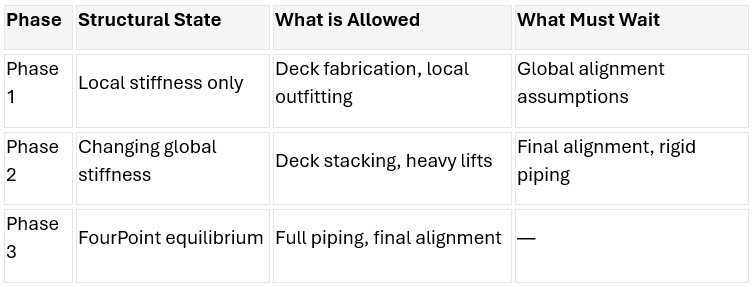
Key Engineering Takeaways
Deflection during deck stacking is unavoidable
Progressive erection inherently alters load paths and global stiffness. Small but cumulative deflections continue after each deck installation and cannot be ignored when precision alignment is required.Equipment cannot be considered “fixed” before FourPoint status
Machinery and equipment requiring tight alignment tolerances (rotating equipment, compressors, pumps, large valves) must be treated as provisionally installed until the final structural condition is achieved. Premature fixation inevitably leads to misalignment, nozzle overloads, and rework.Piping is structurally constrained by deck deflection
Horizontal piping within individual decks may be partially completed earlier, but vertical piping and interdeck connections are highly sensitive to differential movement. Installing these systems before deflections have stabilized locks in stresses and compromises system integrity.Hydrotesting is a structural milestone, not only a piping one
Because piping systems in modular topsides are typically welded across decks, mechanical completion and hydrotesting can only be reliably performed after FourPoint equilibrium is reached. Testing earlier exposes the system to overstress during subsequent structural settlement.Planning must follow structural behaviour—not schedule pressure
The division of work into:Deck fabrication and local outfitting
Deck stacking and heavy lifts
Piping completion and final alignment is not arbitrary; it reflects the evolving stiffness states of the structure. Attempting to compress or overlap these phases without regard to structural behaviour consistently results in downstream delays rather than schedule gains.
Attempting to accelerate piping or alignment activities before the structure has reached its final deflected shape typically results in:
Rework
Delayed testing
Increased commissioning risk
Conclusion
The so‑called FourPoint Theory, though informal in name, is firmly grounded in established structural mechanics and observed yard behaviour. It describes a fundamental reality of modular topside construction: a partially completed module does not behave as a rigid body. When supported or assembled through four-point conditions—whether during lifting or during progressive deck stacking—the structure is statically indeterminate, stiffness-dependent, and continuously deforming until its final configuration is reached.
From an engineering standpoint, the FourPoint structural condition can be rigorously defined as the moment when:
All decks have been installed
Primary framing and bracing are fully closed
Self-weight is fully applied
Global deflections have stabilized
Only at this point does the module reach its final stiffness state and geometric equilibrium.
For EPC contractors and shipyards, the FourPoint Theory provides more than a theoretical explanation—it offers a practical planning framework:
It explains why certain activities must be deferred, even when they appear ready on paper
It provides an objective technical basis to justify sequencing decisions to project management and clients
It reduces commissioning risk by aligning construction logic with real structural behaviour
Engineering success in modular construction depends not on how fast components are installed, but on when the structure stops moving.
Recognizing and respecting the FourPoint structural condition transforms deflection from an execution “surprise” into a controlled design and planning parameter, improving quality, predictability, and long-term operability of FPSO and FLNG topsides.
APA References
1. TU Delft – Four‑Point Lift & Sling Load Distribution Study
von Morgen, B. J. (2008). Report 2008.TL.2244: Transport Technology – Four‑Point Lift Configuration and Sling Load Distribution. Delft University of Technology, Faculty of Mechanical, Maritime and Materials Engineering. Retrieved from https://repository.tudelft.nl/file/File_0be18966-9dcc-4e30-b210-a12d203292bf
[onepetro.org]
2. ESDEP – Offshore Deck Structural Systems
European Steel Design Education Programme. (n.d.). ESDEP Lecture Note WG 15A: Structural Systems – Offshore (Superstructures II). University of Ljubljana. Retrieved from https://fgg-web.fgg.uni-lj.si/~/pmoze/esdep/master/wg15a/l1100.htm
[storage.go...leapis.com]
