
The Strategic Importance of Sea Trials for FPSO and FLNG Units Before Sail Away
On June 4, 1996, the maiden flight of the Ariane 5 rocket ended in failure just 37 seconds after launch. The vehicle deviated from its trajectory and was destroyed, resulting in a loss of over $370 million.
The cause was not a hardware defect, nor a manufacturing issue. The failure originated from a software module that had already been successfully used in the previous Ariane 4 program.
The problem was more subtle: the system was operating correctly—but outside the conditions for which it had been validated. The new rocket’s flight profile generated values that exceeded the expected range, triggering a failure that propagated rapidly through the system.
This case remains one of the clearest examples of a critical engineering lesson:
systems that work in isolation—or even in previous projects—may fail when exposed to new, real operating conditions.
In offshore projects, the same principle applies. Mechanical completion and individual system testing do not guarantee that a floating production unit will behave as expected once all systems operate together under realistic conditions.
This is where final integrated testing—such as sea trials—becomes essential.
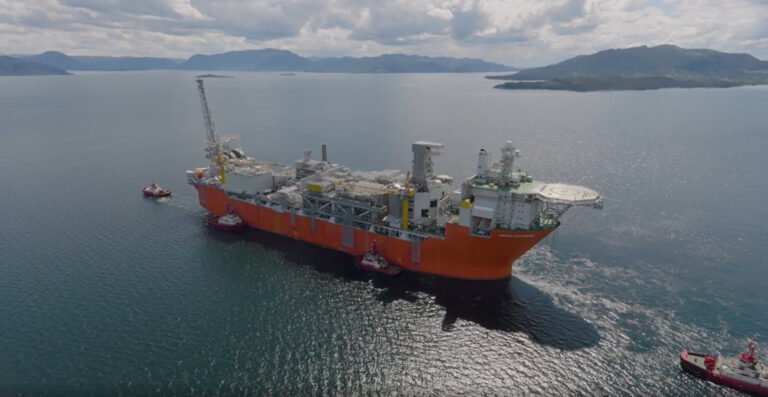
Johan Castberg FPSO during seatrials. source: Equinor
What Are Sea Trials?
Sea trials are a controlled testing phase conducted after Mechanical Completion and prior to sail away. Typically performed at the yard or in sheltered waters, they simulate offshore conditions in order to validate:
Marine systems
Safety systems
Electrical generation and distribution
Integrated topside and hull functionality
Unlike isolated commissioning tests, sea trials represent one of the first opportunities to operate the unit as a complete, independent system, without reliance on shore utilities.
Typical Sea Trial Activities
Sea trials include a wide range of tests, many of which go far beyond simple system startups:
Safety & Emergency Systems
Deluge system test: verifying coverage and flow rate over critical areas.
Foam release test: checking the effectiveness of foam-based fire suppression.
Fire water pump performance test: validating flow and pressure against nominal performance curves—essential for offshore fire protection.
Lifeboat launch and recovery: functional and safety checks.
Fire & Gas detection system: alarm simulations and emergency shutdowns.
These tests ensure that safety-critical responses are effective under realistic operating conditions.
Marine Systems Validation
Inclining test: confirming the unit’s stability and center of gravity.
Cooling water system: dynamic testing of pumps, valves, and exchangers under operating conditions.
Ballast system: verifying the ability to manage operating draft.
Bilge, HVAC, and utility systems: functional tests and interface checks with topside systems.
These tests move beyond functionality and focus on system performance under load and interaction.
Electrical & Control Systems
Black start test: starting generators without external power.
Load shedding: verifying automatic response to overload conditions.
UPS and emergency power: continuity and failover testing.
This validates the ability of the facility to operate independently and safely under different scenarios.
Why to conduct Sea Trials
Design Validation
Sea trials allow engineers to verify that marine systems perform as designed. If issues arise, there’s still time to modify piping, instrumentation, or control logic before sail away.Operational Readiness
They ensure the unit can operate at its design draft, which is essential for systems like cooling water, ballast, and cargo offloading.Risk Mitigation
Identifying and solving problems at the yard is far less costly than troubleshooting offshore, where logistics and weather add complexity.Regulatory & Class Compliance
Trials are often witnessed by classification societies and flag state inspectors, and are mandatory for issuing the sail away certificate.
Safety & Operational Considerations
Sea trials are not just technical—they are operationally critical:
The unit acts as a standalone offshore facility, disconnected from shore utilities.
Living Quarters (LQ) must be fully operational, including HVAC, galley, and emergency systems.
Marine services (ballast, bilge, firewater, mooring) must be manned and tested under real conditions.
Crew training is essential: personnel must be familiar with offshore protocols, PTW systems, and emergency response.
Weather limitations must be respected: sea trials often rely on oceanic tugs for station keeping, and adverse conditions can compromise safety and test validity.
Draft, NPSH, and Yard Selection
A critical technical aspect of sea trials is the relationship between quay depth, operating draft, and pump performance. Many marine systems—especially fire water, ballast, and cooling systems—rely on pumps that require a minimum Net Positive Suction Head (NPSH) to operate safely and efficiently.
For traditional FPSO and FLNG units, a water depth of 10–11 meters is typically not sufficient to reach the operating draft needed to safely run all pumps without risk of cavitation. Cavitation can lead to vibration, damage, and reduced performance—especially dangerous for critical systems like fire water pumps.
Some fabrication yards are equipped with deep quays (typically 16–18 meters), allowing the floater to be ballasted to its minimum operating draft. This enables realistic testing of marine systems under actual operating conditions, reducing the need for offshore revalidation and ensuring that pump systems are validated with proper NPSH margins.
Planning Sea Trials from Day One
Sea trials must be planned from the very beginning of project execution. The Execution Plan should clearly define the scope, objectives, and timing of sea trials, ensuring alignment across engineering, commissioning, and marine teams.
Sufficient time must be allocated for execution—ideally at least one week duration, one month before sail away—to allow for troubleshooting and resolution of any issues that arise. Conducting sea trials too close to sail away risks carrying unresolved problems offshore, where fixes are more complex and costly.
It’s also important to remember that Mechanical Completion and testing of marine systems should be fully achieved at the yard, before sail away. This minimizes the offshore scope of work, avoids hot work in remote conditions, and ensures a safer, more efficient transition to operations.
Final Thoughts
Sea trials are not a formality. They are a critical validation point where design meets reality.
As demonstrated by historical engineering failures, systems that perform correctly in isolation may still fail when exposed to real operational conditions. Sea trials provide a controlled opportunity to identify these risks before offshore deployment, where consequences are significantly higher.
Their strategic value lies in their ability to reveal what cannot be seen during isolated testing: the behaviour of a complex system operating as a whole.
References
European Space Agency. (1996). Ariane 5 Flight 501 failure: Report by the Inquiry Board. ESA/CNES.
Sommerville, I. (n.d.). Ariane 5 launch accident. Software Engineering Case Studies.
DNV GL. (2012). Rules for classification and construction: Guidelines for sea trials of motor vessels (VI‑11‑3).
International Association of Classification Societies. (2024). Rules and regulations for the classification of ships: Sea trials requirements.
International Maritime Organization. (2002). Standards for ship manoeuvrability: Explanatory notes to the standards (MSC/Circ.1053).
