
Asia’s Offshore Giants: Comparing Chinese and South Korean Shipyards in FPSO and FLNG Construction. 2nd part: infrastructures
This article is the second Article of a series exploring the unique characteristics of Chinese and South Korean shipyards in the FPSO and FLNG market (first article available at this link). These two industrial giants play a pivotal role in shaping the future of floating energy infrastructure, each with its own strengths, challenges, and strategic approaches.
Infrastructure Matters: Facilities That Define Offshore Capability
Beyond workforce and engineering expertise, the physical infrastructure of a shipyard plays a decisive role in its ability to deliver complex offshore units like FPSOs and FLNGs. In this regard, Chinese and South Korean shipyards diverge significantly in terms of equipment availability, quay design, and environmental resilience.
🏗️ Size Still Matters: Infrastructure and Efficiency
Korean shipyards such as Hyundai, Samsung, and Hanwha dominate in terms of physical footprint, supporting their capacity for large-scale offshore integration. These yards are not only large but also highly efficient, thanks in part to their primary focus on commercial shipbuilding. Offshore projects, while technologically advanced and prestigious, are often considered value-added segments within their broader business model.
This commercial shipbuilding foundation brings several advantages:
• Continuous use of dry docks: Commercial shipbuilding ensures that dry docks are rarely idle, maximizing utilization.
• Investment in infrastructure: High throughput justifies and funds advanced infrastructure, including mega docks, heavy-lift cranes, and deepwater quays.
• Operational efficiency: The ability to switch between commercial and offshore projects enhances flexibility and resource optimization.
In contrast, specialized offshore yards, such as some in China, may face efficiency challenges:
• Dry dock underutilization: Without a steady stream of commercial vessels, dry docks may remain idle between offshore projects.
• Resource bottlenecks: Since dry docks are scarce and critical, any delay in offshore integration can significantly impact yard productivity.
Thus, while specialized offshore yards may offer tailored solutions, multi-purpose shipyards with commercial roots often achieve higher efficiency and better infrastructure utilization.
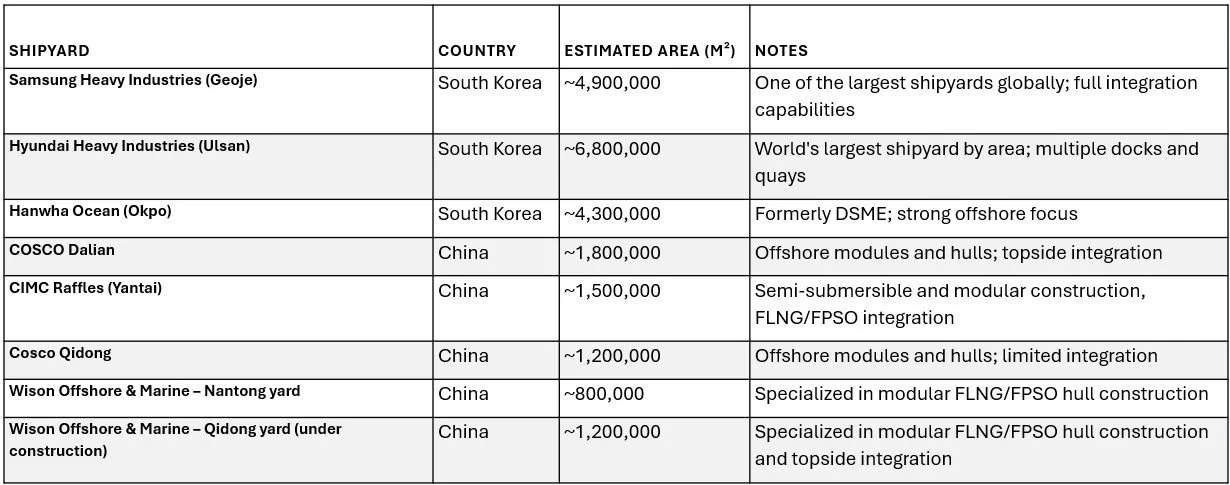
🛢️Why Infrastructure Matters for FPSOs and FLNGs
Floating Production Storage and Offloading units (FPSOs) and Floating Liquefied Natural Gas units (FLNGs) are among the largest and most complex offshore structures ever built. Their sheer size and weight demand exceptional shipyard infrastructure:
Modern FPSO hulls are often based on VLCC-sized vessels (~300 meters long).
FLNG units, such as Shell’s Prelude (488m) and Coral Sul FLNG, surpass 400 meters in length.
FLNGs are typically at least twice as heavy as FPSOs in dry weight, with some exceeding 200,000 tons.
This scale makes infrastructure not just a convenience but a necessity. Only a handful of shipyards globally—primarily in South Korea—have the physical and technical capacity to handle such projects efficiently.
🌪️ Environmental Resilience: Typhoon Risk and Operational Safety
While infrastructure scale is critical, environmental resilience also plays a key role in offshore project execution. Shipyards located in typhoon-prone regions, such as South Korea and the Shanghai area, face seasonal risks that can disrupt operations and damage assets.
Summer months bring frequent typhoons that can halt construction, delay integration, and pose safety risks.
Shipyards must implement robust mooring systems and contingency plans to protect floating assets.
In 2003, the Kizomba FPSO at Hyundai reportedly broke its moorings during a typhoon and drifted, raising concerns about mooring resilience.
In 2022, BP’s Tortue FPSO drifted approximately 200 meters off the quayside at COSCO’s Qidong yard after Typhoon Muifa passed through the region. The incident, though resolved without major damage, highlighted the vulnerability of even modern facilities to extreme weather events (Offshore Energy, 2022: https://www.offshore-energy.biz/bps-new-fpso-drifts-away-from-quayside-as-typhoon-passes-through-shipyard/).
These incidents underscore the importance of weather-resilient infrastructure and operational protocols, especially for shipyards handling multi-billion-dollar offshore units.
✅ Key Takeaways
Infrastructure is a Strategic Asset
The ability to deliver complex offshore units like FPSOs and FLNGs depends heavily on a shipyard’s physical infrastructure—size, equipment, and integration capabilities—not just engineering expertise.Korean Shipyards Lead in Scale and Efficiency
Hyundai, Samsung, and Hanwha benefit from massive footprints, continuous dry dock utilization, and high infrastructure investment, driven by their commercial shipbuilding base.Chinese Yards Face Utilization and Integration Challenges
While some Chinese yards are specialized in offshore construction, they often lack the scale, integration capacity, and throughput of their Korean counterparts, leading to potential inefficiencies.FLNGs Demand Exceptional Infrastructure
FLNG units are significantly larger and heavier than FPSOs—often exceeding 400 meters in length and 200,000 tons in dry weight—requiring mega docks, deepwater quays, and ultra-heavy lift cranes.Environmental Resilience is Critical
Typhoon-prone regions like South Korea and Shanghai pose seasonal risks. Historical incidents (e.g., Kizomba FPSO, BP Tortue FPSO) show that even modern yards must invest in robust mooring and weather mitigation systems.Integrated, Multi-Purpose Yards Offer Strategic Flexibility
Yards that can switch between commercial and offshore projects are better positioned to maintain high utilization and adapt to market shifts.
