
Asia’s Offshore Giants: Comparing Chinese and South Korean Shipyards in FPSO and FLNG Construction. 3rd part: The Power of Cranes
This article is the third Article of a series exploring the unique characteristics of Chinese and South Korean shipyards in the FPSO and FLNG market (first article about track record, second article about infrastructures). These two industrial giants play a pivotal role in shaping the future of floating energy infrastructure, each with its own strengths, challenges, and strategic approaches.
For transparency regarding the independence of the analysis and limitation of liability, readers are invited to review the full Disclaimer available here.
Heavy Lifting Equipment: The Power of the Crane
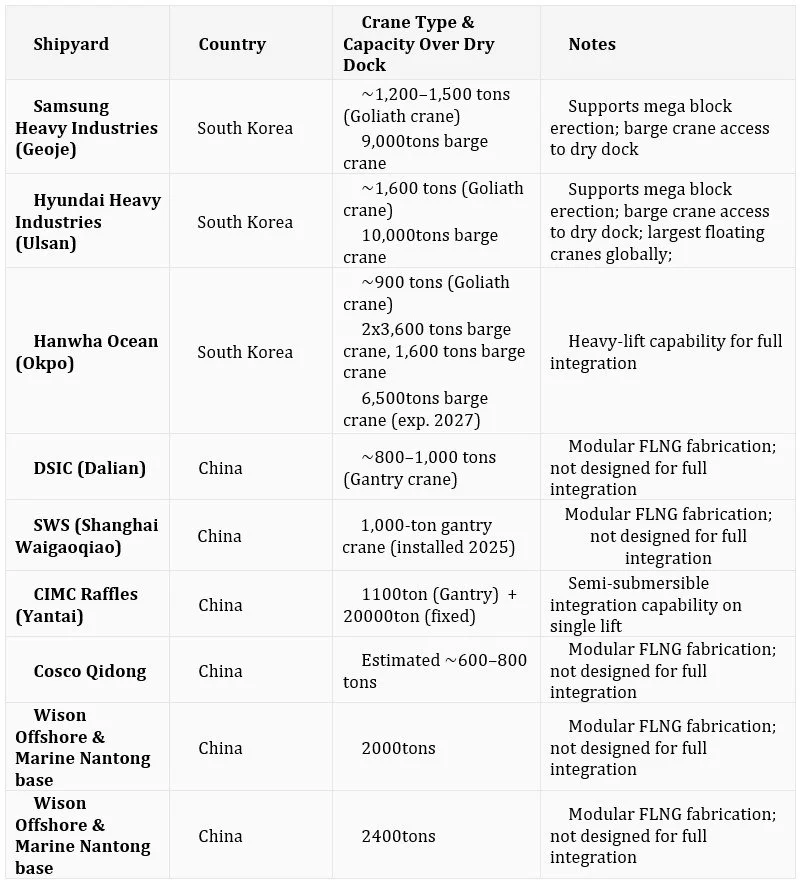
In offshore construction, crane capacity is one of the most critical assets. Whether it's a gantry crane positioned over a dry dock or a floating barge crane, the goal remains the same: to lift and install the largest possible structural components—like assembling a giant Lego set. This need for scale explains the continuous growth in crane size and lifting capacity, with some cranes now capable of lifting thousands of tons in a single operation. These heavy-lift systems are essential for both hull mega block erection and topside module installation, enabling safer and more efficient construction workflows.
South Korea: Yards such as Samsung Heavy Industries (SHI) and Hyundai Heavy Industries (HD) are equipped with ultra-heavy lift cranes and dedicated barge cranes. These facilities enable one-lift topside integration, reducing assembly time and improving safety.
China: While major yards like DSIC and Wison have invested in large gantry cranes, the availability and integration of floating barge cranes is less consistent. This can lead to more segmented construction processes and reliance on external lifting services.
Mega Block Erection: A Game-Changer in Yard Efficiency
In modern offshore construction, the ability to handle mega blocks—large, pre-outfitted sections of a vessel—is a major differentiator. These blocks can be fabricated in-house or subcontracted to external yards, then transported and installed using heavy-lift equipment. This modular strategy significantly shortens execution schedules and improves quality control. It in fact enable to have parallel workflows with simultaneous outfitting and erection, reducing overall project duration.
Refer to hull execution critical path article for more insights.
Korean Yard Superiority: Integrated Lifting and Coastal Advantage
Korean shipyards are globally recognized for their advanced infrastructure and strategic coastal locations. Major players like Hyundai Heavy Industries (HD), Samsung Heavy Industries (SHI), and Hanwha Ocean (former DSME) are all situated directly on the open sea, providing unrestricted access to deep water. This geographical advantage allows:
Deployment of floating barge cranes with capacities exceeding 3,000 tons
One-lift topside integration, reducing the need for segmented assembly
Efficient float-out operations without tidal or draft constraints
These yards typically combine gantry cranes with floating cranes that can operate directly over dry docks, enabling the erection of massive modules and integrated topsides in a single lift. This setup not only enhances safety and precision but also minimizes dry dock occupancy, increasing overall yard throughput.
Chinese Yard Constraints: Infrastructure and Location Bottlenecks
In contrast, many Chinese shipyards—especially those involved in offshore construction—are located in the Yangtze River Delta, including areas like Shanghai, Nantong, and Jiangyin. While these locations offer proximity to industrial hubs and supply chains, they also introduce significant geographical limitations:
Limited draft in river channels restricts the size and weight of modules that can be floated out
Tidal sensitivity requires precise scheduling of float-out operations, increasing logistical complexity
Narrow waterways limit the maneuverability of large floating cranes or heavy-lift vessels
Moreover, Chinese yards typically rely on gantry cranes with lifting capacities up to around 1,000 tons, which are sufficient for hull block erection but inadequate for large topside modules. The absence of high-capacity barge cranes—particularly those exceeding 6,500 tons—creates a critical bottleneck for FPSO and FLNG construction. As a result, these yards are often forced to:
Break down topsides into smaller modules
Perform segmented lifting and in-dock integration
Extend the duration of topside campaigns
Occupy dry docks for longer periods, reducing yard efficiency
Dry Dock Orientation: A Critical Factor in Crane Access
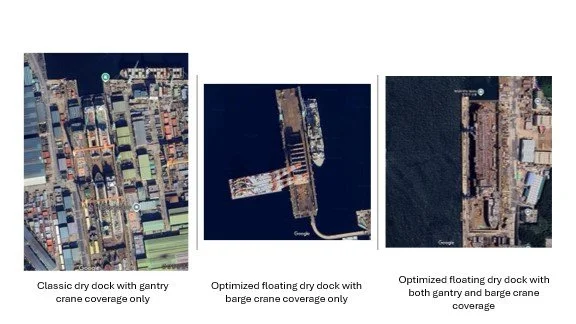
An additional and often overlooked constraint is the orientation of dry docks. In most Chinese shipyards, dry docks are arranged transversely to the quay—meaning they are perpendicular to the shoreline. This configuration prevents barge cranes from accessing the dock directly, as they cannot align alongside the modules to perform vertical lifts. Even if high-capacity barge cranes were available, their use would be severely limited by this layout.
In contrast, Korean shipyards typically employ floating docks or dry docks aligned parallel to the quay. This orientation allows barge cranes to operate directly over the dock, enabling efficient one-lift topside integration and mega block erection. The flexibility in dock layout further enhances the operational efficiency of Korean yards, allowing them to fully leverage their heavy-lift capabilities.
Strategic Implications
The contrast between Korean and Chinese shipyards highlights a broader strategic issue: yard location and lifting infrastructure are not just operational details—they are competitive differentiators. Korean yards, with their coastal access and integrated crane systems, are better positioned to handle the increasing scale and complexity of offshore projects. Chinese yards, unless they invest in deep-water facilities and ultra-heavy lifting capabilities, may continue to face constraints that limit their competitiveness in the high-end offshore market.
Deepwater Quays: Where Commissioning Begins
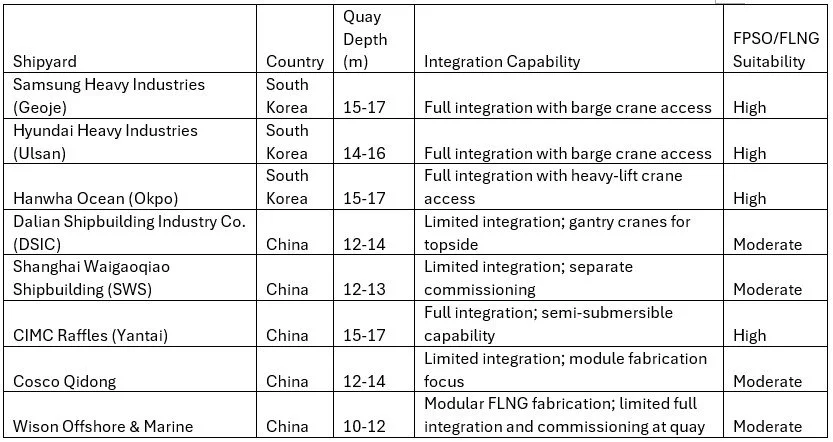
The depth and design of a shipyard’s quay directly affects its ability to commission large offshore units without relocation.
South Korea: Korean shipyards boast deep-draft commissioning quays adjacent to fabrication zones. This allows for in-yard commissioning, streamlining the delivery timeline and reducing logistical risks.
China: While some Chinese yards have deep quays, many rely on separate commissioning bases or longer seatrials period, which can introduce delays and additional transport costs.
Key Takeaways:
Crane Capacity Remains Central: High-capacity gantry and barge cranes are essential for mega block erection and one-lift topside integration, especially for large FPSO and FLNG projects.
South Korea Sets the Benchmark: Korean shipyards like SHI, HD, and Hanwha Ocean offer mature infrastructure, combining heavy-lift capabilities with deep-draft quays and optimized workflows.
China Is Catching Up Fast: Chinese yards have made impressive strides in expanding gantry crane capacity, upgrading facilities, and accelerating project execution. While barge crane availability remains a constraint, ongoing investments suggest this gap may narrow quickly.
Modular Construction Is Key: The shift toward large, pre-outfitted blocks enables parallel workflows, improves quality control, and reduces project timelines—benefiting yards that can support this approach.
Commissioning Infrastructure Matters: Deepwater quays adjacent to fabrication zones streamline delivery, but alternative strategies—such as semi-submersible integration or remote commissioning bases—are also evolving.
In summary, while South Korea currently leads in integrated heavy-lift and commissioning infrastructure, China’s rapid development and adaptability position it as a formidable player in the offshore construction market. The global landscape is evolving, and both regions are likely to play pivotal roles in shaping the future of large-scale offshore projects.
Conclusion: A Tale of Two Strategies
China is betting on scale, cost-efficiency, and rapid industrialization to become a dominant offshore builder. South Korea continues to lead in technological innovation and global trust, especially in FLNG. As the offshore energy market grows, both nations are poised to play pivotal roles—China as the rising giant, and Korea as the seasoned specialist.
However, it's important to recognize that there is no perfect shipyard. Each yard has its own strengths and weaknesses:
Some excel in cost and modular fabrication (e.g., Chinese yards),
Others in full integration, engineering precision, and turnkey delivery (e.g., Korean yards).
The choice of shipyard often depends on the specific needs of the project, such as budget, timeline, technical complexity, and integration requirements.
